
Somewhere in a design studio, a fit model is standing in for you. She is five feet nine, her waist runs about nine inches smaller than her bust, and she is the reason the sample jacket never pulled the way yours does. Ready-to-wear clothing is drafted on one live body, then graded up and down by rules that assume every other woman scales the way she does.
She does not. That gap between the fit model and your actual skeleton is exactly what a body shape map measures, and it is why two women can carry the same midi dress into the same fitting room and have two completely different conversations in there.
Most fashion advice treats that map like a verdict, sorting you into a costume category and handing you a list of prohibitions. The industry reads it differently. Patternmakers treat body shape as a set of horizontal perimeters, because the relationships between those perimeters predict how fabric will hang before a single seam is sewn. Learning how to find your body shape gives you that same predictive lens. Shopping becomes an engineering check. Not a gamble.
Quick answer: measure four perimeters with a soft cloth tape held parallel to the floor, which are your shoulders, bust, natural waist, and the widest part of your hips. Then compare the spreads. If shoulders, bust, and hips sit within 5 percent of each other and your waist is less than 25 percent smaller, your frame is a rectangle. Hips 5 percent or more above the upper line read pear. Shoulders or bust 5 percent or more above hips read inverted triangle. Bust and hips within 5 percent of each other with a waist at least 25 percent smaller read hourglass. A waist equal to or larger than your outer perimeters reads apple.
Why Your Body Shape Is About Architecture, Not Weight
A persistent myth ties silhouette categories to the scale, as if ten pounds could redraw your skeletal coordinates. It cannot. Weight changes how soft tissue distributes across your frame, but your shoulder line, rib cage, and pelvic bone sit where they have always sat. That is why retail styling treats silhouette mapping as an administrative fit tool, fully separated from health or fitness indicators.
| Myth | Fact |
|---|---|
| Gaining weight moves you into a completely different body shape category. | Volume changes while the bone path stays put. A linear frame stays linear, and a wide hip anchor stays wide. |
| Plus sizes all collapse into one silhouette. | Proportional ratios repeat across every size run. A size 22 inverted triangle still carries a broader upper line than hip line, exactly like her size 6 counterpart. |
The misfit between retail grading and real bodies is not anecdotal. North Carolina State University’s College of Textiles analyzed body scans of more than 6,300 women and found that only 8 percent carry the hourglass figure most sizing systems still assume [[1]]. Dr. Cindy Istook, the study’s lead researcher, put the industry’s lag plainly:
“Companies are recognizing that there’s an issue. They just haven’t changed their sizing system to demonstrate it.” Dr. Cindy Istook, NC State College of Textiles
In a follow-up statement she was even more specific: “If we can serve the top four groups, we would have almost 90 percent of the market covered. Right now, the industry is serving less than 90 percent because of the sizing system that’s based on the hourglass.” Read that again the next time a dress fails you at the zipper. Your fitting room frustration is a sizing system problem, not a body problem.
How to Measure Your Frame for an Accurate Silhouette Map
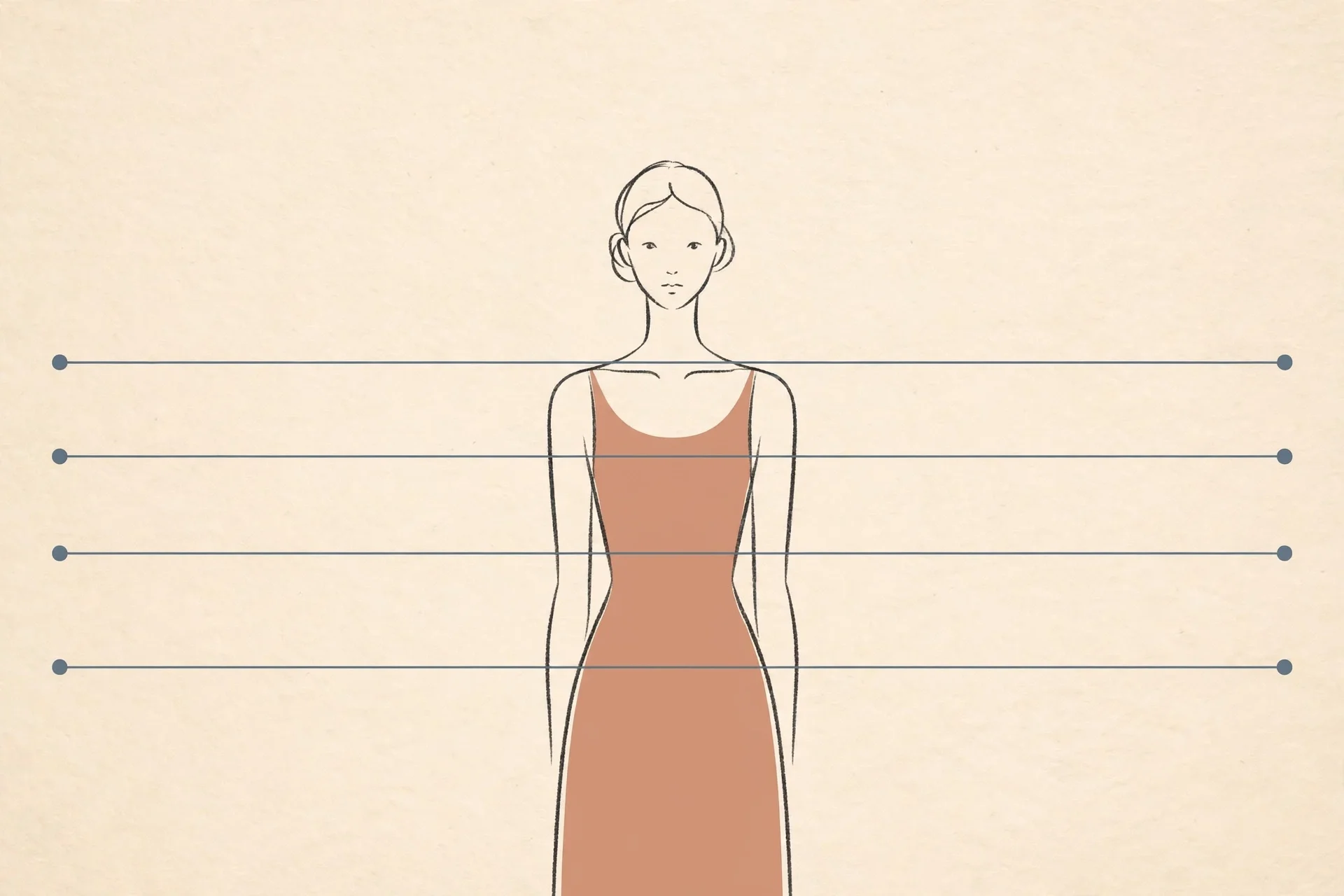
You need three tools: a flexible cloth measuring tape, a mirror, and a notebook. Skip the metal construction tape, because it bridges your curves instead of following them and can skew a reading by up to two inches. Measure against bare skin or over thin leggings and an unpadded bra, keep the tape parallel to the floor on every pass, and hold it snug without compressing the skin. One more rule that most guides skip: pick a physically neutral day. Acute bloating can temporarily add up to two inches at the waist, and measuring right after a long lunch is how rectangle frames get misdiagnosed as something else.

Step 1: Shoulders
Place the tape at the outer point of one shoulder crown and wrap it fully around your upper chest and shoulder blades until it meets the start. This pass is the hardest to run alone without tilting your neck, so use the mirror to check your alignment. If you have a partner or a tailor nearby, delegate it. Shoulder data drives every jacket decision you will ever make.
Step 2: Bust
Wrap the tape around the fullest part of your chest line and keep it straight across your back so it does not sag toward your waist. Wear the unpadded bra for this pass, because a padded one adds perimeter that your clothes will never actually sit on.
Step 3: Natural Waist
Locate the narrowest part of your midsection, usually an inch or two above your belly button and just below your lowest rib. If you cannot find it by eye, lean gently to one side. The point where your torso creases is your natural waist. Exhale normally before you read the number. A held breath is a false waist.
Step 4: Hips
Wrap the tape around the widest part of your low hip area, spanning the fullest extension of your glutes. This is not where your hip bones sit. It is lower than that, and measuring at the bone line is the single most common reason a pear reading comes back flat.
Log all four numbers to the nearest quarter inch. These are your structural perimeter lines, and their relationships, not any single number, decide your classification.
The Five Core Structural Frameworks, by the Numbers
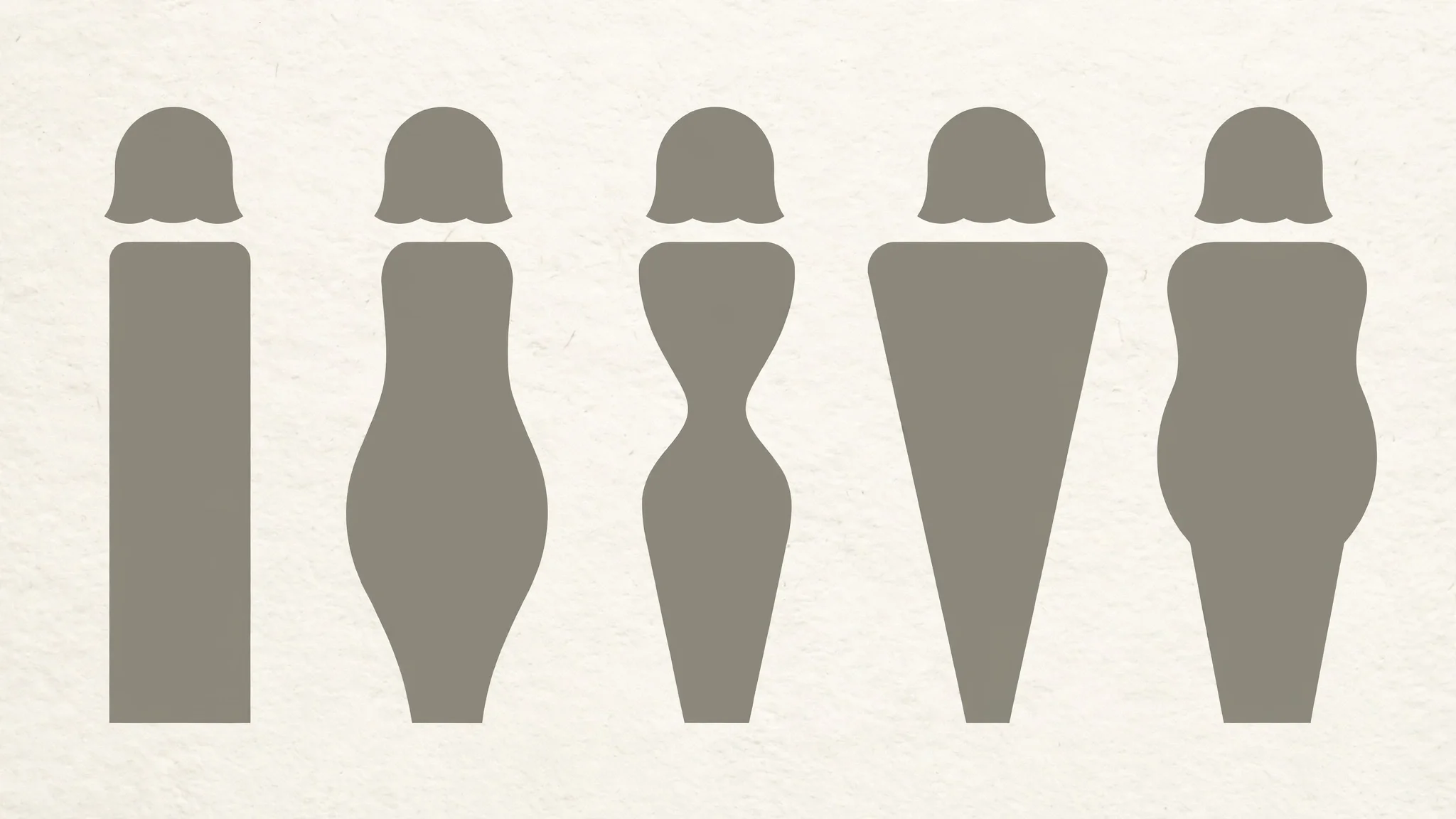
Human frames carry real structural variation, and the NC State analysis quantified it: approximately 46 percent of women classified as rectangular, a little more than 20 percent carried the spoon or pear layout, nearly 14 percent read as inverted triangles, and only 8 percent aligned with a true hourglass, with the remainder splitting among triangle and hourglass variants [[1]]. The study also used concrete inch cutoffs, which pair neatly with the percentage rules stylists use:
| Architectural Silhouette | Metric Target Proportions | Fabric Interaction Pattern |
|---|---|---|
| The Rectangle Framework | Shoulders, bust, and hips within 5 percent of each other; waist less than 25 percent smaller (study cutoff: less than nine inches smaller than bust or hips). | Fabric hangs linearly down the frame without lateral displacement or pulling. |
| The Pear Framework | Hips 5 percent or more above shoulders and bust (study cutoff: hips at least two inches larger than bust). | Fabric meets structural resistance first at the full hip, anchoring garment volume at the lower plane. |
| The Hourglass Framework | Bust and hips within 5 percent; waist at least 25 percent smaller (roughly nine to ten inches in). | Fabric tracks inward at the ribs, then releases smoothly over the high hip. |
| The Inverted Triangle Framework | Shoulders or bust 5 percent or more above hips (study cutoff: bust three or more inches larger than hips). | Fabric cascades inward from a broad upper plane, creating natural ease below the torso. |
| The Apple Framework | Waist perimeter equal to or larger than the shoulder and hip planes. | Fabric rests along the center register and drops smoothly past the midsection. |
The Rectangle Framework: Linear Balance
A rectangle profile shows outer perimeters varying within 5 percent, with a waist less than 25 percent smaller. If your shoulders measure 38 inches and your waist sits at 31 inches, that 18 percent drop keeps you inside rectangle territory. This is the frame where relaxed fit, unconstructed pieces drop effortlessly from the shoulder line, while heavily nipped waists can bunch or gap. It is also the frame most ready-to-wear blocks accidentally flatter, which is a small irony given how rarely it is celebrated.
The Pear Framework: Lower-Register Focus
If your hip measurement runs at least 5 percent above your shoulder or bust line, your frame anchors volume in the lower register. A shoulder read of 36 inches paired with a hip read of 39 inches is a classic pear layout, an 8 percent spread. Garments meet resistance first at the full hip and seat line, so tailored jackets with a clean, soft shoulder build balance the silhouette naturally. Once your deltas point pear, our guide to how to dress for a pear body shape turns that reading into specific jacket, hem, and waistband moves.
The Hourglass Framework: Symmetrical Ratios
An hourglass requires bust and hips within 5 percent of each other and a waist at least 25 percent smaller, which in inches usually means nine to ten inches in. Because fabric tracks inward at the ribs and flares at the high hip, stiff or boxy textiles create an inadvertent tent effect on this frame. Garments that mimic the curve, wraps, ties, darts, behave best. Only 8 percent of women carry this layout, yet most sizing systems still draft for it, which explains a great deal of ready-to-wear strangeness for everyone else.
The Inverted Triangle Framework: Upper-Register Structure
When your shoulder or bust line sits 5 percent or more above your hips, your framework prioritizes the upper register. A 40 inch shoulder line over a 37 inch hip line fits this blueprint, and the NC State data says nearly 14 percent of women share it. Your shoulders act as a natural coat hanger. Unstructured drop-shoulder cuts read relaxed on your frame, and clean vertical seam paths below the waist draw the eye toward your linear legs.
The Apple Framework: Center-Register Volume
The apple framework is defined by a waist perimeter equal to or larger than the shoulder and hip planes, with volume concentrated through the torso while the limbs often stay slim and linear. Stiff, constricting waistbands pinch or slide on this frame. Fluid textiles that drop cleanly from the shoulder line let clothing skate over the midsection instead of catching at it.
Reading Your Deltas Like a Patternmaker
The math is simple and repeatable. Take the difference between two perimeters, divide by the smaller one, and multiply by 100. A 36 inch shoulder against a 39 inch hip is a three inch spread, and three divided by 36 gives you hips running about 8 percent wider. Run your checks in this order and stop at the first match:
- Waist equal to or larger than shoulders and hips: apple.
- Hips 5 percent or more above shoulders and bust: pear.
- Shoulders or bust 5 percent or more above hips: inverted triangle.
- Bust and hips within 5 percent, waist 25 percent or more smaller: hourglass.
- Outer perimeters within 5 percent, waist drop under 25 percent: rectangle.
| Sample Set (Shoulders / Bust / Waist / Hips) | Outer Spread Check | Waist Drop Check | Verdict |
|---|---|---|---|
| 38 / 37.5 / 31 / 38 | 1.3 percent, within band | 18 percent, under 25 | Rectangle |
| 36 / 36 / 30 / 39 | Hips 8.3 percent wider | Not reached | Pear |
| 40 / 40 / 36 / 37 | Shoulders 8.1 percent wider | Not reached | Inverted triangle |
| 37 / 37 / 27 / 37.5 | 1.4 percent, within band | 27 percent, over 25 | Hourglass |
| 38 / 37 / 39 / 39 | Waist exceeds outer planes | Not reached | Apple |
Notice what the order does for you. It removes the temptation to average your way into a shape that feels familiar rather than one that matches the numbers.
How to Apply Proportional Balance, Not Camouflage
Identifying your category is a baseline tool, never a list of clothing prohibitions. Modern styling focuses on focal balance rather than camouflage tricks: pair a structural exterior layer with a fitted base layer so the eye keeps a clear reference point. Suppose you carry an inverted triangle frame and want a structured double-breasted blazer. Old-school rules would tell you to skip it. The balance method says otherwise.
Start with a close-fitting knit tank tucked into raw denim in a straight fit, which draws a clean line around your actual volume. Leave the blazer unbuttoned so the open front cuts two sharp vertical lines down your torso, narrowing the upper register while the structured shoulder adds a polished finish.
Anchor the hem with footwear in a slightly heavier sole profile, and the jacket’s weight reads intentional instead of top-heavy. A fluid A-line midi skirt does the same balancing work from the other direction for pear frames. Necklines are the fastest dial of all, and our breakdown of the best necklines for every body shape maps which cuts add or remove visual weight at the shoulder line.
This is also where the map meets the wardrobe. Knowing your perimeters tells you which easements to check first on a garment tag and which silhouettes will drape rather than fight, the same logic that anchors a durable capsule wardrobe. Working stylists treat the map the same way. Elysha Lenkin, a New York personal stylist whose practice centers on midlife wardrobe resets, builds client work from a clear shape reading before any purchase happens, precisely because the reading removes guesswork from the shopping floor.
Common Diagnostic Missteps and Framework Exceptions
| Misstep | What It Does to Your Numbers | The Fix |
|---|---|---|
| Measuring with tense posture or a sucked-in stomach | Artificially shrinks the waist, faking an hourglass drop | Stand neutral, exhale normally, re-measure |
| Measuring on a bloated day | Adds up to two inches at the center register | Re-run the pass on a routine, neutral day |
| Measuring over a thick sweatshirt or denim | Inflates every perimeter, worst at the waist | Bare skin or thin leggings and an unpadded bra |
| Taping at the hip bone instead of the fullest seat | Flattens a pear spread into a false rectangle | Drop the tape to the widest extension of the glutes |
If you land on the border between two categories, do not force the data into one bucket. Hybrid frames are common: you might carry the structured shoulder line of an inverted triangle alongside the lower-register hip volume of a pear. Borrow styling notes from both categories and let your daily style goals break the tie. The map is a reference tool for navigating retail sizing grids with confidence, not a permanent verdict on your personal expression.
Frequently Asked Questions
Can your body shape change over time?
Your core skeletal proportions stay consistent through adulthood, because the bone structure underneath does not change. Major life transitions like pregnancy, long-term training that redistributes muscle, or significant weight change can shift soft tissue enough to move you across a classification band, which is worth re-measuring after, not during, such transitions.
What if my measurements put me between two shapes?
Treat boundary placement as a styling benefit, not an error. If your shoulders point to an inverted triangle while your hips align with a rectangle, borrow the structured shoulder advice from one group and the fluid vertical line layouts from the other. Hybrid readings build the most customized fit guides.
Should I take my measurements with clothes on?
Measure against your skin or over thin, close-fitting base layers like leggings and an unpadded bra. Bulky items such as a thick sweatshirt or denim distort every perimeter and produce calculation errors exactly where your waist definition and hip metrics matter most.
What if my bust and shoulders point to two different shapes?
Prioritize your shoulder line for outerwear, jackets, and structured tops, because garments hang from the shoulder first. If your shoulders are broad but your bust is small, an inverted triangle approach still gives the most predictable tailoring results.
Are visual body shape quizzes accurate?
Mirror-only quizzes miss the back plane and tend to flatter whichever shape you expect to see. Perimeter math removes that bias, which is why patternmakers use tapes and scans instead of glances. Run the four measurements once, log them, and let the deltas decide.
Your structural map is a compass, not a cage. The point of knowing your perimeters is to walk up to any rack and predict the drape before you reach for the hanger. Once the map is in hand, the next move is deciding what you actually want to say with the clothes that fit it, and that is where finding your personal style picks up.
Where to go next with your reading:
- How to Dress for a Rectangle Body Shape: Practical Curves
- How to Dress for a Pear Body Shape: 4 Smart Strategies
- How to Dress for an Hourglass Body Shape: Waist-First Rules
- How to Dress an Inverted Triangle Body Shape: Balance Rules
- How to Dress an Apple Shape: Reliable Fit Rules That Balance It
Official Sources
- ASTM International: Standard Tables of Body Measurements for Adult Female Misses Apparel Sizing (D5585), Access Date: August 25, 2026.
Research Sources
- North Carolina State University: Fashion Designers Ignoring Shapes of Women’s Bodies, Access Date: August 25, 2026.
- NC State University Libraries Repository: Body Shape Analysis Using Three-Dimensional Body Scanning (Simmons and Istook), Access Date: August 25, 2026.
Industry Sources
- The Technician (NC State): Fashion Designers Fail to Tailor, Access Date: August 25, 2026.
- Elysha Lenkin Style: Stop Body Shaming From Ruining Your Style, Access Date: August 25, 2026.
Additional Reading
- TrendTome: How to Find Your Personal Style in 3 Clear Steps, Access Date: August 25, 2026.
- TrendTome: Best Necklines for Every Body Shape: 5 Fit Rules, Access Date: August 25, 2026.
- TrendTome: How to Dress for a Pear Body Shape: 4 Smart Strategies, Access Date: August 25, 2026.