Somewhere between the third closet purge video you saved and the fourth pair of almost-right jeans, the project stopped being fun. You wanted a wardrobe that feels like you. You got a to-do list. The strange part is that the answer was never in the mood board, because it has been sitting in your laundry hamper the whole time.
Most style advice runs the same script: purge everything, buy a capsule, adopt an aesthetic by Friday. That order is backwards, and it is expensive. Finding your personal style is a process of observation and editing, not consumption, and it starts with the messy pile on the bedroom chair.
How to find your personal style in 3 clear steps:
- Run a laundry basket audit to expose the cuts and fabric weights you reach for when you are tired or busy.
- Name three style words, one practical, one aspirational, one emotional, and use them as a filter for every future purchase.
- Map silhouettes and fabric weights to your real weekly calendar so the closet matches your life, not a fantasy version of it.
The Core Principle: Style Starts with Editing, Not Shopping
American closets are full and barely used. Between 2000 and 2015, global clothing production doubled while the average number of times a garment is worn fell by 36 percent, according to the Ellen MacArthur Foundation. The hangers hold monuments to impulse buys and aspirational lives. The hamper holds the truth.
We have been trained to treat shopping as the cure for style confusion. A new job, a new city, a new season, and the default answer is a new bag of clothes. Added to a closet that already feels useless, extra volume only deepens the decision fatigue. Unworn fabric is expensive clutter.
The consumption myth: finding your style requires buying a completely new wardrobe. The reality: personal style is curation. You identify the clothes you already wear and love, edit out the items that do not serve your week, and only then shop the gaps.
“Developing personal style is essentially building a relationship with yourself by noticing patterns, testing boundaries and refining,” says author and content creator Stephanie Yeboah in The Guardian. Notice comes first. Buying comes last.
That sequence is also the only sane on-ramp to a Capsule Wardrobe, a small, deliberately chosen set of interchangeable pieces built around neutral bases. You cannot edit a rack you have never read, and our guide on how to build a capsule wardrobe picks up exactly where this audit ends.
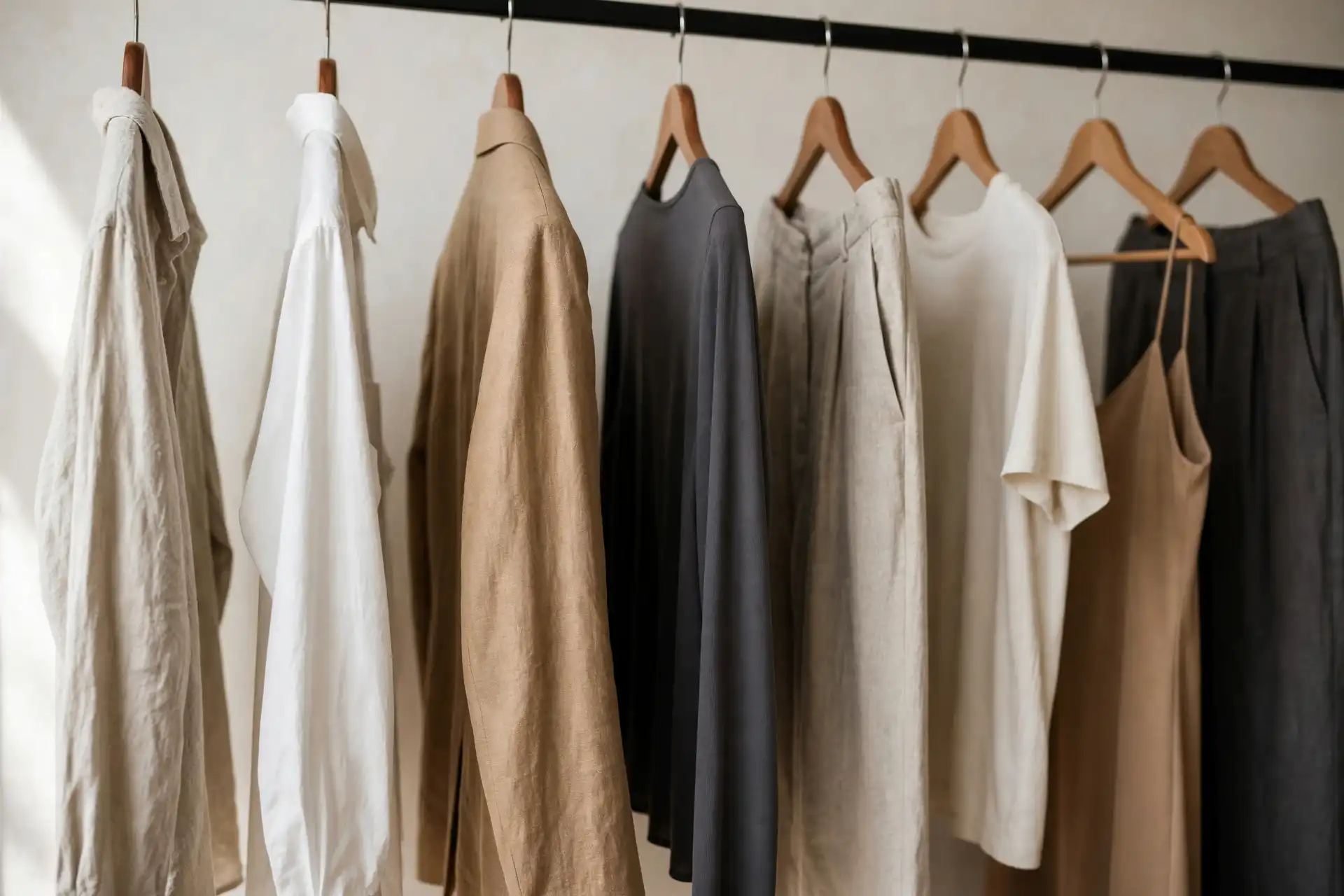
An edited clothing rack demonstrates the clarity of a capsule wardrobe, where every piece is chosen to coordinate easily. Notice how the garments are spaced so you can read the silhouette of each piece, a practical necessity for reducing morning dressing fatigue.
Step 1: Run a Laundry Basket Audit, Not a Closet Purge
Clean hangers show your aspirations. Dirty laundry shows your behavior. The audit therefore starts at the hamper, the one place that records what you reach for when you are tired, busy, or running late, with zero mental negotiation.
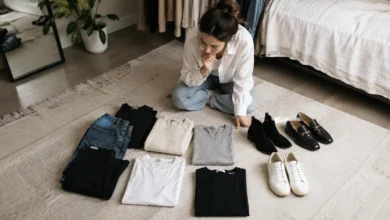
Empty the basket and sort everything into three piles.
| Pile | What it reveals | What to do with the data |
|---|---|---|
| The High-Frequency Regulars | Items you wear, wash, and immediately wear again. Note the cuts: a Relaxed Fit with extra room and no waist tailoring, or a Straight Fit that runs one width from hip to hem. | Count the repetitions. Four identical cotton crewnecks are not a lack of variety. They are your comfort baseline, the first line of your style brief. |
| The Occasional Needs | Clothes dictated by specific tasks, like training gear or client-facing tailoring. | Keep them, but budget them separately. They serve your calendar, not your identity. |
| The Hesitation Pieces | Garments you wore for an hour, felt wrong in, and tossed back on the pile. | These are your real avoid list. Write down the seams, rises, and fibers that bothered you. |
Repetition is not a styling failure. It is data. Write it down.

Step 2: Name Your Look in Three Words
Behavior first, vocabulary second. New York stylist Allison Bornstein turned this sequence into the Three-Word Method, a framework that went viral for a good reason: it bridges what you actually wear with what you want to project. As Seamwork documented while testing the method, the three words split into three distinct jobs.
The Practical Word
This one describes your real Tuesday: school pickup, a standing desk, a clinic shift, a wet dog on a leash. Words like functional, athletic, or utilitarian live here. If your most-worn pieces all share one trait, that trait is the word.
The Aspirational Word
This is the direction you admire, held one honest notch above your current life. You might lean toward Quiet Luxury, minimal branding with maximal fabric and construction quality, or the heritage-coded calm of Old Money, muted palettes and natural fibers with no visible logos. The aspirational word keeps your basics from going bland.
The Emotional Word
This defines how the clothes should feel from the inside: powerful, grounded, approachable, rebellious. It settles the fitting-room tie-breaker when two pieces both fit and only one feels right.
The Words at Work: Two Real Weeks
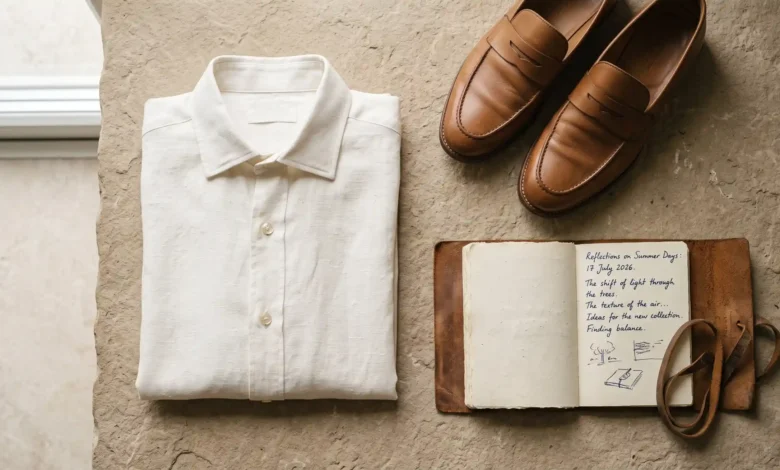
Take a software engineer moving from fully remote to three office days. She picks minimal, structured, ease. Her Tuesday uniform becomes a crisp cotton poplin button-down, dark straight-leg denim, and unadorned leather loafers. The poplin carries the structure the office expects, the denim keeps the remote-work ease, and the plain leather keeps it minimal. The outfit works because it satisfies all three words at once, and it survives a 7:40 train because none of the three pieces needs babysitting.
A second-grade teacher reads differently: practical says washable, aspirational says polished, emotional says calm. Her formula lands on a linen blend shirtdress at 130 to 160 grams per square meter that survives a 75 degree classroom and a humid playground recess, with one structured tote as the polished note. Same method, different life. That is the point.
Sifting through your wardrobe this way helps isolate the recurring silhouettes that consistently make you feel comfortable. Pay attention to how fabrics drape and how seams sit against your body, because those tactile details decide what you actually wear.
Step 3: Match Silhouettes and Fabric Weights to Your Real Week
Fashion media loves a geometry chart, and proportions do have a place. Our guide on how to find your body shape in four simple steps uses them as a starting point for reading drape. The mistake is treating the five-shape framework as a rulebook. Your body is not a problem to be camouflaged, and a wardrobe built around fear reads like it.
Balance comes from matching cloth to movement. If you sit nine hours a day, rigid trousers end up unworn no matter what the chart promises. Fabric weight is the dial most guides skip, so here is the trade-off the mood boards leave out: do not buy pure linen for a desk job and call it breathability, because it creases by the second meeting. A linen blend at 130 to 160 grams per square meter keeps the airflow and loses the crumple. The logic flips for structure: an unlined blazer under 220 grams per square meter collapses on the hanger and reads sloppy by lunch.
Silhouette Decision Matrix
| Physical routine | Suggested silhouette base | Strategic fabric choice | Practical benefit |
|---|---|---|---|
| Desk work, long periods of sitting | Relaxed Fit trousers or mid-rise bottoms | Matte crepe or soft modal at 170 to 260 grams per square meter | Eliminates waistband pinching and resists seat creasing |
| Active commuting, high mobility | Straight Fit trousers, denim, or knit tops | Linen blend at 130 to 160 grams per square meter | Breathes in motion and holds its line without starch |
| Hybrid roles, casual-to-formal swings | A-line skirts or unlined blazers | Crisp cotton poplin at 110 to 140 grams per square meter, or dense rayon | One shoe swap moves the outfit across dress codes |
| Variable days, errands and pickup | Drop-shoulder overshirts or midi skirts | Mid-weight twill or quilted cotton at 200 to 260 grams per square meter | Layers come off without wrecking the silhouette |
The Fantasy Self: The Most Expensive Habit in Your Closet
Every closet has a tenant who does not pay rent. The Fantasy Self buys heeled sandals in a rainy city, dry-clean silk for gardening weekends, and cocktail dresses for a calendar full of school pickups. She is fun to shop for. She is ruinous to own.
“[People] have to dress for who they are and the life they have, not something hypothetical,” personal stylist and content creator Vitor Arruda told The Guardian. Your receipt history probably disagrees with him. That disagreement is the budget leak.
The fix is arithmetic, not willpower. If 80 percent of your week runs Business Casual, tailored but relaxed attire with no suit required, or Smart Casual, everyday wear anchored by one polished element, then 80 percent of the wardrobe budget goes there. Before any new piece enters the cart, name the specific day it gets worn in the next seven. No named day, no purchase.
For anything still tempting after the seven-day test, run the 30 Wears test popularized by Livia Firth: will you actually wear it thirty times? Occasion wear gets one exemption, and only one, because the care label is part of the price. The FTC Care Labeling Rule, 16 CFR Part 423, puts the cleaning instructions on the garment, and a dry-clean-only tag on a machine-wash life is a Fantasy Self purchase.
For readers rebuilding after a career shift, a move, or a body change, this is the gentle part. Letting the Fantasy Self go is not settling. It is funding the person who is actually here.
The 90-Day Style Filter: How to Make It Stick
Style sticks when it runs on a loop, not a makeover. For ninety days, keep the rules small enough to survive a busy week:
- Buy nothing outside your three words, with the seven-day and 30 Wears tests as the gate.
- Re-audit the hamper once a month and let the gap list, not the feed, write your shopping list.
- Remix what you own before replacing anything. Lizzie Wheeler, vintage expert and founder of Studio Dorothy, gave The Guardian a good drill: “Choose one garment and make five different looks around it. Rinse and repeat.”
By day ninety the words will have edges, the rack will coordinate, and the next move is turning the formula into a repeatable uniform, which is exactly what our guide on how to create a signature style maps out.
Personal Style FAQs
Can my personal style change over time?
Yes. Lifestyle shifts, physical transitions, and aging naturally trigger style evolution. Lean into your current practical routine instead of clinging to old style categories, and revisit your three words once a year.
What if I love multiple, contrasting aesthetics?
That is where the Three-Word Method shines. Pairing a structured word like minimal with a contrasting emotional word like romantic builds a balanced signature uniform instead of boxing you into one pre-packaged aesthetic. The 70 percent dominant and 30 percent accent split keeps the mix coherent.
Do I need a large budget to find my style?
Absolutely not. True style curation is a zero-budget editing exercise. The laundry basket audit, the three words, and the remix drill all cost nothing, and thrifted pieces pass the same fabric-weight checks as full-price ones.
Should I follow body shape rules?
Use them as a sorting tool for reading drape, not as a rulebook. Proportion data helps you predict how a fabric will hang, while your routine, not a geometry chart, decides what you will actually wear.
How long does it take to find your personal style?
Roughly ninety days of filtered decisions. The audit and the words take an afternoon, but the pattern only becomes visible after a few weeks of buying nothing outside the filter.
Learning how to find your personal style is not about chasing a trend cycle. It is about grounding your rack in your real week, starting with versatile lengths like a midi or a maxi, and letting repetition become a signature instead of a rut. The hamper already knows. Now you do too.
Sources
Official Sources
- eCFR: Care Labeling of Textile Wearing Apparel, 16 CFR Part 423, accessed August 25, 2026.
Research Sources
- Ellen MacArthur Foundation: A New Textiles Economy: Redesigning Fashion’s Future, accessed August 25, 2026.
- Seamwork: We Tried the 3 Word Method. Here’s What We Learned., accessed August 25, 2026.
- The Guardian: ‘Dress for Who You Are’: How to Start Finding Your Personal Style, accessed August 25, 2026.
Industry Sources
- ThredUp: 2026 Resale Market and Consumer Trend Report, accessed August 25, 2026.
- Harper’s Bazaar UK: How to Find Your Personal Style: 8 Styling Tips to Clear Closet Confusion, accessed July 17, 2026.
- Selvane: The Wardrobe Audit: A Systematic Method for Evaluating What You Own and What You Need, accessed July 17, 2026.
Additional Reading
- TrendTome: How to Find Your Body Shape in 4 Simple Steps, accessed August 25, 2026.
- TrendTome: How to Build a Capsule Wardrobe: 4 Steps to Stop Overbuying, accessed August 25, 2026.
- TrendTome: How to Create a Signature Style: 4 Steps to a Repeatable Formula, accessed August 25, 2026.