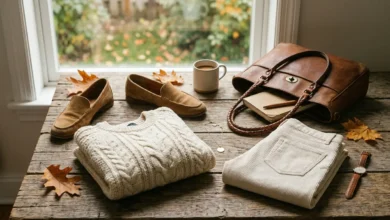
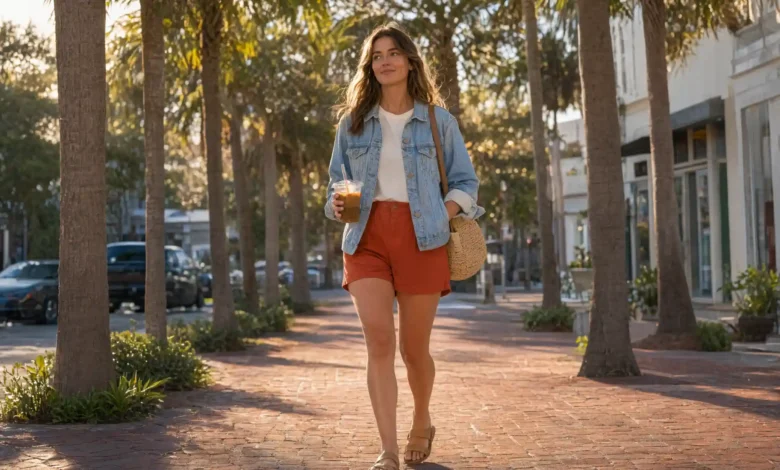
There is a specific moment every October when the mismatch becomes funny. The stores flip to rust and chocolate, the candles turn to pumpkin, and you walk back out into a Tampa parking lot at 3 p.m. into 86 degrees with a humidity reading that would make a sauna blush. The sweater on the mannequin is a lie, and yet the instinct behind it is real. You still want to look like October feels.
That tension is what makes fall outfits for Florida weather a translation problem instead of a shopping problem. The state’s autumn arrives as a color story, a texture story, and an occasional evening story, rarely as a temperature story. The National Weather Service’s Tampa Bay office puts it plainly in its fall outlooks: dew points in the middle 60s to middle 70s, along with “high temperatures in the mid 80s to lower 90s persist well into October.”
September is still hurricane season with the statistical peak barely behind you, October is summer wearing better colors, and November is when the north of the state finally gets to play by normal autumn rules while Miami remains unconvinced until December.
So the wardrobe move is not a replacement. It is a recoloring and a re-layering of what already works in the heat, plus a short list of pieces that earn their keep the one week a cold front actually slides through. Here is the whole system, month by month, fabric by fabric, and occasion by occasion.
Quick answer: Fall outfits for Florida weather work when you (1) keep summer-weight breathable fabrics and move them into fall color, (2) add removable layers like a shacket, kimono, or utility vest for air-conditioned rooms and November mornings, (3) let accessories carry the season with gold jewelry, a structured bag, and a hat, (4) hold boots until evening lows settle below 70 degrees, which means November for most of the state, and (5) follow the six occasion formulas below for church, work, date night, festivals, brunch, and cold-front evenings.
What fall actually feels like in Florida, month by month
September is the least autumnal month on the calendar and the most important one to accept. The Atlantic hurricane season runs from June 1 to November 30, with the statistical peak of activity landing around September 10, so early fall dressing here includes a packable rain shell and shoes that survive a sudden downpour more often than it includes a cardigan. October brings the first honest change, and it is a change in the air before it is a change in the thermometer.
Cold air holds less moisture than warm air, which is why the season’s first fronts register as a humidity drop before they ever read as a temperature drop, a mechanism the Florida Museum of Natural History walks through in its cold-front explainers. By November, those fronts start sticking in the Panhandle and North Florida, Jacksonville settles into highs in the low 70s with nights in the 50s, and the state effectively splits in two.
The regional split matters more than the month label. A Gainesville tailgate in late November and a Miami dinner the same night are different climates wearing the same date. Rounded averages from the NOAA U.S. Climate Normals look like this:
| Month | North (Jacksonville) | Central (Orlando, Tampa) | South (Miami) | What changes in the closet |
|---|---|---|---|---|
| September | 87 high, 70 low | 90 high, 73 low | 89 high, 77 low | Nothing, and that is the point. Summer pieces stay in full rotation while the rain shell rides along. |
| October | 81 high, 63 low | 85 high, 69 low | 86 high, 75 low | Mornings up north finally want a light layer. Everywhere else, the shift is color and accessories, not weight. |
| November | 72 high, 53 low | 77 high, 60 low | 81 high, 70 low | The north dresses for real autumn, central Florida needs evening layers, and the south tolerates a linen shirt at noon without regret. |
Within a single month the slide can be steep. Tampa’s November afternoons drift from around 81 degrees at the start of the month to the mid 70s by the end, so a layer that feels silly on November 2 feels necessary by November 28.
Florida fall at a glance
- September: summer with a pumpkin candle burning in the window.
- October: summer’s heat in autumn’s colors, with drier air sneaking in after fronts.
- November: two seasons in one state, real fall north of Interstate 4 and warm fall south of it.
The fabrics that make fall colors wearable at 85 degrees
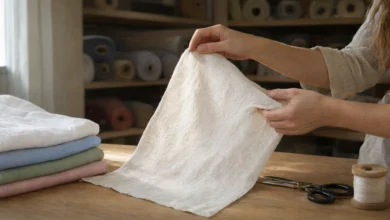
The site’s standing rule applies here more than anywhere: weight and weave decide whether a piece works, and the fiber name on the label comes second. Our technical guide to the fabrics that handle real heat covers the full GSM primer, and the short version for a Florida fall is that you want autumn’s palette poured into summer’s weights. A rust linen blend at 130 to 160 grams per square meter reads October and breaths like July.
A chocolate cotton poplin at 110 to 140 holds a pressed line through a humid commute. TENCEL and modal rayons sit in the 120 to 160 range and add drape, and Lenzing, the company behind the TENCEL name, describes its lyocell fibers as supporting “a natural dry feeling through moisture control,” which is exactly the job description for a date-night top in Orlando in October.
Flannel is the one fabric to keep on a short leash. Before late November, and only north of the central corridor, it works as an open shirt over a tee or tied at the waist, never buttoned and never in the brushed heavyweight version. The brushed surface traps a layer of warm air against the skin, which is the entire point of flannel and the entire problem in a state where the afternoon dew point can outlast the calendar.
| Fabric | Weight that works | Where it lands in a Florida fall |
|---|---|---|
| Linen blend | 130 to 160 GSM | Rust and olive shirts, unstructured blazers. The wrinkle reads as texture, not mess. |
| Cotton poplin | 110 to 140 GSM | Chocolate, cream, and mustard work tops that survive a humid drive with the collar intact. |
| TENCEL or modal rayon | 120 to 160 GSM | Maxi dresses and evening tops, where drape matters and moisture needs somewhere to go. |
| Cotton twill shacket | 200 to 260 GSM | The heaviest layer most of the state needs before December. Tied at the waist at noon, worn properly at 6 p.m. |
How to layer for air conditioning, not for cold
The swing that actually matters in October is not between day and night. It is the 20 degrees between the parking lot and the restaurant, between the sidewalk and the office, between the patio and the museum. Florida’s fall layering is really a strategy for over-chilled interiors, which flips the usual advice on its head: the layer should be easy to take off, easy to carry, and easy to tie around the waist, because most days it will spend more time carried than worn.
A useful test before buying any fall layer is to ask whether you would happily carry it for six hours. A 200 to 260 GSM cotton twill shacket passes. A lined wool jacket fails, and a failed layer gets left in the car within a week, which is how closets accumulate November clothing in a state with a two-week November.
Kimonos and open cardigans pass for the same reason over a dress or a bodysuit, and a utility vest passes for outdoor weekends because it adds the layered silhouette without adding a sleeve of insulation. Three-quarter sleeves pull double duty in this system, giving sun coverage for the afternoon hour while still reading as a fall proportion.
A fall palette that reads autumn in bright sunshine
Color does the seasonal lifting that weight cannot. Terracotta, rust, olive, burgundy, chocolate brown, mustard, and deep green all read as October even in a linen blend at noon, and a muted floral on a dark ground reads more autumnal than a bright floral on white without adding a single ounce of warmth.
The site’s 70 to 30 ratio scales down neatly here: keep roughly 70 percent of the outfit in the neutrals your summer closet already owns, cream, tan, white denim, straight-leg blue, and spend the 30 percent accent budget on the warm tones. A monochromatic run of chocolate on chocolate is the quiet luxury version of the same idea, tonal dressing that photographs like fall while weighing like summer.
Accessories finish the translation. Gold jewelry warms up a cream outfit the way a sweater would, a structured handbag swapped for a soft summer tote sharpens the silhouette into something more autumnal, and a straw hat stays correct through October before a felt brim takes over in November. One statement note per outfit, with everything else quiet, keeps the look current instead of costumed.
Sandals now, boots later: timing the switch
Boots are the piece people reach for first and regret longest. The honest trigger is the evening low, not the calendar: once lows settle below 70 degrees for a stretch, boots stop reading as costume and start reading as sense. In practice that lands in November for central and South Florida and late November for the north, with the Panhandle occasionally earning a boot week earlier after a strong front.

Until then, the rotation is sandals, espadrilles, loafers, and clean sneakers, all of which pair fine with fall colors. When the boot week finally arrives, the one-pair recommendation holds: a pointed toe on a 2 to 3 inch block heel, because the pointed toe lengthens the leg under midi hems and the block heel handles grass, gravel, and parking lots.
Our guide to how to wear ankle boots with every hemline maps which hem takes which boot, and the short version for Florida is that the midi skirt plus ankle boot combination is the state’s best cold-front uniform, working from a Jacksonville church step to a Tampa patio.
Boot timing at a glance
- Through October: sandals, espadrilles, loafers, sneakers. Boots read as costume at 85 degrees.
- November: ankle and Chelsea boots earn their keep in central and South Florida evenings.
- Late November and beyond: North Florida and the Panhandle can follow normal autumn boot rules.
Six outfit formulas that work from Gainesville to Miami
Each formula below keeps the insulation honest and lets color, texture, and accessories say October. Swap weights up one row if you are north of Interstate 4 in November, or down one row if you are in Miami at any point.
| Occasion | The formula | Why it holds up at 85 degrees |
|---|---|---|
| Church or services | Rust or olive linen-blend midi skirt, cream cotton poplin top, pointed flats or a low block heel, gold earrings, structured crossbody. | The skirt moves air all afternoon while the palette and the gold carry the season. |
| Office | Chocolate wide-leg trousers in a 150 to 220 GSM woven, cream bodysuit, lightweight cardigan that lives at the desk. | The trousers look like fall weight without being fall weight, and the cardigan handles the conference room instead of the commute. |
| Date night | Burgundy or muted-floral TENCEL maxi dress, kimono left in the car until the indoor seating arrives, sandals in October and ankle boots in November. | Rayon-family drape reads dressy, sheds humidity, and the kimono is insurance against an aggressive thermostat. |
| Fall festival or tailgate | Straight-leg denim, three-quarter sleeve tee, utility vest, sneakers, straw hat through October. | The vest gives the layered silhouette with no sleeve of insulation, and denim forgives grass, bleachers, and gravel. |
| Brunch and errands | Tan or white denim, rust bodysuit or linen shirt, loafers or espadrilles, structured bag in place of the summer tote. | Light bottoms keep the noon hour honest while the rust top and the sharper bag say October. |
| Cold-front evening | Cotton twill shacket at 200 to 260 GSM over a long-sleeve tee, dark straight denim, Chelsea boots. | The one formula where the weather genuinely cooperates, north of the central corridor or any late-November front. |
If you are visiting: packing for a 50 to 85 degree swing
Visitors usually pack for the postcard and get caught by the thermostat. A few rules cover almost every fall trip:
- Pack around the evening low of your coolest night, not the afternoon high of your warmest day.
- Bring one removable layer for every two outfits, shacket, kimono, or fine-gauge cardigan, nothing lined.
- Keep a packable rain shell in the bag through November 30, hurricane season does not check the calendar on the way out.
- Shoes: one sandal, one sneaker, and one boot only if your trip lands in November and includes northern evenings.
- Leave the heavy sweater at home unless a specific cold front is in the forecast for a northern stop.
Starting from where your closet already is
- If your closet is basically all summer: recolor before you replace. An audit first, then two or three new pieces in rust, olive, burgundy, or chocolate, one removable layer, and one structured bag will translate most of what you own. The counts follow the audit, never the other way around, and the transitional fall essentials that earn their hanger in warm weather is the companion list for what to add.
- If you run cold in air-conditioned rooms: you are the one reader who should own a genuinely warm layer, and the trick is to keep it in the right place. A 220 GSM cardigan that lives in the car or the desk drawer solves the restaurant problem without making the parking lot worse.
- If one trip covers more than one region: plan each day around the evening low of wherever you will sleep, and treat the afternoon high as a given you already know how to dress for. The year-round capsule wardrobe system handles this same logic with a two-bin rotation for people who live between climates.
Who this approach will not work for
Honest limits, briefly. A uniform or a strict dress code overrides all of it, and someone required in a polyester blend in an Orlando kitchen in October needs cooling strategies, not styling formulas. If you love a heavy cable knit for its own sake, wear it, but call it what it is, a sentimental choice for a photo or a two-hour outdoor dinner, not a working wardrobe.
Readers in the Panhandle from late November onward should ignore most of this and follow normal autumn rules, because your weather has genuinely changed. And if warm palettes simply are not yours, run the entire system in tonal neutrals, cream, taupe, chocolate, and let texture carry the season instead of color.
Frequently Asked Questions About Fall Outfits for Florida Weather
What should I wear in Florida in October?
Summer-weight pieces in fall colors: linen blends and TENCEL in rust, olive, and chocolate, plus one removable layer like a shacket or kimono for mornings and air-conditioned rooms. Afternoon highs still run 81 to 86 across most of the state, so insulation is the enemy and color is the signal.
Do you need a jacket in Florida in the fall?
A light one, and only a removable one. Through October, a 200 to 260 GSM shacket or a lightweight cardigan covers every swing you will actually meet, most of which happen indoors. A genuinely insulated jacket earns its keep only in North Florida from late November on.
When can I wear boots in Florida fall?
When evening lows settle below 70 degrees for a stretch: November for most of the state, late November north of Orlando. Before that, boots at 85 degrees read as costume, so sandals, loafers, and sneakers stay in rotation through October.
How do I build fall outfits for Florida weather without buying a new wardrobe?
Recolor, do not replace. Keep your summer silhouettes, swap two or three pieces into rust, olive, burgundy, or chocolate, add one removable layer and one structured bag, and let gold jewelry carry the rest of the seasonal signal.
Is October a good time to visit Florida?
Yes for thinner crowds and humidity that is finally backing off, no if you came for crisp air and foliage. Pack summer clothing in a fall palette with one light layer, and keep a rain shell handy, since hurricane season runs through November 30.
Fall in Florida Is a Translation, Not a Replacement
The sweater on the mannequin was never the point. Florida’s autumn is one of the honest ones in a different sense: it strips the season down to what actually travels in heat, the colors, the textures, the gold, the structured bag, the boot that finally makes sense on a 62 degree evening in Jacksonville.
Once you stop asking the state for a November it does not have and start translating the one it does, fall outfits for Florida weather stop being a contradiction and become a small, repeatable skill. Start with the audit, pick three recoloring pieces and one removable layer this week, and save the boots for the evening the weather actually agrees.
Sources
Official Sources
- NOAA National Centers for Environmental Information: U.S. Climate Normals, Access Date: August 24, 2026
- NOAA: Tropical Cyclone Climatology, Access Date: August 24, 2026
- National Weather Service, Tampa Bay Area: Autumn Began on Sept. 22nd, So When Does It Usually Cool Off?, Access Date: August 24, 2026
Industry Sources
- Lenzing (TENCEL): What are TENCEL Lyocell and Modal Fibers, Access Date: August 24, 2026
Research Sources
- Florida Museum of Natural History: Tell Me About: Cold Fronts, Access Date: August 24, 2026
Additional Reading
- Weather Spark: Tampa November Weather, Average Temperature, Access Date: August 24, 2026
- Visit Jacksonville: Jacksonville, FL Average Weather by Month and Climate, Access Date: August 24, 2026