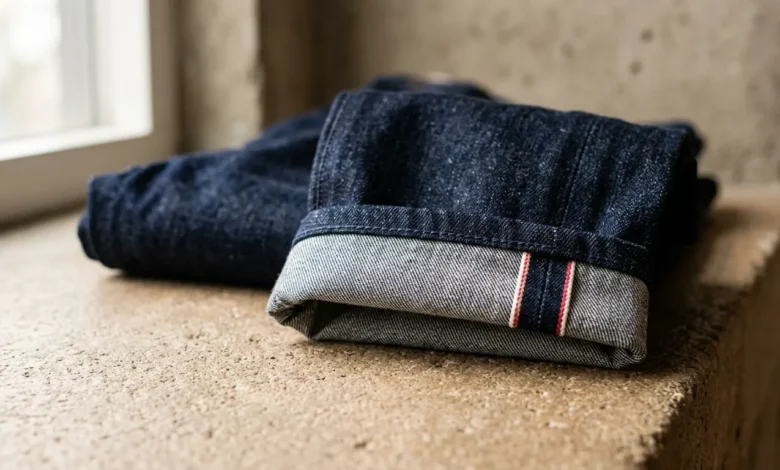
Paying $200 or more for jeans that feel like cardboard on day one sounds like a bad trade. Yet rigid, unwashed denim remains a cornerstone of intentional wardrobes precisely because untreated cotton molds to your frame over time. If you are looking for a clear raw denim buying guide, navigating the technical terms, from sanforization to fabric weight in ounces, does not have to feel overwhelming. Once you understand how rigid twill behaves under strain and moisture, picking the right pair becomes a straightforward formula.
Raw denim differs from standard washed jeans in one fundamental way: it receives no factory washing, distressing, or mechanical softening after dyeing. The fabric arrives in its unwashed, rigid state straight off the loom or finishing line. Buying a pair requires evaluating textile physics rather than relying on vanity sizing tags.
To buy raw denim, follow a 4-step selection process: 1. Choose between sanforized (pre-shrunk, 1–3% shrinkage) and unsanforized (loomstate, 5–10%+ shrinkage) fabric. 2. Pick a midweight fabric (12–16 oz) for all-season durability. 3. Use flat-lay garment measurements, prioritizing upper thigh and rise clearance over waistband stretch. 4. Inspect for quality hardware, chain-stitched hems, and 10 oz pocket canvas.
1. Sanforized vs. Unsanforized: Calculating Denim Shrinkage Before You Buy
Before choosing a fit, you must select between two distinct fabric treatments. This decision determines how much the jeans will shrink after their first exposure to water.
Sanforized Denim: The Low-Maintenance Standard for Beginners
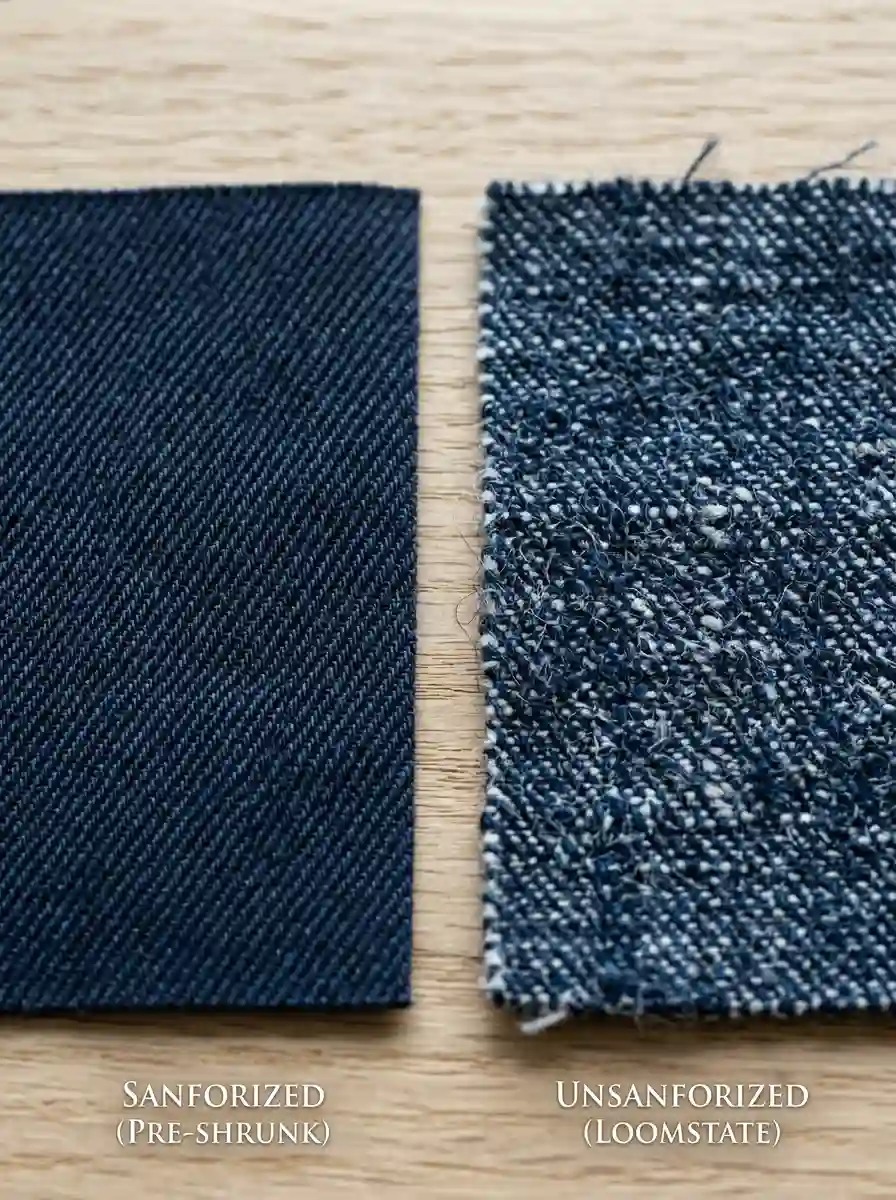
Sanforization is a mechanical pre-shrinking process patented by Sanford Lockwood Cluett in 1930. The raw fabric is treated with steam, heat, and rubber-belt compression to compact the cotton fibers before the garment is sewn.
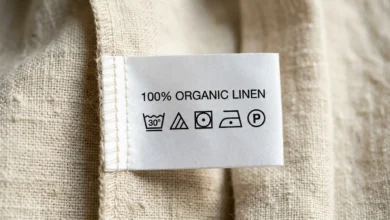
Sanforized raw denim shrinks minimally, typically between 1% and 3% upon its first wash. If a waistband measures 32 inches out of the box, it will lose less than half an inch after cleaning. This predictability makes sanforized denim the most reliable starting point for first-time buyers. U.S. manufacturers like Tellason build most of their core collections on sanforized twill to remove sizing guesswork. When checking garment tags, decoding clothing fiber labels and FTC care tag rules helps confirm whether you are evaluating 100% rigid cotton or a blended weave.
Unsanforized (Loomstate) Denim: The Traditional Shrink-to-Fit Process
Unsanforized denim, often called loomstate denim, bypasses mechanical pre-shrinking entirely. The fabric comes directly off the loom to the sewing table without steam or rubber-belt compression.
Unwashed loomstate denim shrinks dramatically during its first hot soak or wash, contracting by 5% to 10% or more across the total garment volume. A 32-inch waistband can shrink up to 2 full inches, while the inseam may lose 2.5 to 3 inches in length. Buyers choosing unsanforized denim must size up accordingly to accommodate this contraction.
Some Japanese textile mills offer a “One-Wash” or rinsed unsanforized option. This variation undergoes a single factory rinse to pull out the initial shrinkage while preserving the uneven, textured character of loomstate yarn. If you opt for untreated loomstate fabric, understanding how to soak unsanforized raw denim for the first time ensures you control water temperature and timing to set the fit accurately.
Sanforized vs. Unsanforized At a Glance
- Sanforized: Pre-shrunk mechanically with 1% to 3% post-wash shrinkage. Buy true to size based on your actual thigh measurements.
- Unsanforized (Loomstate): Untreated fabric that contracts 5% to 10% upon washing. Expect to size up 1 to 2 inches to allow for total garment shrinkage.
| Parameter | Sanforized Denim | Unsanforized (Loomstate) Denim |
| Post-Wash Shrinkage | 1% to 3% (Minimal) | 5% to 10%+ (Significant) |
| Waist Contraction | Under 0.5 inches | 1.5 to 2.0 inches |
| Inseam Contraction | 0.5 to 1.0 inch | 2.5 to 3.5 inches |
| Sizing Approach | Buy true to actual physical measurements | Size up 1–2 waist sizes before initial soak |
| Fabric Surface Texture | Smooth, uniform finish | Uneven, slubby, textured character |
2. Denim Weight Tiers: How Ounces per Square Yard Affect Break-In and Durability
Denim weight is measured in ounces per square yard of fabric ($\text{oz/yd}^2$). This figure dictates how stiff the garment feels initially, how warm it wears, and how crisp the wear lines, commonly called whiskering and honeycombs, will develop over time.
Lightweight vs. Midweight vs. Heavyweight Raw Denim
Raw denim falls into three broad weight tiers:
- Lightweight (Under 12 oz): Soft out of the box with minimal break-in friction. While comfortable in warm weather, lightweight rigid denim wears through faster at high-friction stress points like the inner thighs.
- Midweight (12 oz to 16 oz): The standard range for versatile, all-season wear. Midweight denim offers sufficient body to hold sharp creases without feeling restrictive during daily movement. Specialist publications like He Spoke Style recommend a 13 oz to 14 oz midweight fabric as the sweet spot for a first pair.
- Heavyweight (Over 16 oz to 25+ oz): Dense, highly structured fabric engineered for cold weather and high-contrast fading. Heavyweight denim requires patience. During the first two weeks, a 19 oz fabric can feel like wearing armor, even leaving light bruises on the hip bones or turning the button fly into a genuine thumb workout.
| Weight Tier | Ounce Range | Initial Feel | Break-In Period | Best For |
| Lightweight | Under 12 oz | Pliable, thin | 1 to 3 days | Warm climates, casual daily wear |
| Midweight | 12 oz to 16 oz | Firm, structured | 2 to 4 weeks | All-season versatility, first-time buyers |
| Heavyweight | Over 16 oz | Rigid, thick | 1 to 3 months | High-contrast fading, cold weather durability |
3. The Flat-Lay Sizing Protocol: How to Measure for Raw Denim Without Fit Errors
Relying on labeled waist tags is the fastest way to buy the wrong size. A stamped “32” on a clothing tag rarely measures 32 inches around the inner waistband. To get an accurate fit, measure a pair of well-fitting non-stretch pants laid flat on a table using a fabric tape measure.
For a broader look at rise heights and silhouette geometry across washed jeans, our guide on general jeans rise and body shape fit mechanics covers how rise proportions balance your torso.
Why Waist Stretch Must Never Override Thigh and Rise Clearance
Unwashed 100% cotton yarns stretch under constant body pressure. Over the first 20 to 30 wears, a raw denim waistband will expand by 0.5 to 1.0 inch under tension.
Many buyers make the mistake of sizing down two sizes to account for this stretch. Not always a smart move. While the waistband expands under strain, structured seam zones like the upper thigh, front rise, and hip joints experience almost zero stretch. Sizing down to force a tight waist pulls the crotch seam tight against the body, causing premature fabric blowout within six months.
Step-by-Step Flat-Lay Measurement Protocol
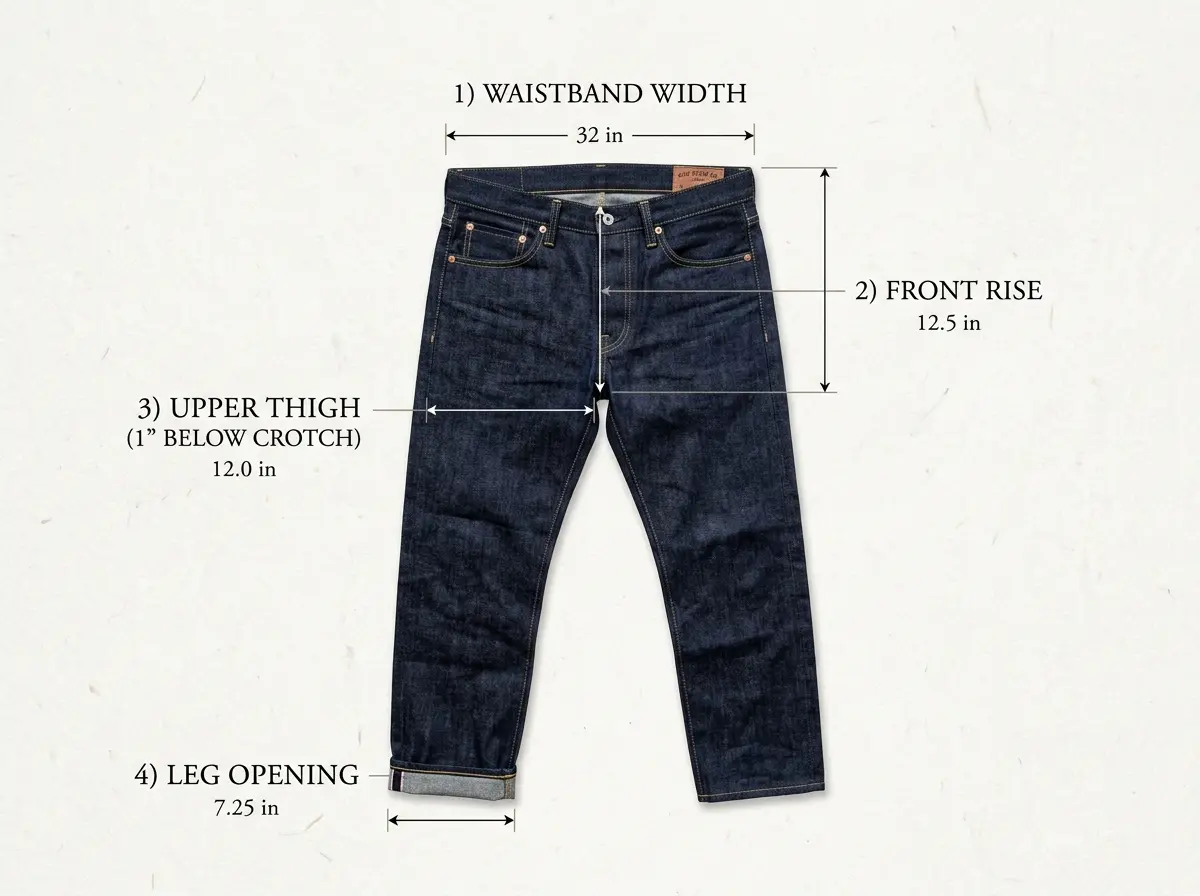
- Waistband: Button the pants, lay the waistband flat with front and back aligned, measure seam to seam, and double the figure.
- Upper Thigh: Measure flat across the leg opening starting 1 inch below the crotch seam.
- Front Rise: Measure from the crotch seam straight up to the top of the front waistband.
- Leg Opening: Measure flat across the bottom hem from side to side.
Comparing your flat-lay measurements against the manufacturer’s size chart reveals how each zone behaves under daily wear:
| Garment Zone | Measurement Method | Stretch Physics | Sizing Rule |
| Waistband | Flat across top seam, doubled | Expands 0.5 to 1.0 inch with wear | Select 0.5 inches smaller than actual waist |
| Upper Thigh | 1 inch below crotch seam | Minimal stretch (under 0.25 inches) | Match or exceed your thigh measurement |
| Front Rise | Crotch seam to waistband top | Zero stretch | Choose based on sitting comfort |
| Leg Opening | Flat across bottom hem | Zero stretch | Select based on shoe pairing |
4. Garment Inspection: 4 Construction Details That Separate Durable Denim from Price Markup
High price tags in the raw denim market should reflect superior hardware, dense pocket canvas, and specialized shuttle loom weaving rather than brand marketing.
When evaluating a pair before purchase, inspect these four technical markers:
- Selvedge ID Line: Selvedge denim is woven on vintage shuttle looms that create clean, self-finished edges along the fabric border. Turning up the cuff reveals a crisp woven strip, often featuring a red or white contrast thread, that prevents fraying.
- Chain-Stitched Hems: Traditional hems stitched on vintage Union Special 43200G machines create diagonal thread tension. As the cotton shrinks, this tension forms puckered wear lines known as the “roping effect.”
- Heavyweight Pocket Bags: Thin pocket lining wears out long before the main twill breaks in. Look for 10 oz heavy cotton canvas pocket bags secured with clean lock-stitching.
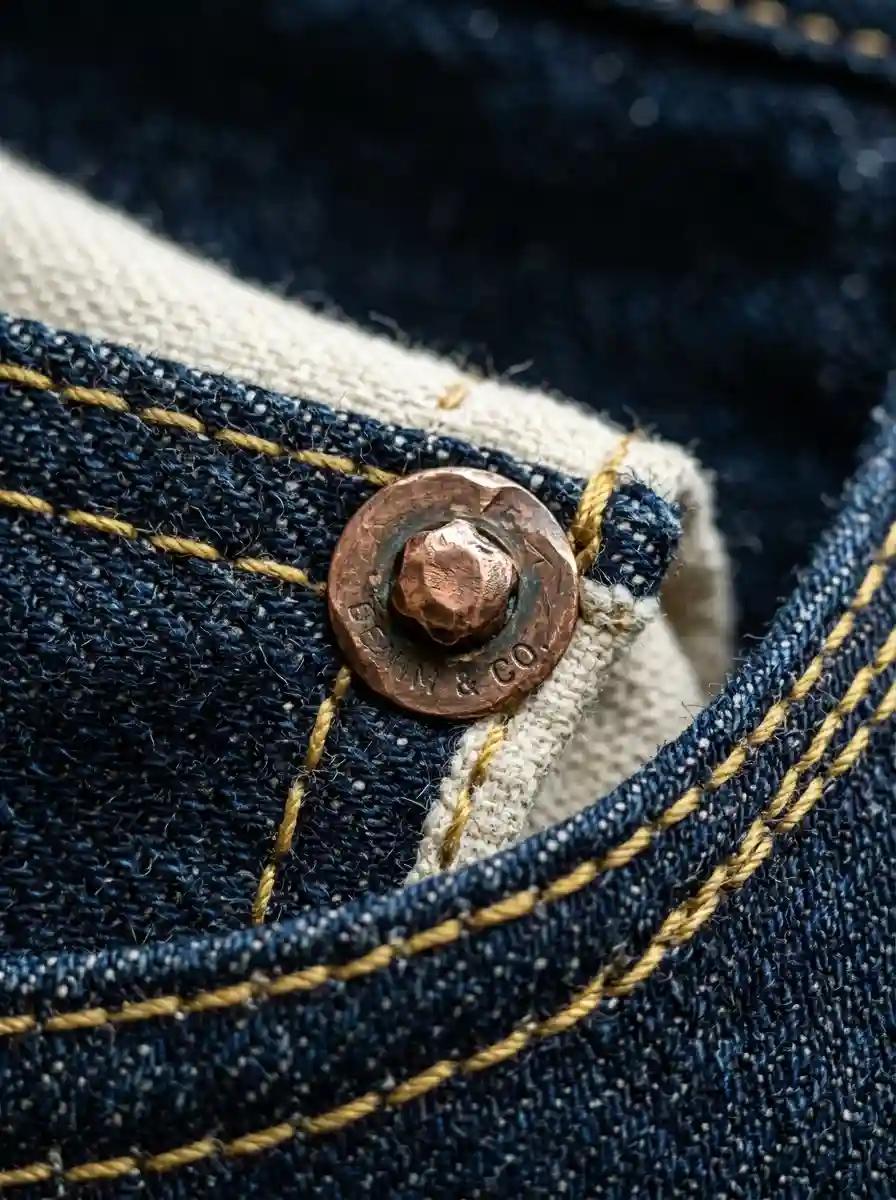
- Punch-Through Copper Rivets: High-stress points at pocket corners should be reinforced with solid copper rivets. Flat-stamped decorative caps often pull free under heavy strain.
Before finalizing your order, running through pre-checkout garment inspection steps ensures you check for loose thread tension or seam pulling. Federal labeling rules under FTC 16 CFR Part 303 require clear fiber content disclosure, while FTC 16 CFR Part 423 governs care tag mandates.
Pre-Checkout Construction Inspection Checklist
- Selvedge Edge Verification: Confirm a clean woven self-edge is present along the outer leg seam.
- Hem Construction: Look for diagonal chain-stitch construction along the inner cuff.
- Pocket Canvas Weight: Verify pocket lining uses heavy $10\text{ oz}$ cotton canvas.
- Hardware Strain Points: Check for solid copper punch-through rivets at front pocket stress points.
Who Raw Denim Isn’t For: Practical Trade-offs and Alternative Choices
Rigid denim is not a universal solution for every closet. Acknowledging its practical limitations prevents costly buyer’s remorse.
You should skip raw denim if your routine demands:
- Immediate Softness: Raw cotton arrives stiff and structured. It takes weeks of regular wear to break down stiff yarns.
- Zero Dye Transfer: Unwashed indigo bleeds onto light surfaces during early wear. This friction-based dye transfer, known as indigo crocking, will stain white leather sneakers, canvas totes, and light upholstery. If dye bleed is a concern, reviewing guidelines on how to stop raw denim indigo from bleeding onto shoes provides practical mitigation steps.
- High Elasticity: Raw denim contains 100% rigid cotton with zero elastane or spandex. If you rely on synthetic stretch for active movement, rigid twill will feel restrictive.
Scenario-Based Buying Recommendations: Matching Raw Denim to Your Lifestyle
Selecting the right pair comes down to matching weight, treatment, and fit to your actual daily environment.
- The Smart Casual Professional: Choose a sanforized 13 oz midweight pair in a clean Straight Fit with dark indigo thread. The moderate weight layers easily under a blazer, providing a structured silhouette suitable for office settings.
- The Active Commuter: Select a sanforized 12 oz lightweight or midweight fabric cut in a Relaxed Fit. The roomier thigh dimension allows comfortable bicycle commuting without putting extreme pressure on the crotch seams.
- The Heritage Enthusiast: Opt for a 16 oz to 18 oz unsanforized loomstate denim cut in a Regular Fit. The untreated yarn develops pronounced slub texture and high-contrast fading patterns after initial soaking. Pair your jeans with leather work boots or canvas sneakers; exploring what shoes to wear with straight fit raw denim offers clear footwear formulas for different leg openings.

| Buyer Scenario | Recommended Weight | Fabric Treatment | Suggested Fit | Key Benefit |
| Smart Casual Office | 13 oz to 14 oz (Midweight) | Sanforized | Straight Fit | Clean dark indigo finish, easy blazer pairing |
| Active Commuter | 12 oz to 13 oz (Light-Mid) | Sanforized | Relaxed Fit | Extra thigh room, reduced crotch seam strain |
| Heritage Enthusiast | 16 oz+ (Heavyweight) | Unsanforized | Regular Fit | High-contrast fades, rich loomstate texture |
Frequently Asked Questions About raw denim buying guide
How much does raw denim stretch in the waist and thighs after wearing?
Unwashed 100% cotton waistbands stretch approximately 0.5 to 1.0 inch over the first 20 to 30 wears under body pressure. In contrast, high-strain structural zones like the thighs, hips, and front rise experience minimal stretch (under 0.25 inches). Always size your jeans to clear your thigh measurements rather than relying on waistband expansion.
What is the difference between sanforized and unsanforized denim when choosing a size?
Sanforized denim undergoes steam and mechanical pressure to pre-shrink the fabric, resulting in minimal post-wash shrinkage (1% to 3%). You can buy sanforized jeans true to your actual physical measurements. Unsanforized denim skips pre-shrinking and contracts by 5% to 10% during its first soak, requiring you to size up 1 to 2 inches in the waist and length.
What denim weight is best when learning how to buy raw denim for the first time?
A midweight fabric between 12 oz and 14 oz per square yard provides the ideal balance for first-time buyers. Midweight denim offers structural durability and crisp fading potential without the uncomfortable, rigid break-in period associated with heavy fabrics over 16 oz.
Is selvedge denim always raw denim?
No. Selvedge refers to the woven finished edge produced on traditional shuttle looms, whereas raw refers to the unwashed state of the fabric dye. You can purchase washed selvedge jeans that have been artificially distressed, just as you can buy raw denim woven on wide modern looms without a selvedge edge.
Choosing a Pair of Raw Denim That Lasts
Buying raw denim is an investment in garment longevity and personal fit. By prioritizing thigh clearance over waist tags, selecting an appropriate midweight fabric, and deciding between sanforized ease and unsanforized texture, you avoid the common pitfalls that lead to uncomfortable fits. Once you find the right pair, following practical care routines, including learning how to wash raw denim without fading, ensures your jeans age gracefully while maintaining their structural integrity for years to come.
Sources
Official Sources
- Federal Trade Commission (FTC): Textile Fiber Products Identification Act (16 CFR Part 303) | Access Date: July 2026 | Source Tier: Tier 3
- Federal Trade Commission (FTC): Care Labeling of Textile Wearing Apparel (16 CFR Part 423) | Access Date: July 2026 | Source Tier: Tier 3
- Tellason: Sanforized vs. Unsanforized Denim | Access Date: July 2026 | Source Tier: Tier 1
- Buck Mason: A Guide to Wearing Raw Denim | Access Date: July 2026 | Source Tier: Tier 1
Industry Sources
- Heddels: Buying Your First Pair Of Raw Denim: The Beginners Guide | Access Date: July 2026 | Source Tier: Tier 5
- He Spoke Style: The Complete Raw Denim Guide | Access Date: July 2026 | Source Tier: Tier 5
- Denimio: Non-Wash vs. One-Wash Denim | Access Date: July 2026 | Source Tier: Tier 6