A ClosetMaid survey of 1,000 women found the average closet holds 103 items of clothing, and 12 percent of them had never been worn. That gap between owning and wearing is the whole problem in this category. A complete women’s wardrobe essentials guide exists to close it, not by adding more hangers but by making every hanger earn its place.
The idea has real lineage. Susie Faux, who ran the London boutique “Wardrobe” in the 1970s, built the capsule wardrobe concept around a short core of reliable pieces, and Donna Karan’s 1985 “Seven Easy Pieces” collection made the same argument in America: a bodysuit, a tailored jacket, a skirt, a pant, a dress, and a leather piece, all interchangeable. Fewer, better, mixed constantly.
This guide updates that lineage with mechanics instead of vibes: cost per wear, fabric weight, and fit checks. Below is the full checklist, the tests each piece has to pass, the order to build in, and the honest adjustments for budget, body shape, and climate.
The short version: build a complete wardrobe essentials checklist for women around 20 pieces in five categories. 1) Audit what you own and actually wear. 2) Keep only pieces that pass a cost-per-wear test, a three-outfit pairing test, and a real-life climate test. 3) Fill gaps in order: tops, bottoms, layers and outerwear, shoes, then accessories. 4) Buy neutral colors first, fit before fabric, fabric before brand. 5) Re-run the tests twice a year as your seasons, size, and schedule change.
What Counts as a Wardrobe Essential in the First Place
An essential is defined by function, not by any canonical list. The pieces below all pass three tests, and anything that fails one of them is a trend purchase, which is a fine thing to buy occasionally but a different budget line.
The first test is cost per wear: the price divided by the number of times you will realistically wear it, with cleaning and repairs counted in the total. The FTC’s Care Labeling Rule, 16 CFR Part 423, requires care instructions that hold up for the useful life of a garment, and that care line on the tag is real money. A dry-clean-only blouse quietly triples its lifetime cost compared with a machine-washable one.
The second test is pairing: the piece should join at least three outfits you already own without effort. The third is real life: it suits the climate you live in and the dress code you actually face, not the ones you imagine. These tests matter because clothing utilization has been sliding for years. The Ellen MacArthur Foundation’s textiles research found the number of times a garment is worn has fallen 36 percent over fifteen years, which is what happens when clothes are bought for an imagined life rather than the one in front of us.
At a glance: essential or trend piece
- Essential: you can name three outfits it joins before you finish your coffee.
- Essential: the care routine fits your actual week and budget.
- Trend piece: it was bought for one event, and the event has passed.
- Trend piece: it only works with the one thing you bought it with.
The Complete Wardrobe Essentials Checklist for Women
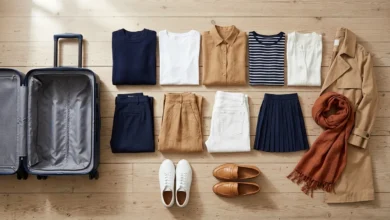
Here is the full checklist, with the check each piece should pass before it earns a hanger. Keep the palette neutral-first: black, navy, chocolate, camel, cream, and white cover nearly every pairing in the table.
| Category | The piece | The check it should pass |
|---|---|---|
| Tops | White cotton poplin shirt | Look for 110 to 140 GSM so it holds a press without going sheer. |
| Tops | Fine-gauge merino or modal crewneck | It should slip under a blazer with zero bunching at the armhole. |
| Tops | Breton or solid knit top | Taste decides the pattern; the slot itself is non-negotiable. |
| Tops | Crepe blouse in a neutral | Matte crepe over glossy satin for office days, since it shrugs off water spots and desk friction. |
| Bottoms | Straight-leg dark denim | Midweight, around 12 ounces per square yard, in a mid to high rise that closes cleanly when you sit. |
| Bottoms | Tailored trouser in black, navy, or chocolate | The waistband test happens seated, not standing. |
| Bottoms | Neutral midi skirt, A-line or bias-cut | Take a full stride without fighting the hem; mid-calf lands right for most heights. |
| Dresses | One solid wrap or shift dress | It should survive a wedding invite and a Tuesday, depending on shoes. |
| Layers | Tailored blazer with a structured shoulder | Shoulder seam meets your shoulder; everything else a tailor can fix for 20 to 40 dollars. |
| Layers | Reliable trench coat in cotton gabardine | Collar sits flat whether you belt it or wear it open. |
| Layers | Fine cashmere or merino sweater | Seven-gauge or so: thin enough to layer, dense enough to wear alone in October. |
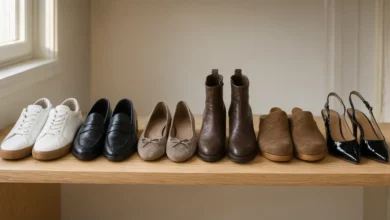
| Shoes | Leather flat, ballet or loafer | It should flex at the ball of the foot on the first wear, not the tenth. |
| Shoes | Clean white leather sneaker | Plain, cleanable, no loud logo panel. |
| Shoes | Block-heel boot or pump | A block heel carries gravel and cobblestones; the base matters more than the height. |
| Accessories | Leather belt | Match the leather and metal family to the shoes you own most. |
| Accessories | Structured leather handbag in a neutral | It should stand upright on the floor when empty. |
| Accessories | One dominant-metal jewelry anchor | Pick one metal for roughly 70 percent of what you wear and let the other accent. |

Five of these pieces do the heaviest structural lifting, and each has its own fit mechanics that we have mapped separately in the fit guide to the five structural essentials. The checklist tells you what to own; that guide tells you how each piece should sit on your body.
How to Build a Basic Wardrobe From Scratch in the Right Order
Start with an audit, not a shopping trip. Stylist Aricia Symes, founder of Unfoldid, told the New York Post, “I often see closets full of 12 to 15 pairs of black pants that are nearly identical.” Near-duplicates are the tell of a wardrobe built by accident. Pull everything out, keep what passes the three tests, and note the gaps that remain.
Then fill gaps by cost per wear, and run the math in plain language before checkout. A 220 dollar blazer worn 150 times over a few years works out to about a dollar and a half per wear. A 35 dollar top worn four times costs almost nine dollars a wear. The expensive piece was the cheap one. Symes’s budgeting approach matches this: she suggests putting roughly a quarter of a clothing budget toward core essentials, a quarter toward signature pieces, and the remaining half toward trend items or one quality splurge.
Buy in the order the checklist lists, because tops and bottoms multiply outfits while accessories only finish them. Keep interchangeability as the entry fee, the way Donna Karan did in 1985: every new piece had to work with the ones already hanging. If the audit reveals overbuying as the disease, the four-step capsule method is the treatment, and it pairs cleanly with this checklist.
Making the Same Twenty Pieces Work Across Seasons
Transitional dressing is a fabric-weight game, not a second wardrobe. GSM, the grams per square meter a fabric weighs, is the number to watch. The poplin shirt at 110 to 140 GSM and a tissue-weight merino or modal layer at 120 to 150 GSM can stack under the same trench from March into November without bulk. Linen blends in the 130 to 160 GSM range carry humid summers, and the 12-ounce denim carries everything else.
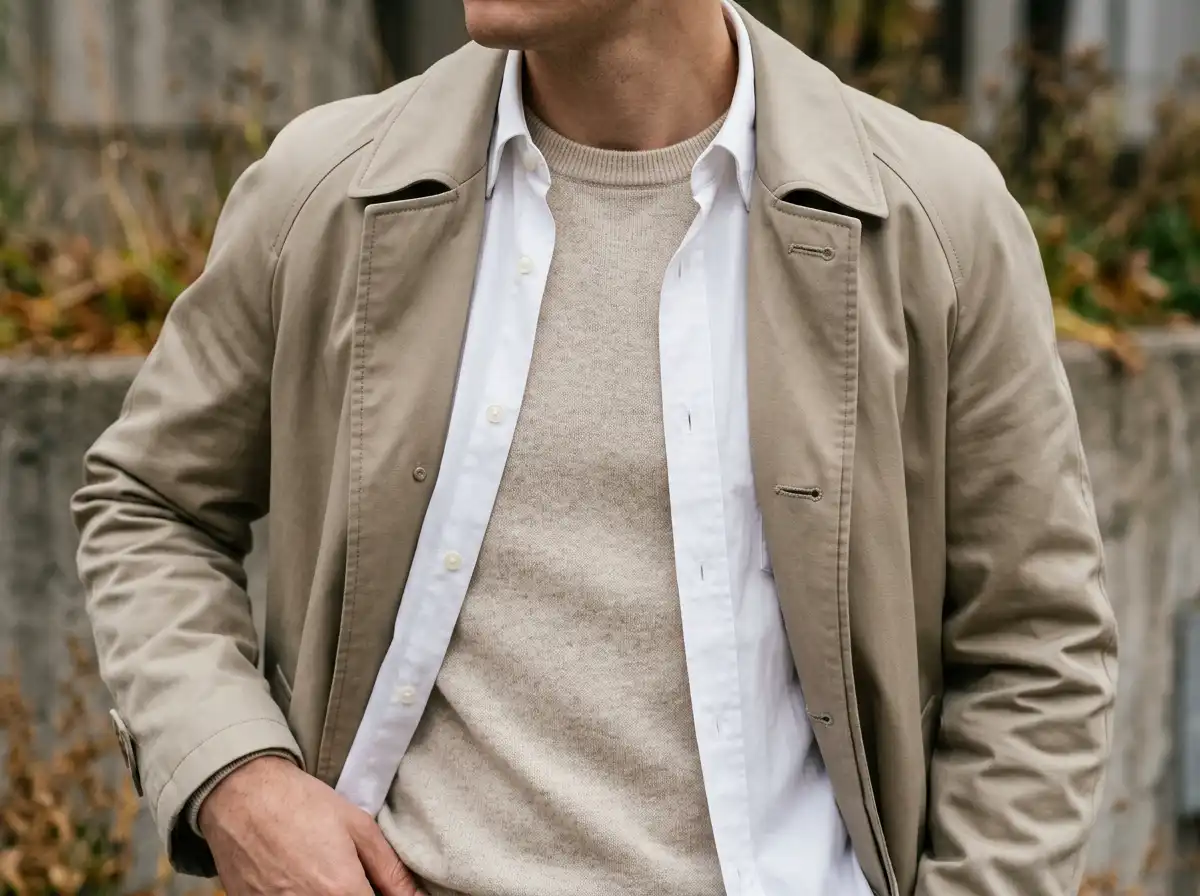
Two small switches sell the season change better than any new purchase. Footwear goes closed-toe, and the palette goes one shade deeper, cream to camel, white to ecru, while the silhouettes stay identical. Weight, shoes, and tone do the work a second shopping trip would have done.
Adjusting the Checklist to Your Actual Life
If you are rebuilding after a size or life change: buy in stages and start with the two categories you wear most days. Proportions shift before taste does, so find your body shape in four simple steps before replacing the structured pieces, and replace the rest only as something earns its exit.
If your budget is tight this season: shop the audit first. Inexpensive tailoring, usually 20 to 40 dollars for a side seam or hem, converts the near-right pile into the right pile. Buy denim and shoes new, where fit and wear matter most, and let the trench and cashmere come from resale, where construction outlives the first owner.
If your dress code is business casual most days: shift the ratios rather than the list. A second blazer, a second trouser, and an extra crepe blouse turn the checklist into a work rotation without touching the weekend pieces.
If you live somewhere hot nine months a year: swap the heavy trench for a lighter cotton topper, lean on the linen blends and the poplin, and keep the checklist’s structure. The categories hold; only the weights change.
Who This Checklist Won’t Work For
Three honest exclusions. If your job puts you in a uniform or scrubs five days a week, your essentials list is shorter and more specific than this one, and that is fine. If you split the year between two genuinely different climates, you need two overlapping mini-wardrobes rather than one universal list. And if your work puts you on camera constantly, repetition reads differently on screen, so you will want more rotation than 20 pieces allow.
None of that makes the tests obsolete. It just means the checklist bends to the life, never the other way around.
Frequently Asked Questions About Women’s Wardrobe Essentials
What should every woman have in her basic wardrobe?
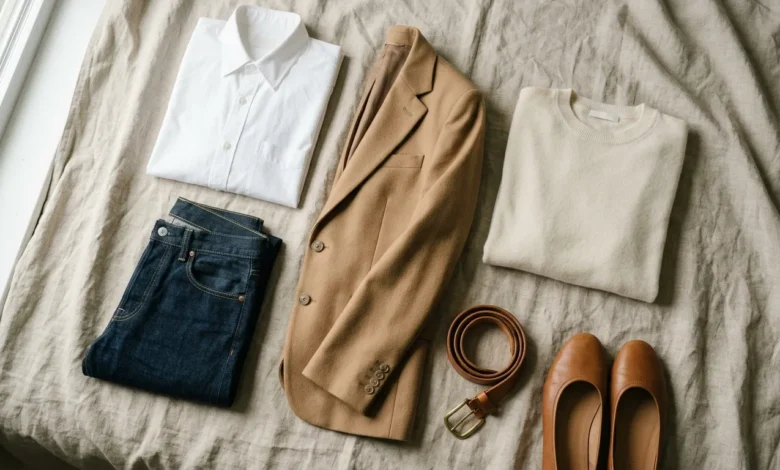
Five pieces form the structural core: a white cotton poplin shirt, straight-leg dark denim, a tailored blazer, a neutral midi skirt, and a reliable trench coat. The full checklist above builds out from that core to about 20 pieces across tops, bottoms, dresses, layers, shoes, and accessories.
How many clothes do you actually need for a functional wardrobe?
Fewer than most closets hold. The ClosetMaid survey found an average of 103 items per closet with 12 percent never worn, so volume clearly is not doing the work. About 20 tested pieces covers most weeks; the exact number should fall out of your audit, not a rule.
How do I transition wardrobe essentials between seasons?
Change weight and footwear, not the whole list. A tissue-weight merino layer at 120 to 150 GSM under the same poplin shirt reads as fall, closed-toe shoes replace sandals, and deeper tonal colors do the rest. The pieces stay; the proportions shift.
How do you mix and match wardrobe basics effectively?
Keep roughly 70 percent of the outfit in your neutral base and let one piece carry the contrast, either through color or texture. Pairing a crisp poplin with a soft merino knit adds depth without adding color, and splitting proportions a third to two-thirds keeps silhouettes from looking cut in half.
Is a complete women’s wardrobe essentials guide the same thing as a capsule wardrobe?
Related, not identical. The essentials are the pieces themselves, while a capsule is a size limit and a method for rotating them. Build the essentials first, then apply a capsule structure if a hard number keeps your buying honest.
Where to Start This Weekend
Do the audit on Saturday. It takes an afternoon and it is the only step that costs nothing. Then pick the single gap that would unlock the most outfits you already half-own, and fill one gap per month at the quality level the cost-per-wear math supports.
A complete women’s wardrobe essentials guide is not a list you finish. It is a standard you keep, and the closet that results is quiet in the best way: nothing shouting, everything working.
Sources
Official Sources
- Federal Trade Commission: Care Labeling of Textile Wearing Apparel & Certain Piece Goods (16 CFR Part 423), Access Date: August 7, 2026
Research Sources
- Ellen MacArthur Foundation: A New Textiles Economy: Redesigning Fashion’s Future, Access Date: August 7, 2026
- The Journal News (USA Today Network): Women come out of the closet in a new survey (ClosetMaid, 1,000 women), Access Date: August 7, 2026
Industry Sources
- Donna Karan: Our Brand (Seven Easy Pieces, 1985), Access Date: August 7, 2026
- Vogue: Donna Karan on Her Favorite Pieces From Her Career, Access Date: August 7, 2026
- Susie Faux: Confidence Tricks from Susie Faux of Wardrobe, Access Date: August 7, 2026
Additional Reading
- New York Post: Cost per wear is the closet math social media swears by, Access Date: August 7, 2026