Scroll any lingerie site for two minutes and you will meet a teddy, a chemise, a bustier, and a babydoll, none of them defined, all of them priced. The types of lingerie collected their names over roughly a century of fashion, and the labels genuinely mean different things, even when two pieces look alike on the hanger.
The confusion costs real money. A bustier bought for waist shaping will not shape your waist, because that was never its job. A polyester satin chemise bought for the feel of silk will sleep hot. Naming is not marketing fluff here. It is the difference between buying the right garment and buying the right photograph.
This guide sorts the whole category into four families, explains the job each style actually does, and says plainly which pieces earn permanent drawer space and which are fine to skip.
The types of lingerie sort into four families: 1) everyday foundations (bras, panties, hosiery), 2) sleepwear (babydolls, chemises, nightgowns, pajama sets), 3) one-pieces (teddies, bodysuits, slips), and 4) structured pieces (corsets, bustiers, garter belts). A functional drawer starts with foundations, adds two sleepwear pieces you will actually sleep in, and treats structured lingerie as occasion wear.
The Types of Lingerie, Sorted Into Four Families
Every piece you have ever seen, from a cotton bralette to a steel-boned corset, lands in one of four families. The family tells you the job. The style name tells you the cut.
| Family | What is in it | The job it does | When it earns space |
|---|---|---|---|
| Everyday foundations | Bras, bralettes, panties, hosiery | The daily layer under clothing, comfort and support first | Always, and this is where most of the budget should go |
| Sleepwear | Babydolls, chemises, nightgowns, pajama sets, camisoles | What you actually sleep and lounge in | Two or three pieces you genuinely reach for |
| One-pieces | Teddies, bodysuits, slips | One garment replacing a top-and-bottom pairing | One or two, for occasions or specific outfits |
| Structured pieces | Corsets, bustiers, garter belts, shapewear | Shaping, lift, or holding up stockings | Occasion wear, for most people |
The budget logic follows the families. Foundations deserve the largest share, sleepwear a real one, and the structured family a single occasion purchase until you know you love wearing it.
Everyday Foundations: Bras and Panties
Foundations are the largest slice of the category by a wide margin. Bras alone held more than 61.8 percent of the U.S. lingerie market in 2024, according to Grand View Research, which is why this is the one family where fit effort pays for itself.
The bra styles worth knowing
Six cuts cover nearly every outfit you own.
- T-shirt bra. Molded, seamless cups that disappear under knits and jersey. The default workhorse.
- Bralette. Wireless and unlined, cut like a small top. Comfort-first, with light shaping only.
- Balconette. Cups that run straight across and lift from below, made for square and boat necklines.
- Plunge. A deep center gore that stays hidden under V-necks and wrap dresses.
- Push-up. Padding set at an angle to push the bust up and inward. A look, not a necessity.
- Strapless. All of the support lives in the band, so fit matters twice as much here.
Panties, sorted by coverage
- Brief. Full coverage in the back, sitting at or near the natural waist.
- Bikini. Narrower sides and a lower rise, the middle ground of the group.
- Boyshort. Borrowed from menswear trunks, covering the hip fully.
- Thong. Removes visible panty lines under thin fabrics. A tool, not a mandate.
- High-waisted. Rises to the smallest part of the waist and smooths without any shapewear compression.
The fit problem no size label solves
The most repeated number in lingerie says 80 percent of women wear the wrong bra size. Its actual origin is a 2008 study of 30 women published in Chiropractic & Osteopathy, in which 70 percent wore bras that were too small and 10 percent too large. Thirty people is not a census, and the statistic deserves that asterisk. The direction still matches what professional fitters report every day: most people self-select a band or cup that is off, usually a cup that is too small.
Part of the problem is that real size ranges are enormous and labels are not universal. Frederika Zappe, the national fit specialist at Wacoal Europe, has spent roughly 25 years fitting across lines that run from A to K cups and band sizes 28 to 56. Your labeled size is a starting coordinate, not an identity. Measure your underbust and fullest bust, try the nearest size plus one sister size, and judge by the band, which should carry most of the support without digging.
Sleepwear: Babydolls, Chemises, and the Names Around Them
Sleepwear is where the naming confusion peaks, because three or four styles can look nearly identical in a thumbnail and behave differently on the body.
Babydoll vs. chemise
The babydoll is fitted through the bust and then flares out from an empire seam just below it, usually landing between mid-hip and upper thigh, and it typically arrives with a matching panty. The chemise has no waist seam at all. It hangs straight from the shoulder and skims the body to the thigh, closer to a slim slip dress.
The practical difference is what the flare does. A babydoll swings with you and forgives the midsection. A chemise reads sleeker and shows more of your actual shape. Neither is the sexier choice by default. They are simply different amounts of reveal.
Babydoll vs. chemise at a glance
- Babydoll: empire seam, flared skirt, forgiving through the middle
- Chemise: straight cut, body-skimming, longer and sleeker line
- Shared territory: silk, satin, or mesh, and both work as sleepwear or occasion wear

Negligees and peignoirs
A negligee is the dressier end of sleepwear: sheer or semi-sheer, often trimmed in lace, cut like a gown rather than a slip. The peignoir is its companion piece, a sheer robe worn over the top. The name comes from the French verb for combing the hair, because the original peignoir was a dressing-room layer worn while brushing it. Of everything in this guide, the peignoir is the one I would call strictly optional. It is a robe moment, and either you love a robe moment or you will never put it on.
Camisoles, slips, and the pieces that double as clothing
A camisole is a sleeveless strappy top that works as sleepwear, loungewear, or a layer under open shirts. A slip is the dress-shaped underlayer that keeps skirts from clinging and static from ruining a hemline, and the bias-cut version has moonlighted as outerwear since the 1990s. For actual sleeping, fabric matters more than cut, and this is where cotton and modal beat satin every time. Our breathable fabric guide covers why breathability changes how a whole night feels.
One-Piece Lingerie: Teddies and Bodysuits
A teddy combines a camisole top and a panty bottom into a single garment, usually in lace or sheer mesh. The silhouette is older than the name: it descends from the envelope chemise of around 1911, which replaced the separate bra and panties with one layer, per the Vintage Fashion Guild.
The bodysuit is its practical cousin. Cut to be worn under clothing as much as out of it, it smooths a top into a clean line, and brands like SKIMS have turned it into a wardrobe staple in its own right. The honest trade-off with both is plumbing: a one-piece means snaps or hooks at the bottom, and bathroom logistics are worth a thought before you buy. Some people find the trade completely worth it for the no-gap, no-untuck line. Others try one teddy and decide separates were fine.
Structured Pieces: Corset vs. Bustier, Plus the Garter Belt
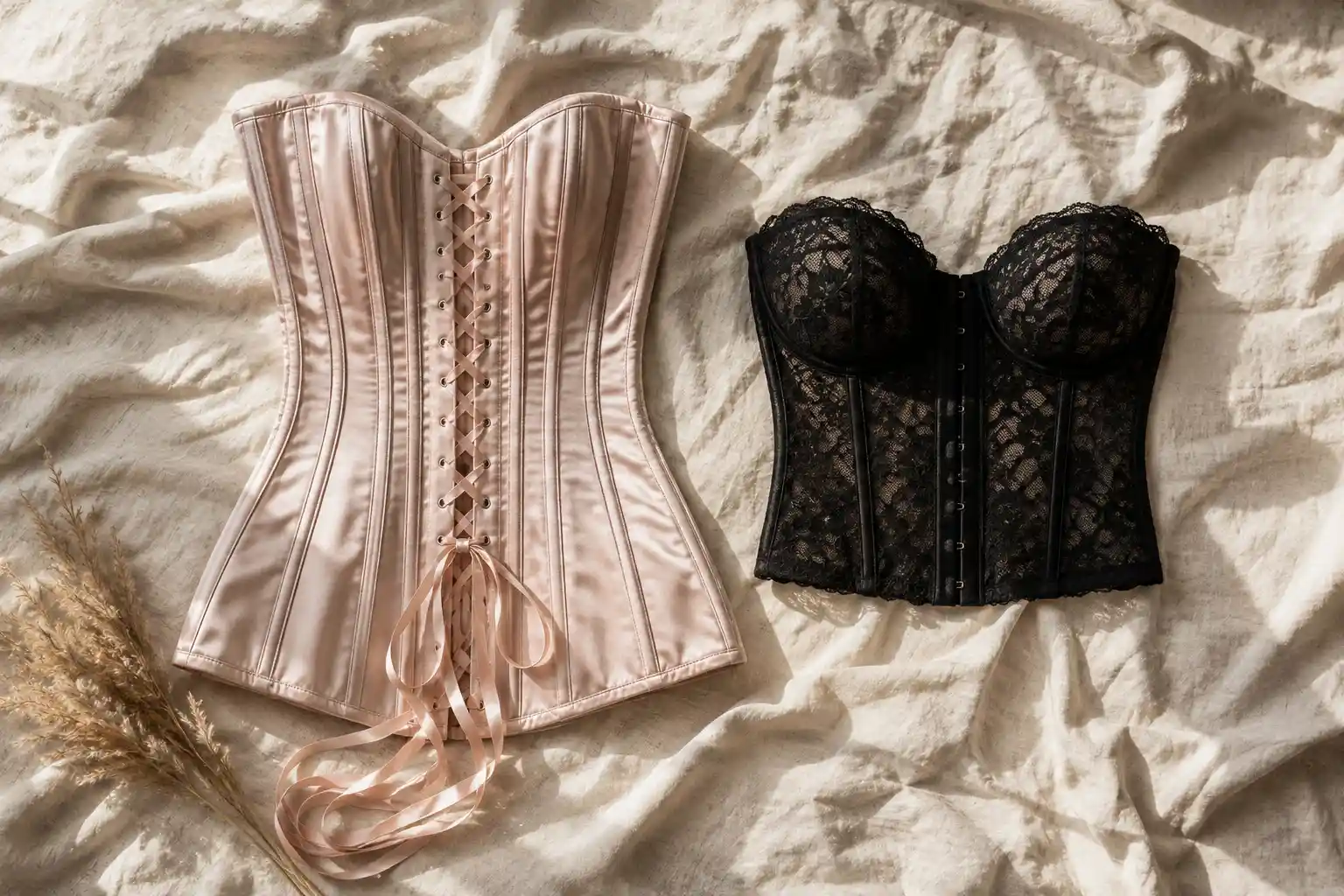
This is the most confused pair in lingerie. The difference is mostly length and boning, and it decides what each piece can actually do.
| Corset | Bustier | |
|---|---|---|
| Where it ends | Extends over the hips | Stops at the waist or just below the ribs |
| Boning | Rigid steel, built to hold a shape | Lighter plastic or spiral bones that keep fabric smooth |
| Closure | Back lacing, adjustable inch by inch | Hook-and-eye, like a bra |
| Main job | Shaping the waist | Lifting the bust and smoothing the torso under strapless clothing |
| How people wear it | As a foundation layer, or as outerwear over shirts and dresses | Under strapless dresses, or alone as a going-out top |
The garter belt is simpler than its reputation: a waistband with adjustable clips that hold up stockings instead of relying on silicone bands. It belongs to the hosiery family more than the shaping one.
Shapewear, the modern branch of this family, runs from high-waisted shorts to full bodysuits and works by compression. It is a legitimate tool for a smooth line under a specific dress, and it is not a daily obligation. Waist definition that lives in the garment, like a wrap tie or a belted line, tends to outlast anything that depends on squeezing.
Fabric: The Part That Decides Whether You Will Wear It
Cotton remains the everyday default, and the market agrees: Fortune Business Insights projects cotton will hold about 37.7 percent of the lingerie market in 2026. It breathes, washes easily, and survives daily rotation.
Modal and micromodal, made from beechwood pulp, drape softer than cotton and wick moisture, which is why they dominate the better sleepwear lines.
Silk is the temperature regulator: cool to the touch, warm in winter, and genuinely durable if you respect the care label. Weight is told in momme, where one momme equals about 4.34 grams per square meter. For sleepwear, 19 momme is the accepted minimum for real quality, 22 momme is the comfortable middle at roughly 95 grams per square meter, and 25 and up gets noticeably heavier. The catch is care: hand washing, or a mesh bag on a delicate cycle, always.
Satin is a weave, not a fiber, which is why the tag matters so much. The FTC’s Textile Rules require the actual fiber on the label, so check it: a silk satin breathes and a polyester satin traps heat, and the two look nearly identical in a product photo.
Lace and sheer mesh are the decorative workhorses. The quality tell is lining. Lace that sits against skin should be lined or backed, because scratchy unlined lace is the single most common reason a pretty set stops getting worn.
Matching Styles to Your Body, Loosely
Treat these as starting points, not laws, because fit within a style beats the style itself. If you do not know your shape yet, our four-step body shape guide sorts it quickly.
- Pear, narrower shoulders with fuller hips: babydolls that flare from the bust balance the silhouette, and boyshorts cover the hip without cutting in.
- Hourglass: bustiers and corsets follow the waist instead of fighting it, and high-waisted briefs land where your waist actually is.
- Apple, fuller through the middle: empire-line babydolls and looser chemises skim rather than grip.
- Rectangle: pieces with ruching, wrap ties, or a belt suggest a waistline the way tailoring does.
And the universal rule from foundations applies everywhere else: a comfortable cut you reach for beats a flattering cut you avoid.
What Is Worth Owning and What You Can Skip
The honest drawer math, the same pass-every-test logic we apply in the wardrobe essentials fit guide: three to five bras that fit, a week’s rotation of cotton or modal panties, two sleepwear pieces you actually sleep in, and one special-occasion set. That is a complete lingerie wardrobe. Everything beyond it is preference, not necessity.
Skip the matching-set obligation, because separates that coordinate count. Skip dry-clean-only silk if you know you will not hand wash it. Skip heavy shapewear bought on hope rather than for a specific dress. And skip any style chosen purely because the product photo is good, which brings us back to where this article started.
Three Situations, Three Shopping Lists
If you are starting from zero
Foundations first: two bras that fit, one everyday and one for thin fabrics, five to seven panties, and one camisole or cotton nightgown. Nothing structured until the basics prove themselves.
If you are shopping for a wedding night or anniversary
One special-occasion set in a fabric you already know you like, whether that is a silk chemise, a lace teddy, or a bustier under something else. Buy it at least a week early so sizing surprises happen before the date instead of on it. For a wedding, the same rule applies with white or ivory swapped in.
If comfort is the entire point
Cotton or modal bralettes, briefs or boyshorts, and a loose nightgown or pajama set, with zero structured pieces. Comfort-first lingerie is not a lesser category. It is the one you live in.
Frequently Asked Questions About Types of Lingerie
What is the difference between a babydoll and a chemise?
A babydoll is fitted at the bust and flares from an empire seam just below it, usually with a matching panty, while a chemise hangs straight from the shoulder with no waist seam and skims the body to the thigh. The babydoll forgives the midsection, and the chemise shows more of your natural line.
What is a teddy in lingerie?
A teddy is a one-piece garment that combines a camisole-style top and a panty bottom, usually in lace or sheer mesh. It descends from the envelope chemise of the 1910s and is worn as lingerie rather than under clothing, which is the main thing separating it from a bodysuit.
What is the difference between a corset and a bustier?
A corset extends over the hips, uses rigid steel boning, and closes with back lacing so it can genuinely shape the waist. A bustier stops at the waist or ribs, uses lighter boning and hook-and-eye closures, and its job is lifting the bust and smoothing the torso under strapless clothing.
What are the most popular types of lingerie?
Bras are by far the largest category, holding more than 61.8 percent of the U.S. market in 2024 according to Grand View Research, with cotton the leading fiber. Among fashion pieces, bralettes, lace sets, and bodysuits are the current staples, while corsets cycle in and out with trends.
What type of lingerie is best for a wedding night?
The style you will actually feel like yourself in, with the size confirmed ahead of time. A silk chemise or slip if you want soft and romantic, a lace teddy or babydoll if you want more structure and reveal, and a bustier if the outfit over it is strapless. Fabric comfort beats novelty on the night.
Where to Start
The types of lingerie stop being intimidating once each piece is sorted by its job: foundations support, sleepwear sleeps, one-pieces streamline, and structured pieces shape or lift for an occasion. Start with the family your drawer is missing, buy one good piece at a time, and let the care label matter more than the product photo. A lingerie drawer is a small wardrobe, and it deserves the same fit-first logic as the big one.
Sources
Official Sources
- eCFR: Textile Fiber Products Identification Act Rules, 16 CFR Part 303, Access Date: August 13, 2026
Research Sources
- National Library of Medicine, PubMed Central: Breast size, bra fit and thoracic pain in young women, Wood et al., 2008, Access Date: August 13, 2026
Industry Sources
- Grand View Research: U.S. Lingerie Market Size & Trends Report, Access Date: August 13, 2026
- Fortune Business Insights: Lingerie Market Size, Share & Trends Report, Access Date: August 13, 2026
- Vintage Fashion Guild: Lingerie Resource: Chemise and Teddy, Access Date: August 13, 2026
- Lingerie Briefs: Bra Fitting 101: Freddy Zappe Shares Her Expert Advice, Access Date: August 13, 2026
- Shadowline: Peignoirs: The History of One of Lingerie’s Most Glamorous Styles, Access Date: August 13, 2026
Additional Reading
- Marelia: Chemise vs Nightgown vs Babydoll, What’s the Difference?
- Hanky Panky: What Are Bodysuits and Teddies and How to Wear Them
- Angela Friedman: Lingerie Terminology: A Glossary