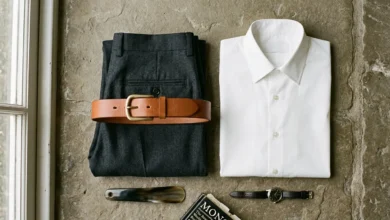
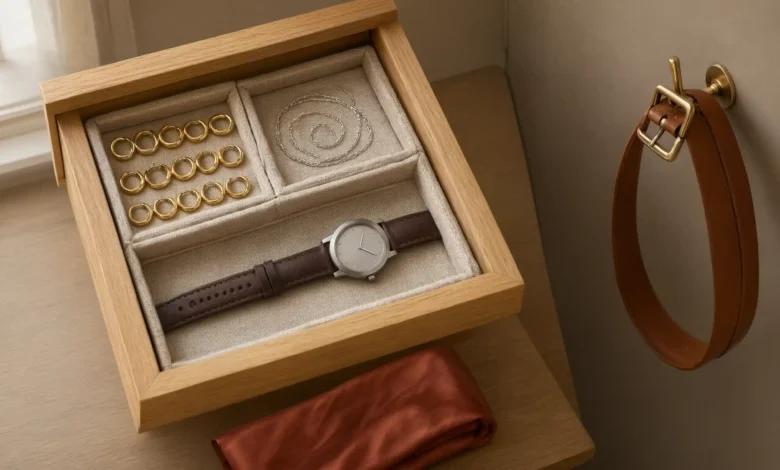
Open the average accessory drawer and you will find a tangle of three necklace chains, a belt rolled into a spiral, one earring from a pair, and a scarf last worn in 2023. Almost none of it is bad. Almost all of it is invisible, unmatched, and forgotten, which is why so many people who own plenty of accessories still feel like they own nothing.
The pieces are usually fine. What fails is the buying pattern, one piece at a time with no plan for how anything works together, so the good stuff sits in storage instead of in rotation. That gap is exactly what how to build an accessories system addresses, taking the same jewelry, belts, bags, and scarves and reorganizing them around a few fixed decisions so they finally get worn.
The five steps below run in a specific order. The audit comes before any shopping, the constants come before the roles, and the storage comes before the rotation rules. By the end you will have a smaller collection that gets worn more.
To build an accessories system, follow five steps in order: 1) pull every accessory into one pile and audit it, 2) set three constants, one dominant metal, one leather neutral, and two accent colors, 3) fill four roles, everyday anchors, bridge pieces, statement pieces, and occasion pieces, 4) store everything where your eyes land using dividers, hooks, and a staging rod, and 5) maintain the system with a one-in-one-out rule and a 30-wear test for new buys.
The Difference Between a Collection and a System
A collection accumulates. A system is built on purpose, around a small number of decisions you make once so you do not have to make them every morning. The shift matters because it changes what you buy, what you keep, and where things live.
Collection vs. system, at a glance
- Collection: bought one impulse at a time, stored out of sight, judged by how much you like each piece alone.
- System: planned as a coordinated set, stored in view, judged by how many outfits each piece completes.
None of this requires owning fewer things, although it usually ends there. It requires that each new piece passes a test before it enters the rotation, and that everything already in the rotation can be seen, reached, and paired.
Step 1: Audit Every Accessory You Own Before Buying Anything
Empty every drawer, box, and hook into one pile on a bed or table. Jewelry, belts, scarves, bags, watches, hats, all of it, including the pieces stored in the bathroom and the ones living in a coat pocket. The pile is the point. Most people have never seen their entire accessory inventory in one place, and the surprise of its size does more persuasive work than any advice in this article.
Sort the pile into three groups as you go: worn in the last three months, kept for sentiment, and everything else. The first group is the seed of your system. The sentimental group gets an honest home, a labeled box if it truly matters, a goodbye if it only matters as an idea. The third group is your exit pile, and reselling or consigning the better pieces funds what comes next.
Do not buy a single organizer or new accessory until this audit is done. Storage bought before an audit is just a nicer home for pieces you never wear, which is the same reason our guide to building a wardrobe from scratch starts with an honest inventory of the closet itself.
Step 2: Set Three Constants Before You Add a Single Piece
A system needs fixed points, decisions made once so daily choices get faster. For accessories, three constants do most of the work.
One Dominant Metal, One Supporting Metal
Pick the metal that matches what you already wear, gold, silver, or a warm neutral like brushed brass, and let it take roughly 70 percent of your jewelry. The remaining 30 percent can be a second metal, enough contrast to feel intentional without tipping into clutter. Our guide on how to mix gold and silver jewelry covers the ratio in depth, including why an even split reads as an accident, and the same logic scales from one outfit to an entire collection.
One health note belongs in this decision. Nickel is the most common contact allergen, with an average sensitivity frequency of 17.5 percent across two decades of patch-test data compiled in StatPearls at the National Library of Medicine. If your ears flare up around mystery metal, the audit is the moment to learn which pieces are surgical steel, titanium, or high-karat gold, and which are plated base metal wearing a costume.
One Leather Neutral
Belts and bags multiply fast when each one is a different color, so choose a dominant leather neutral, black, cognac, taupe, or chocolate, and let it anchor both categories. A cognac belt and a cognac crossbody read as a decision, while five unrelated browns read as noise. If you are still deciding which bag shapes deserve the slot, our handbag buying guide runs the cost-per-wear math on the four shapes that actually rotate.
Two Accent Colors
Scarves, statement pieces, and bag charms carry color, so limit them to two accent colors that already exist in the clothes you wear most. This is what lets a scarf tie a whole outfit together instead of floating beside it. If your closet runs navy, cream, and denim, a rust and olive accent pair will work every time, and a neon that matches nothing stays in the exit pile.
Step 3: Fill the Four Roles Every Rotation Needs
With the constants set, every accessory you own or buy has one of four jobs. Naming the jobs is what stops the drawer from refilling with pieces that have none.
| Role | What it does | Typical pieces | Where the budget goes |
|---|---|---|---|
| Everyday anchors | Finish an outfit without leading it, the pieces you put on without thinking. | Small hoops or studs, a thin chain, one everyday watch, a plain leather belt in your neutral | Spend here first. At 100-plus wears a year, a 60 dollar belt costs less per wear than a 15 dollar trinket worn twice. |
| Bridge pieces | Connect your two metals or your two accents so the rest of the collection can mix. | A two-tone watch, a tan-and-black strap bag, a scarf printed in both accent colors | One or two is plenty. More bridges than destinations is how drawers get crowded. |
| Statement pieces | Provide the one loud note in an outfit while everything else goes quiet. | Sculptural earrings, a bold cuff, a printed silk scarf worn at the neck | Buy rarely and on purpose. A low wear count is the fair price of personality, not a failure. |
| Occasion pieces | Work events only, weddings, galas, funerals. They live outside the daily rotation and outside the wear test. | An heirloom brooch, a formal clutch, a pearl strand | Do not budget from the system at all. These follow the rent-versus-buy logic of formalwear, not capsule math. |
The ratio between roles matters more than the total count. A workable starting system runs roughly six to ten anchors, two bridges, two or three statements, and whatever occasion pieces the sentimental audit spared. If that sounds sparse, remember that ten anchors rotating through your wardrobe produce more distinct outfits than forty solo pieces that never meet.
Belt wearers should note that proportion, not habit, decides when a belt helps. Our guide to when to wear a belt covers the waistline logic, and the short version is that a belt in your leather neutral earns its keep when it closes a color loop or defines a waistline the garment left open.
Step 4: Store Everything Where Your Eyes Land
Visibility is the mechanism the whole system runs on. Home-organization expert Ope Omojola told The Strategist that she keeps “as much of my jewelry as possible visible so that when I’m getting dressed and picking out jewelry, it’s right there.” A piece you cannot see is a piece you will not wear, and storage that hides your best work is working against you.
Match each category to a visible home:
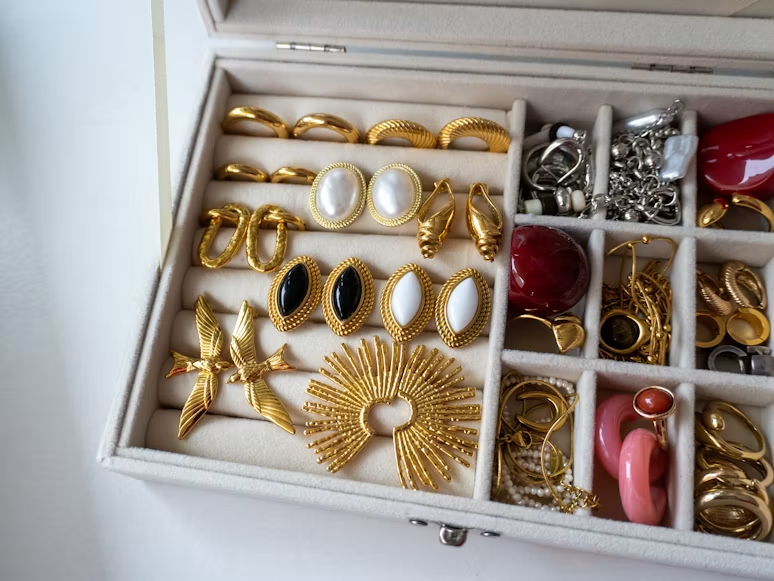
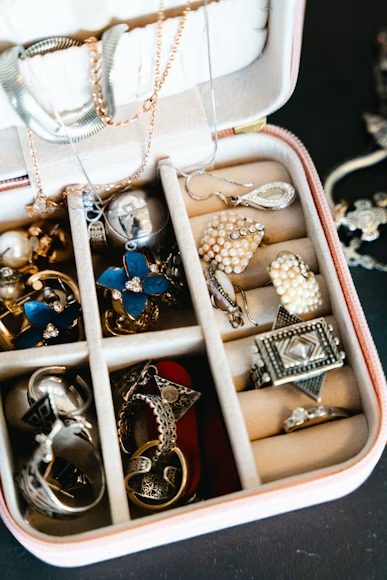
- Jewelry gets a shallow drawer with dividers, or stackable trays on an open shelf. The Strategist’s testing landed on Stackers’ modular trays, which run about 28 to 40 dollars per component, precisely because the neutral lining and open layout keep every piece in view.
- Hang belts on hooks inside the door, or roll them into an open basket rather than burying them under folded knits.
- Scarves do well folded into a visible row with the prints facing out, or hung from a ring.
- Bags sit upright on a shelf, stuffed to hold their shape, handles forward.
- For tomorrow, stage the full look tonight, accessories included, on a valet rod, the pull-out hanging rod closet companies add for exactly this purpose.
The valet rod is the quiet workhorse of the setup. Closet America describes it as a temporary hanging station rather than a replacement for your main rod, and that is the right mental model: it holds the decision you made tonight so tomorrow you only have to execute it.
Step 5: Maintain the System With Two Rules
A system without maintenance is a pile with a waiting period. Two rules keep the rotation honest.
One In, One Out
When a new accessory enters, an existing one leaves, donated, sold, or gifted. Jamie Hord, founder of Horderly Professional Organizing, recommends the rule in Reader’s Digest as the guard against overflow, and it works for accessories for the same reason it works for clothes: the drawer has a physical size, and the rule makes every new piece name its replacement.
The 30-Wear Test
Before any non-replacement purchase, ask the question Livia Firth posed when she and journalist Lucy Siegle launched the 30 Wears Challenge in 2015: “Will I wear it a minimum of 30 times?” For accessories the test is even more revealing than for clothing, because statement pieces lie to you at the register. A 90 dollar belt worn 90 times costs a dollar a wear. A 40 dollar novelty cuff worn four times costs ten dollars a wear. Neither purchase is automatically wrong, but only one of them belongs in the everyday system.
Occasion pieces are exempt, deliberately. A wedding clutch bought for two wears a year is not failing the test, it has a different job, the same logic our summer wedding guest guide applies to formal dresses. What the test forbids is buying occasion-priced pieces on an everyday excuse.
Who This System Will Not Help
Three honest exclusions. If a workplace or uniform dress code decides your accessories for you, the system shrinks to whatever the code allows, and your energy is better spent on the two or three pieces the code leaves open. If you genuinely love maximalist variety and rotate dozens of pieces happily, you do not need a system, you need better storage, and Step 4 stands on its own. And if your budget is tight right now, skip buying entirely: the audit, the constants, and the visibility pass cost nothing and will usually surface enough unworn pieces to feel like a new collection, the same starting point our minimalist wardrobe guide recommends.
Starting Points That Change the Plan
If You Are Starting From Almost Nothing
Begin with the constants, not a shopping list. One pair of small hoops or studs in your dominant metal, one plain belt in your leather neutral, and one bridge scarf cover the first month of the system for well under 100 dollars at most retailers. Add anchors first and statements last, and let real outfits tell you which role is actually empty instead of guessing in a store.
If You Own Too Much Already
Your audit exit pile is the budget. Consign the better pieces, gift the rest, and spend the proceeds only on the role gaps the audit exposed, typically anchors and bridges, since most overfull drawers are heavy on statements. Expect the system to feel smaller for two weeks and then faster forever.
If Your Style Is Mid-Change
Keep the constants loose while your aesthetic is moving. Choose a dominant metal you already wear rather than the one your future self might prefer, and let the accent colors follow the clothes you actually bought this season. A system built on a fantasy wardrobe fails the same week it is installed.
Frequently Asked Questions About Building an Accessories System
What is an accessory capsule wardrobe?
A small, coordinated set of accessories chosen to work with everything you wear, usually built around a dominant metal, a leather neutral, and a couple of accent colors. It is the accessory half of a clothing capsule, and the same audit-first logic applies.
How do you organize jewelry in a closet?
Give jewelry a shallow, divided home at eye level: a drawer insert with compartments, stackable trays on an open shelf, or hooks for necklaces on the inside of a door. The requirement is visibility, one layer deep, so no piece hides under another.
Are pull-out jewelry organizers worth it?
Yes, when they keep pieces visible in one layer. Modular tray systems like Stackers earn their 28 to 40 dollars per component because you buy only the trays your collection needs and can see everything at once. A pull-out organizer that stacks pieces three deep is just a drawer with extra steps.
How many accessories should a capsule wardrobe include?
A workable first system runs about six to ten everyday anchors, two bridge pieces, and two or three statement pieces, plus occasion pieces stored separately. The count is a byproduct of the audit and the four roles, not a target to hit.
How long does it take to build an accessories system?
The audit takes one afternoon, the constants take a week of noticing what you actually reach for, and the storage setup takes an hour once the exit pile is gone. Most people have a functioning system inside two weeks without buying anything new.
Start With the Pile
Every durable accessory collection we have ever admired, on a colleague or a grandmother, was a system in disguise: a small set of constants, repeated until it looked like personality. Building yours is mostly subtraction, one honest pile, three constants, four roles, visible storage, and two rules. Run the audit this weekend, before any shopping tab is open, and let the rotation tell you what it is missing. That is the whole of how to build an accessories system, and the quiet payoff is that getting dressed stops being a negotiation with a drawer.
SOURCES
- National Library of Medicine (NIH): Nickel Allergy, StatPearls, Access Date: August 18, 2026
- Harper’s Bazaar UK: From 30 Wears to 30 Years: How Long Should Our Clothes Last?, Access Date: August 18, 2026
- Refinery29: Livia Firth Interview About Sustainable Fashion and Eco-Age, Access Date: August 18, 2026
- New York Magazine, The Strategist: The Best Jewelry Boxes and Organizers, Access Date: August 18, 2026
- Reader’s Digest: How to Clean Out Your Closet, Access Date: August 18, 2026
- The Spruce: The Best Jewelry Organizers to Protect and Display Your Collection, Access Date: August 18, 2026
- Closet America: What Is a Valet Rod? Reasons Why Valet Clothing Hanger Rods Work for Every Closet, Access Date: August 18, 2026