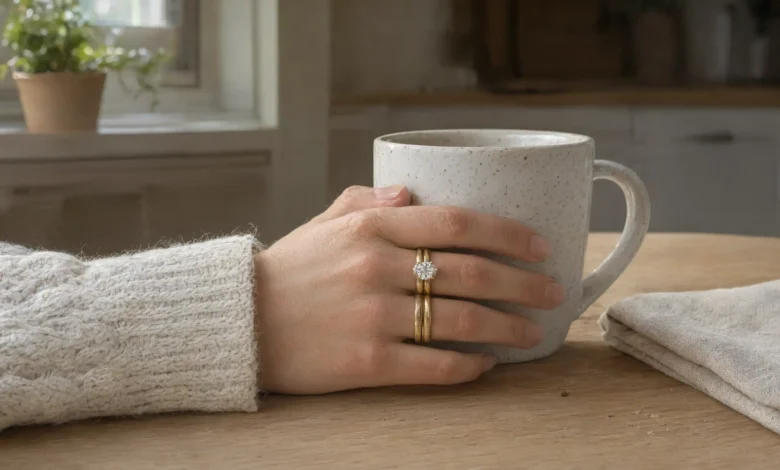
You put your rings on straight at eight in the morning, and by lunch the center stone is facing your palm again. One loose ring is annoying. Two or three rings knocking into each other rotate twice as fast, because each spinning ring drags its neighbor along.
Learning how to keep stacked rings from spinning starts with one honest observation: the stack is rarely the problem. Fit and balance are. Every fix below, from a strip of tape to a jeweler’s torch, is really a way of correcting one of those two things.
To keep stacked rings from spinning, match the fix to the cause: 1) confirm the fit with the shake test on a normal-temperature day, 2) resize down if the stack is genuinely too big, 3) add sizing beads when your knuckle is a size or more larger than your finger base, 4) use a removable ring guard for seasonal or temporary looseness, 5) solder the rings only if you already wear them together every day, and 6) rebalance a top-heavy stack with wider, lower, or contoured bands.
Why Stacked Rings Spin on Your Finger
There are two buckets of cause, fit and design, and they need different fixes. On the fit side, the culprit is usually the gap between your knuckle and the base of your finger. “One of the main reasons that a ring spins on the finger is because it’s too large,” says Vanessa Walilko, jeweler and owner of Kali Butterfly.
“Our knuckles are larger than the finger bones themselves. Sometimes that little bit of difference can mean that the size that you need for the ring to go smoothly over the knuckle is slightly too large for the finger itself.” A ring has to be sized for the widest point it crosses, which leaves slack at the base where it actually sits.
Finger size also moves around more than most people expect. Heat swells the fingers, cold shrinks them, and hydration and hormones shift the fit from week to week, which is why a stack that behaved all summer can spin the first cold week of fall. Mark Schneider Design notes that many wearers see noticeably more spinning in winter, and Borsheims, the Nebraska jeweler, treats loose winter rings as a seasonal norm rather than a defect.
On the design side, gravity does the dirty work. Ashley Taylor, co-founder and lead jewelry designer at Taylor Custom Rings, points out that a larger center stone set high on the finger tends to rotate toward the palm, and that a thin band under a heavy stone makes the imbalance worse.
Taylor also notes that thin bands simply spin more than wide ones, because a narrow shank has less surface contact to friction against the skin. Now add a second ring: two separate bands that each have a little slack will pivot independently, tap each other, and take turns rotating the whole stack. That is why the problem so often shows up only after the wedding band joins the engagement ring.
How Tight Should a Ring Stack Fit?
A well-fitting ring slides on easily but meets slight resistance over the knuckle, then sits snug at the base without pain, deep marks, or swelling, per Jewelers Mutual, the insurance company that handles more jewelry claims than most of us will ever file. The quick version is the shake test used by jewelers like Nazar & Co: hold your hand down at your side and give it a gentle shake. A correctly sized stack stays put or barely shifts. If it slides toward your fingertip or rotates freely, it is loose at the base, even if it feels fine while you are typing at a warm desk.
One caution before anyone touches a sizing tool: do the test on an ordinary day, not in January. Several jewelers, including Lisa Jewelry, warn that resizing during the cold months often produces a ring that spins once your fingers return to their warm-weather size. Size for your average finger, and manage the seasonal swings with something removable.
Same-Day Fixes and Their Honest Limits
If you need the stack to behave today, the removable options are genuinely good enough for what they are. Plastic and silicone adjusters wrap around the shank or sit inside the band, coil-style guards spiral onto the underside, and gold-filled guards clip to the inner band for a more stable hold. Walilko describes the polyurethane spacers and gold-filled guards as the quick fix for people who do not want to alter the ring permanently. The Knot’s roundup priced these anywhere from about 7 to 33 dollars depending on style, and while those figures shift with the market, the category still sits firmly under the cost of any jeweler visit.
The fully DIY versions work on the same principle with humbler materials: a strip of tape, a loop of elastic, dental floss, or fine wire wrapped around the underside of the shank until the ring sits snug. Walilko suggests precious metal wire if you go that route, since it will not irritate the skin the way a mystery alloy might.
Be clear about what you are buying, though. Tape adhesive breaks down with hand washing and leaves residue on the shank. Floss and elastic fray and go gray. Every one of these is a stopgap that holds a ring still for a day or a season, not a fix, and none of them helps a top-heavy stack whose problem is balance rather than size.
At a Glance
- Tape and floss: nearly free, invisible at a glance, defeated by one sink full of hand washing.
- Silicone or plastic adjuster: a few dollars, survives washing, adds a slight cushion you feel for the first week.
- Gold-filled clip-on guard: sturdier, clamps to the shank itself, still comes off at night.
The Jeweler Fixes That Actually Hold
When the spin is constant rather than seasonal, the durable answers live at the jeweler’s bench. They differ in cost, in reversibility, and in which cause they actually address.
Sizing Beads for the Knuckle Gap
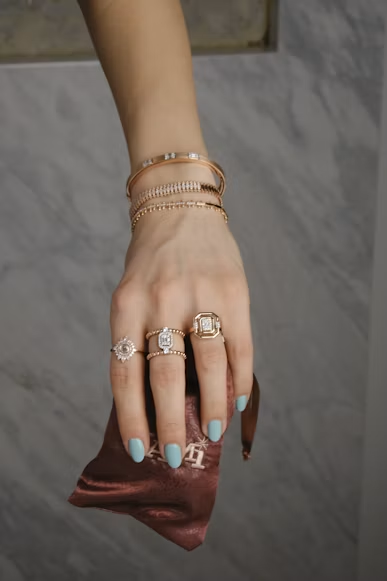
Sizing beads are two small balls of gold or platinum soldered to the inside of the band at the bottom curve. “Jewelers can insert a couple of small gold or platinum sizing beads into the inside of the band,” Taylor says. “This can allow the ring to slip over your knuckle and limit the spinning once it is on.” The beads create two gentle pressure points that hold the ring upright while the rest of the shank stays large enough to clear the knuckle, which is exactly the geometry problem a resize cannot solve.
They are also the standard answer for eternity bands, whose stones run all the way around the shank and usually rule out cutting the band down. Pricing runs from around 40 dollars at a repair shop like Quick Jewelry Repairs to 78 dollars in 14k gold and 156 dollars in platinum at Mira Jewelry Design, with Satinski quoting a broader 30 to 200 dollar range depending on the bench. If your size changes later, a jeweler can remove them.
Resizing Down When the Stack Is Truly Too Big
If the shake test says the stack is simply too large, after a weight change or a mis-sized purchase, cutting it down is the cleanest fix. A straightforward resize on a plain gold band typically runs 30 to 80 dollars, though intricate shanks can push the job much higher. Resizing has real limits, though.
Taylor cautions that it is difficult to size a ring down enough to stop spinning when the knuckle is dramatically larger than the finger base, and eternity bands again resist the saw. Some materials are outside the resizing world entirely: tungsten carbide cannot be cut and reformed at all, per Larson Jewelers, and carbon fiber rings are made in their final shape and cannot be resized, per Element Ring Co. Those rings get replaced in a new size, not adjusted.
Soldering, Only If You Wear Them Together Anyway
Soldering joins the rings at their meeting points with heat and a small amount of matching metal, turning the stack into one unified piece that holds its alignment and stops the two bands from grinding against each other. Justine Elliot, sales director at MiaDonna, puts the cost at over 100 dollars for a 14k solder and over 150 dollars for platinum, rising with intricate designs or mixed metals. It is reversible in theory, but separating soldered rings means melting the joint and carries a real risk of damage, so treat it as a decision, not a trial.
The trade-off is flexibility, and it is the whole ballgame. Marci Bailey, founder of Marcilla Bailey, is blunt about it: “I personally have never soldered my rings together because I was always somebody who wanted the flexibility of wearing them separately. But if you’re somebody that, day in and day out, year after year, you always wear them together, then yes, I think soldering them together is a great idea.”
Bailey also recommends wearing the rings together for a few weeks after the wedding before deciding, and Elliot notes that a soldered set comes out bulkier and may need a larger size to fit comfortably. Soldering is the right call for a confirmed, every-day, together-only stack. For anyone who likes the band alone on vacation weeks, it is a permanent answer to a temporary annoyance.
| Fix | Typical cost | Reversible? | Best when |
| Resize down | 30 to 80 dollars for a simple gold band | Yes, though repeated resizes weaken the shank | The stack is genuinely a half size or more too big |
| Sizing beads | 40 to about 160 dollars depending on metal | Yes, a jeweler can remove them | Your knuckle runs a size or more larger than your finger base |
| Store-bought guard or adjuster | Roughly 7 to 35 dollars for a pack | Fully, it slips off | Looseness comes and goes with weather or training |
| DIY tape or wire wrap | A few dollars at most | Fully | You need today to work and the jeweler visit is weeks away |
| Soldering | Over 100 dollars in 14k, over 150 dollars in platinum | Technically, but separation risks damage | You wear the rings together every single day |
| Hinged retrofit | 1,200 to 1,800 dollars and up, per Satinski | Yes, it is a separate device | A large knuckle gap on a ring you never want to feel loose |
How to Build a Stack That Stays Aligned
Fixes aside, some stacks spin less by construction. A contoured or curved band that nests against the center stone sits flush and resists rotation far better than a straight band leaving a wobbly gap. Wider shanks add friction and stability, which is Taylor’s point about thin bands spinning more.
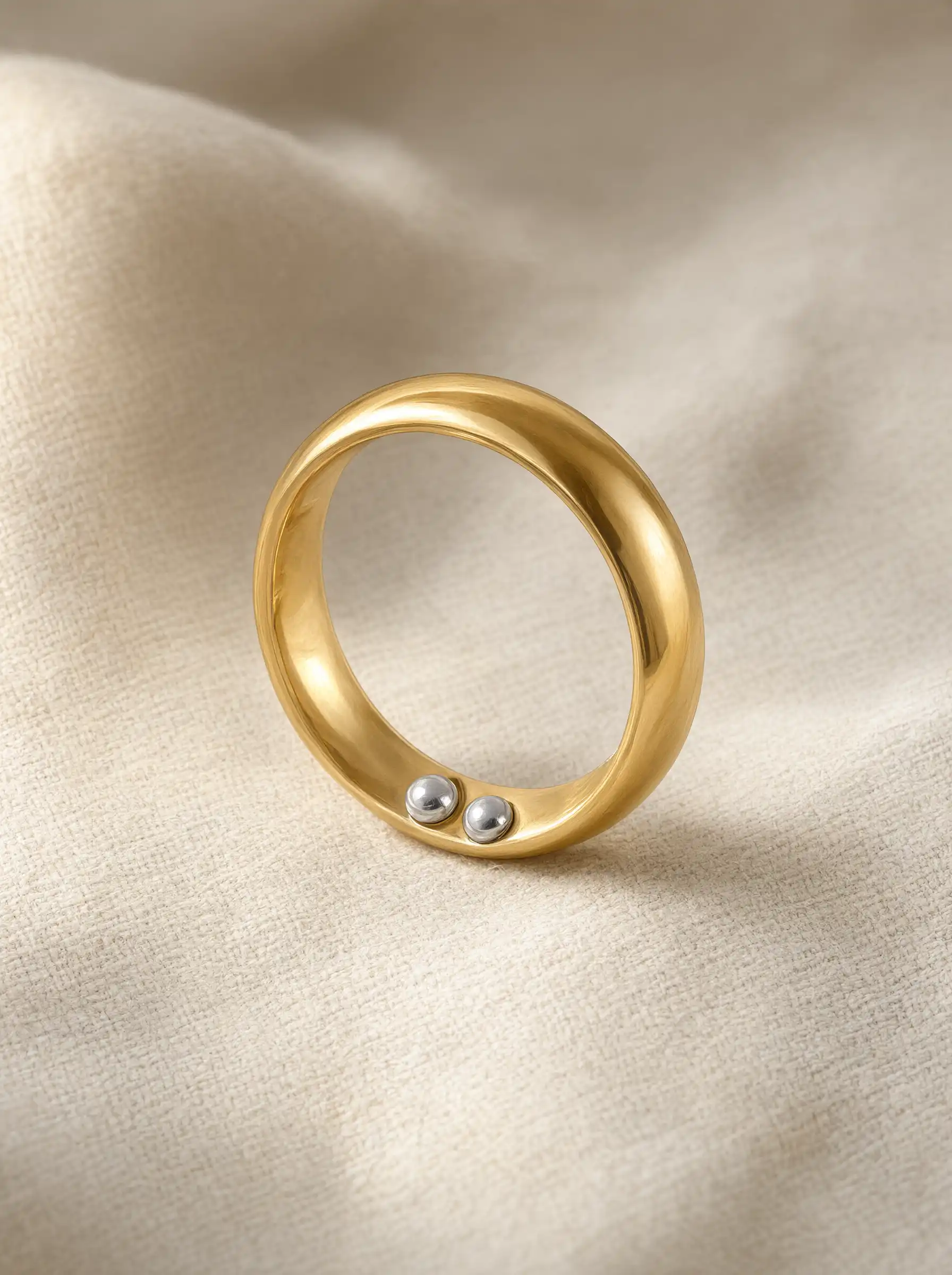
Matching profiles matters too: a flat-edged band paired with a domed one rocks and pivots, while two compatible profiles settle together. And if one ring in the stack is a tall, heavy statement piece, the physics argument says keep it the only loud note, with lower, quieter bands supporting it, the same one-loud-note logic we apply to statement earrings.
Metal choice is the quiet variable. Different metals wear each other down when they rub, which is one of the reasons jewelers cite for soldering mixed-metal pairs in the first place. If you want to keep the rings separate, either choose metals of similar hardness or accept that the softer band will show the friendship first. The same ratio thinking carries into color: a stack reads calmer and looks more intentional when it keeps one dominant metal at roughly 70 percent and lets a second metal accent it, the approach we recommend for mixing gold and silver jewelry generally.
When These Fixes Are the Wrong Move
Soldering is a poor fit for anyone who enjoys wearing the band alone sometimes, and for couples who may upgrade one ring later, since separation is risky and resizing a soldered set usually means taking it apart first. Sizing beads solve the knuckle gap but a small number of wearers simply notice the two bumps inside the band and never stop noticing them, in which case a removable guard is the better truce.
Resizing is the wrong move for a purely seasonal spin, because a ring sized in winter will swim by July. Tape and adjusters are the wrong move as a forever plan, because they manage a problem they never solve. And with tungsten or carbon fiber rings, the entire resizing branch of this article does not apply: the honest options are a guard, beads where the design allows, or a correctly sized replacement.
Choosing a Fix for Your Situation
- If your rings only spin in winter: keep the size and add something removable, like a clip-on guard or silicone adjuster, from November to March. Resizing to fix a cold-weather finger is how people end up with a loose summer ring.
- If your knuckle is a full size or more bigger than your finger base: sizing beads are the purpose-built answer, because they hold the base snug while the shank still clears the knuckle. A straight resize will either fail the knuckle or fail the base.
- If you wear the rings together every day and always will: soldering earns its place. Give it a few weeks of real wear first, per Bailey’s advice, and confirm the alignment looks right before the torch comes out.
- If the stack is top-heavy, with a tall stone on a thin band: no guard fixes gravity. Rebalance with a wider or contoured band, a lower profile, or move the heaviest ring to its own finger on busy days.
- If your size recently changed or is still changing: wait it out with a temporary adjuster and retest monthly. Committing to beads or a resize on a moving target means paying twice.
Frequently Asked Questions About Keeping Stacked Rings from Spinning
Why do my stacked rings keep spinning even though they fit?
Usually because they were sized to clear your knuckle, which leaves extra room at the base of the finger, or because a tall center stone makes the stack top-heavy and gravity rotates it. Two separate rings also push each other around, so a stack spins more than a single ring would.
How do you keep stacked rings from spinning without soldering?
Add sizing beads inside the band, clip on a removable ring guard or silicone adjuster, or have the stack resized down if it is genuinely too big. Choosing contoured bands that sit flush and wider, lower-profile pieces also reduces rotation without joining the rings.
Should I solder my engagement ring and wedding band together?
Only if you wear them together every day and do not expect to want them apart. Soldering keeps alignment and cuts friction wear, but it removes the option to wear one ring alone and makes future resizing harder, so jewelers recommend waiting a few weeks of real wear before deciding.
How much does it cost to add sizing beads to a ring?
Most jewelers charge between about 40 dollars and 160 dollars, depending on the metal, with platinum at the top of that range. That is usually less than a complex resizing, the shank is never cut, and a jeweler can remove the beads later if your size changes.
Can all rings be resized?
No. Tungsten carbide and carbon fiber cannot be resized at all, eternity bands with stones all the way around usually cannot be sized down, and soldered stacks are harder to resize because they often need separating first. Gold, silver, and platinum plain bands are the straightforward cases.
A Stack That Holds Its Place
A ring stack that stays put is mostly a fit decision with a little design support. Confirm the size with the shake test on a normal-temperature day, pick the least permanent fix that solves the actual cause, and save the torch for a stack you already know you will wear as one piece.
If you are still deciding what belongs in your rotation at all, our guide to building an accessories system covers the closet audit that should come before any purchase. The reliable answer to how to keep stacked rings from spinning is the unglamorous one: diagnose whether the cause is fit or balance, then fix that cause, not the symptom.
SOURCES
Industry Sources
- Jewelers Mutual: How Do I Know if My Ring Fits?, Access Date: August 23, 2026
- The Knot: Here’s How to Keep a Ring From Spinning on Your Finger, updated November 5, 2024, Access Date: August 23, 2026 (adjuster prices in this piece are from that edition and may have shifted)
- The Knot: Should You Solder Rings Together? Experts Weigh In, updated December 13, 2024, Access Date: August 23, 2026
- Nazar & Co: How Should Engagement Rings Fit?, Access Date: August 23, 2026
- Borsheims: How to Handle Loose Rings in the Cooler Months, Access Date: August 23, 2026
- Mark Schneider Design: What Causes Rings to Spin (and How to Fix It), Access Date: August 23, 2026
- Larson Jewelers: Can Tungsten Rings Be Resized?, Access Date: August 23, 2026
- Element Ring Co: Can Carbon Fiber Rings Be Resized?, Access Date: August 23, 2026
- Quick Jewelry Repairs: Ring Sizing Beads/Bar Service, Access Date: August 23, 2026
- Mira Jewelry Design: Ring Sizing Beads, Access Date: August 23, 2026
- Satinski: Ring Sizing: Beads, Hinges & Adjustable Costs, Access Date: August 23, 2026
Additional Reading
- Whiteflash: Do Ring Sizing Beads Actually Work?, Access Date: August 23, 2026
- Lisa Jewelry: Why Rings Feel Tighter in Winter and When It Is Not Sizing, Access Date: August 23, 2026