
Somewhere along the way, the silk scarf got typecast as a gift-box purchase, something you receive, admire, fold back into its tissue, and never actually wear. The people who wear one well treat it as working hardware instead. A single square of silk can be a necklace, a belt, a hair tie, a bag charm, or a top, and moving between those jobs is the entire point of owning one. If you have been searching how to style a silk scarf and bouncing between knot diagrams, the missing piece is usually not another knot. It is knowing which size and which weave does which job.
The piece has serious lineage. Hermès cut its first carré in 1937, a print called Jeu des Omnibus et Dames Blanches, and Grace Kelly, Audrey Hepburn, and Jacqueline Kennedy Onassis each made the headscarf part of their public uniform. That history is exactly why the scarf spent a decade reading as dated, and it is also why the current revival looks different. On the fall 2026 runways, Altuzarra draped oversized squares as tops and The Row cinched one at the hip like a belt, while on the street, Bella Hadid and Hailey Bieber have spent recent seasons in bandanas and wrap tops.
What follows is the nine placements that survive real life, the sizes and silk weights each one needs, and the care rules that keep the fabric from water-spotting into regret.
To style a silk scarf, choose the placement first and the knot second: 1) the European loop at the neck for polished days, 2) a loose side knot for softness, 3) a long unknotted drape over plain knits, 4) a headband, 5) a bun or ponytail wrap, 6) a full kerchief, 7) a bag handle wrap, 8) a faux belt threaded through loops, and 9) a bandana top for hot evenings. Match the size to the job, keep the print as the loudest thing in the outfit, and hand wash cool when it needs cleaning.
Know Your Scarf Before You Tie It
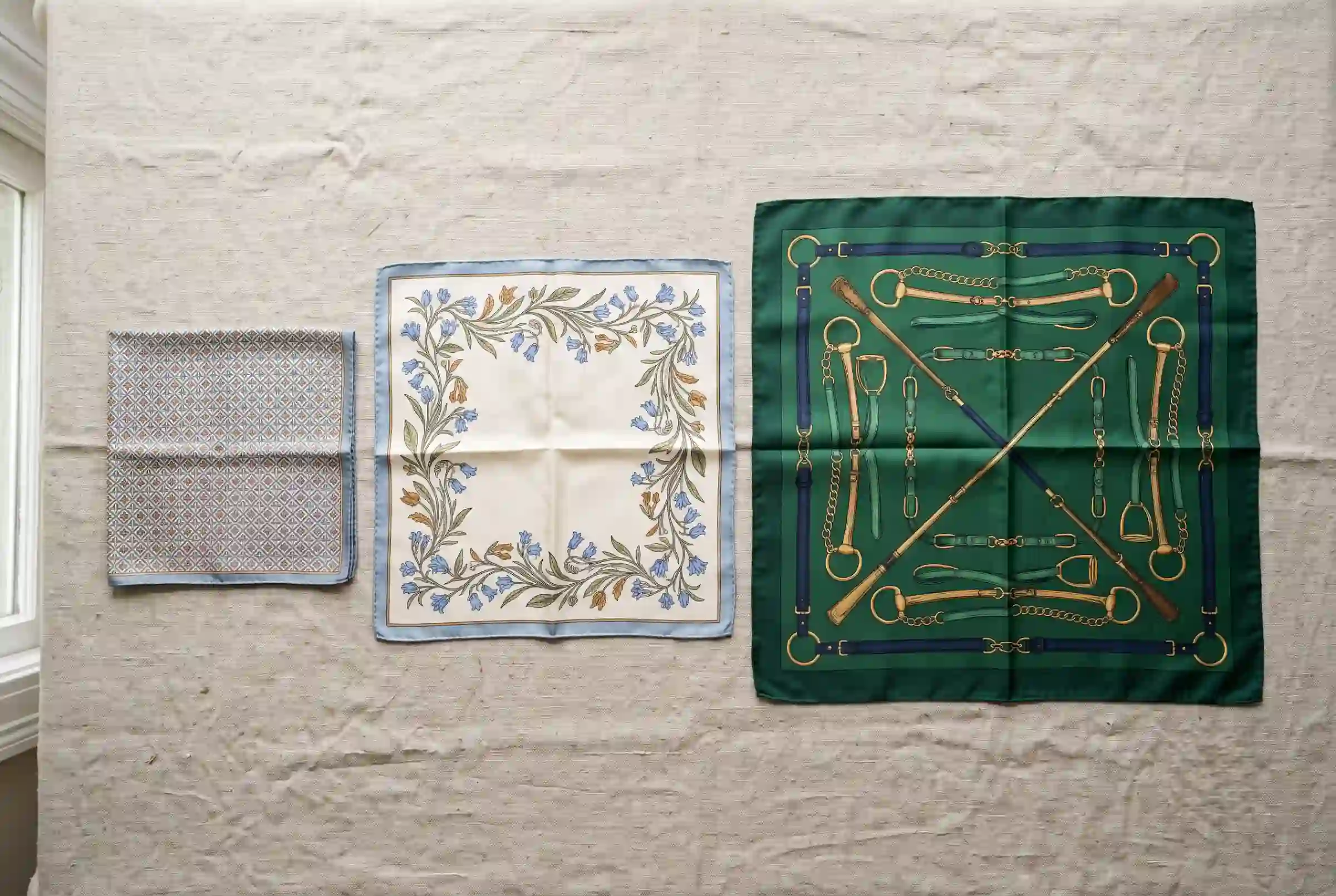
Size decides what a scarf can do before print or color even enters the conversation. The shape of the starting piece sets the menu of placements, and most scarf silk also sits between 12 and 16 momme, a Japanese weight unit that counts the pounds of a 45-inch by 100-yard bolt of the fabric.
The weave matters as much as the weight. Silk twill has a faint diagonal rib that grips its own knots and shrugs off creasing, which is why it is the standard cloth for luxury scarves. Glossy charmeuse is the slippery one that loosens by lunch. If your knots slide and you blame your technique, the weave is usually the real culprit.
| Size | Rough dimensions | Works hardest at | Struggles with |
| Small square | About 20 inches, 50 cm | A neat neck accent under a blazer collar, a wrist wrap | Head wraps and tops, because there is not enough fabric |
| Medium square | About 27 inches, 70 cm | The everyday default, with enough length for headbands and most hair work | A full kerchief on a longer torso can feel skimpy |
| Large square, the carré | About 35 inches, 90 cm | Headscarves, bandana tops, belts, the size Hermès built its name on | A discreet neck accent, and it can swallow a petite frame |
| Oblong or twilly | Roughly 6 to 8 inches wide and 55 to 70 inches long | Wrapping a bag handle end to end, draping like a long necklace | It cannot form a triangle, so head looks are limited |
Square or oblong, at a glance
- Squares fold into triangles, and triangles are what make headscarves and tops possible.
- Oblongs roll into skinny bands, which is what bag handles and necklace drapes want.
- If you own one scarf and want the most options, buy a 27- or 35-inch square.
A good silk square belongs to the same family of quiet, repeatable upgrades we covered in our quiet luxury explainer, where the test is quality that reads at arm’s length. The collector tier is real money, with a new Hermès 90 cm carré now listed at $660 on the house’s own site. The sensible middle is a high-street silk square, like the $60 version Vogue featured from Mango, or a vintage carré from a resale shop, which has already proven the print ages well.
How to Style a Silk Scarf Around Your Neck
The neck is the default for a reason. It is the fastest placement, the one that works with the widest range of outfits, and the one that survives a full day without a mirror check. Three versions cover almost every day.
The European Loop
The tidy one. It sits flat under a blazer collar and reads deliberate over an open shirt.
- Roll or fold the scarf into a band and drape it around your neck so one end hangs about twice as long as the other.
- Wrap the long end around your neck once and bring it back to the front.
- Pull that end through the loop you created, then adjust until the two ends hang roughly even.
It takes thirty seconds once you have done it a few times, and it holds better than it looks, because the wrap creates friction against itself.
The Loose Side Knot
Fold the square into a band, drape it evenly, and tie a single soft knot at the side of your neck so the ends fall forward over one shoulder. This is the version that pairs with boat necks and plain tees. Keep the knot visibly loose, because a tight side knot reads as a uniform instead of a choice.
The Long Drape
No knot at all. Fold a large square narrow or use an oblong, hang it around your neck with the ends even, and let it fall open over a thin knit or a tee. The drape works through contrast, one busy print against a quiet base, and it is the placement to reach for when the outfit is a single neutral color from collar to hem.
Silk Scarf Hairstyles That Stay Put
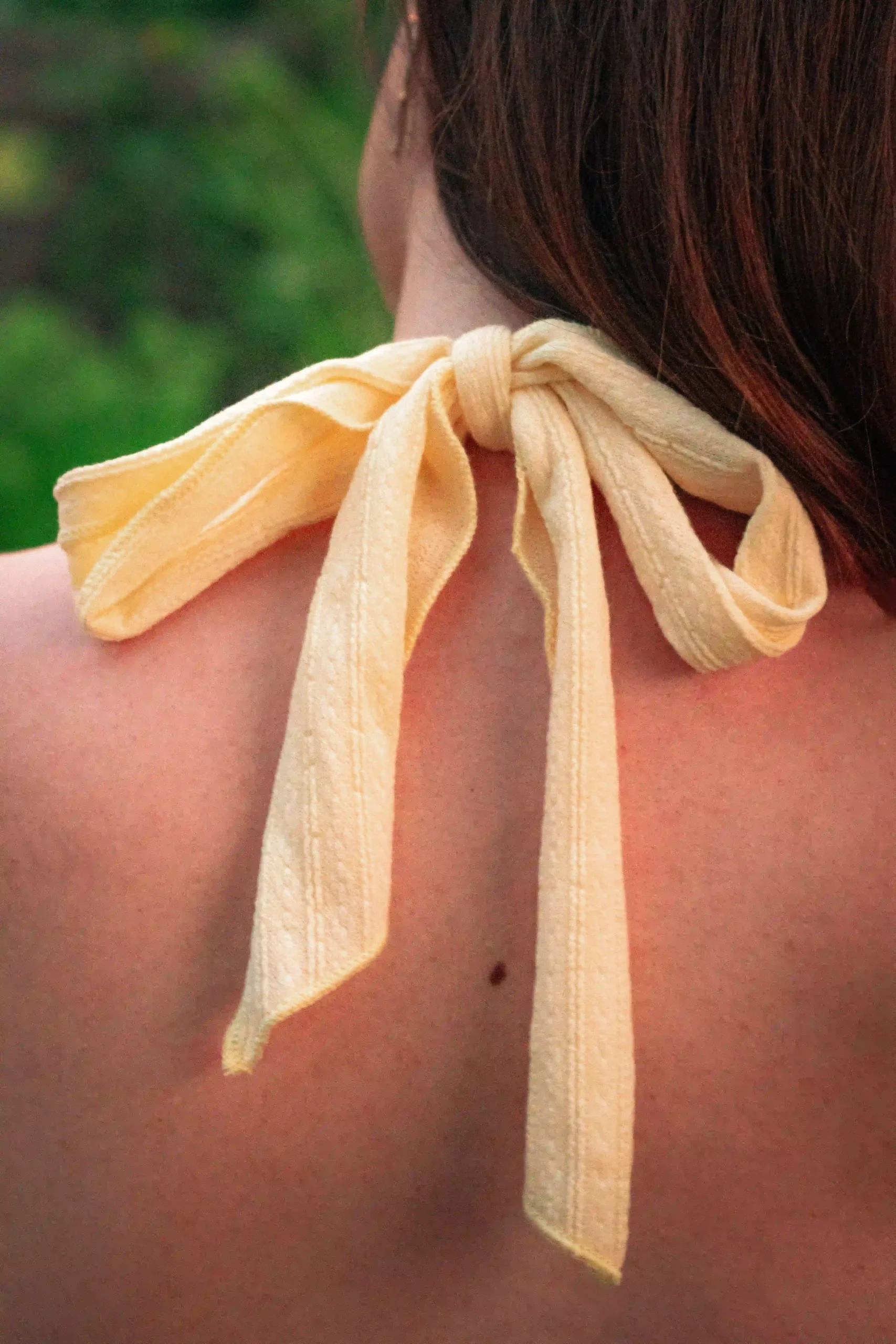
Silk slips. That is the whole problem with the fabric in hair, and every fix is really an anchoring fix. Nicole Adolphe, Head of Style at The Iconic, puts the range plainly in an interview with Beauty Crew: “Scarves can be styled as a chic hair accessory wrapped around a ponytail, braid, or worn as a headband, and tied around the neck as a light accent, or knotted onto a handbag for a splash of pattern.” Three hair versions earn a place here.
The Headband
Center a folded band at your hairline, cross the ends at the nape, and bring them back up to tuck or tie in a small knot at the crown. It behaves best on day-two hair. On freshly washed, glassy hair, cross two bobby pins under the band at each temple and it will stay until you take it off.
The Bun and Ponytail Wrap
Tie your hair first, then wrap a narrow band of scarf around the base of the bun or ponytail and knot it once, ends left hanging. This is the lowest-effort version in the entire guide and the one that survives a commute, a gym bag, and a humid afternoon without asking for anything.
The Full Kerchief
The Grace Kelly move. Fold the square into a triangle, set the long edge across your hairline with the point hanging down your back, and knot the ends under your chin or at the nape. The under-chin knot is the dramatic Riviera version and wants sunglasses, bare ears, and no necklace. The nape knot is the everyday version, and it is the one to try first, because it frames the face without committing to a costume.

The Handbag Trick
Wrapping an oblong around one handle, or knotting a small square at the handle base, does two jobs at once. It personalizes a plain bag, and it protects the handle leather from hand oils and sunscreen. The trick is also the easiest entry point in this guide, since it cannot slip, slide, or come undone in public, and it adds a print to your outfit without adding a single garment.
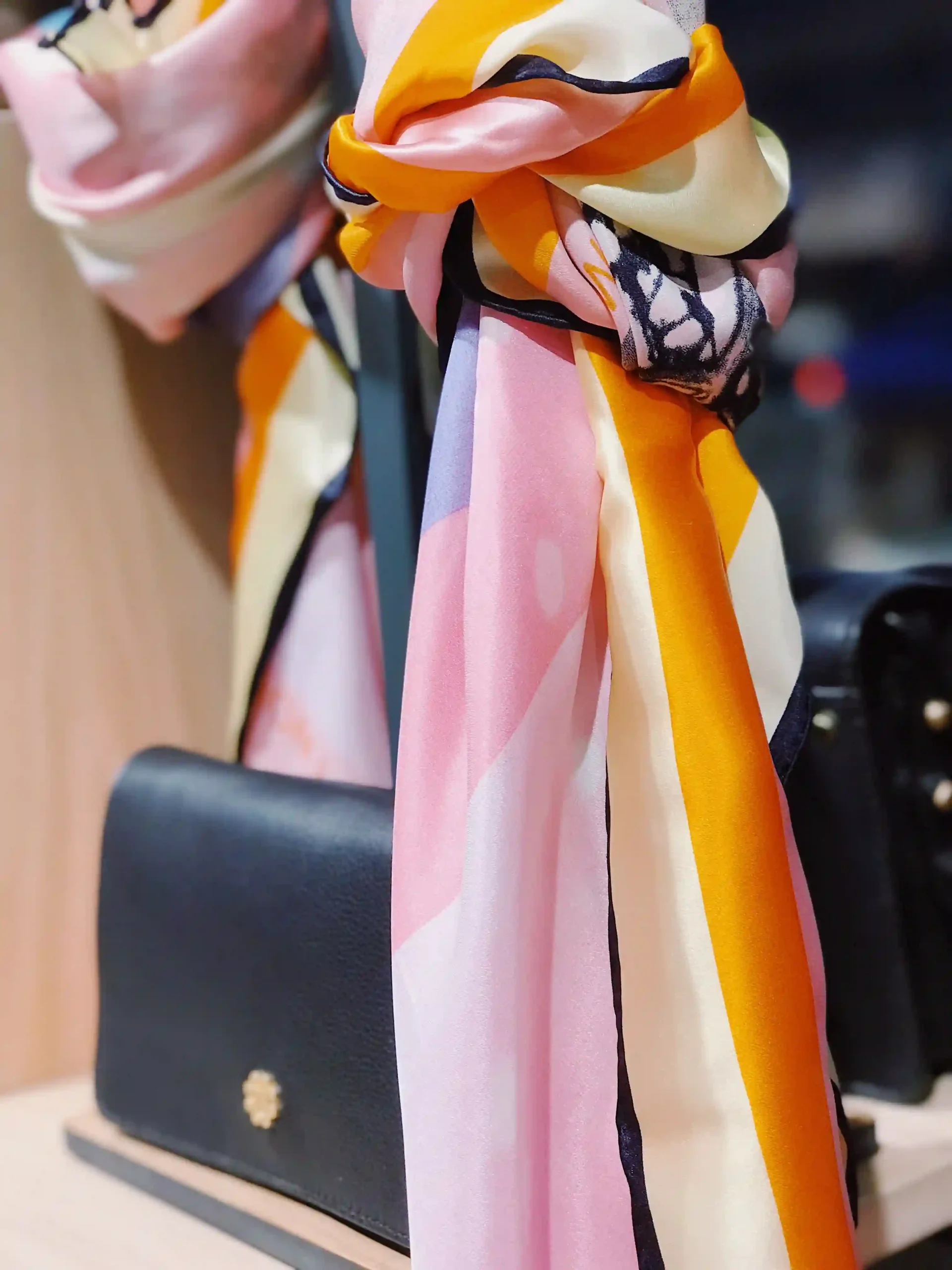
If you are still deciding which bag shapes deserve the scarf in the first place, our guide on how to choose a handbag settles the silhouette question first. One honest caveat: handle wraps fray at the edges from friction over a season, so rotate two scarves, or save the vintage heirloom for the neck.
A Scarf as a Belt, a Top, and the Riskier Placements
Thread a long scarf through belt loops on high-rise denim or tailored trousers and knot it at the front, or let it hang at the hip, and you have the waistline version The Row pushed on the fall 2026 runway. It only works where loops exist to anchor it. On a loopless waistband it migrates within an hour, and the 2026 satin scarf belt moment drew real criticism for assuming a narrow range of bodies, as Cosmopolitan reported when the styling trick circulated.
The honest read is that a scarf belt is a styling accent for looped, high-rise waistlines, and a real belt remains the better proportion tool everywhere else, which is exactly when we would point you to our guide on when to wear a belt.
The bandana top is the least secure placement in this guide and the most fun. You need a 35-inch square folded to a triangle, held by ends tied behind the neck and again across the back. Altuzarra’s fall 2026 version draped the square over leather trousers, and the street-style version pairs it with high-waisted denim. Save it for hot evenings and low-motion plans, because it is held together by two knots and confidence.
Caring for Silk Without Ruining It
The FTC’s Care Labeling Rule requires a care instruction on every garment sold in the US, so the label inside the hem is the first authority, and most silk scarves will say dry clean or hand wash. In practice, a cool hand wash with a mild detergent for delicates handles most scarf silk fine. Rinse cool, roll the scarf in a towel instead of wringing it, dry it flat away from direct sun, and press it on the lowest iron setting from the reverse side while it is still slightly damp.
Two enemies matter more than washing does. Rain and perfume both leave permanent rings on silk, so the scarf comes off before the perfume goes on, and it stays in a drawer on storm days. Store it rolled or flat rather than hung, because a hook leaves a crease line that steaming only partly removes.
Silk care, at a glance
- Read the FTC-mandated label first, then default to a cool hand wash.
- Roll in a towel, dry flat, and iron low from the reverse side.
- Perfume and rain both ring the fabric, so both happen away from the scarf.
When a Silk Scarf Is the Wrong Call
A few honest limits. On high-motion days, like a bike commute or a toddler chase, the knots loosen and the kerchief becomes a fidget toy. In a wardrobe full of loud prints, the scarf has no quiet base to sit against, and it adds noise instead of focus. At the register, anything under about $20 is usually polyester satin that will not grip a knot or breathe in August, so check the fiber content tag the way you would on a blouse. And if hand washing feels like a chore you will skip, buy cotton bandanas for the hair and bag jobs, and let silk stay an occasional pleasure rather than a guilt object.
Choosing Your Starting Placement
If you are short on time in the morning: learn the European loop and the bun wrap first. Both take under thirty seconds after a week of practice, and both look intentional with zero other accessories.
If you are rebuilding a wardrobe after a size or life change: start with the bag handle wrap and the neck loop. Neither one asks the scarf to fit your body, so both work exactly the same on day one of a rebuild and day one hundred, and both add personality while the rest of the closet gets sorted.
If you already know your aesthetic: buy one 35-inch carré whose print repeats the dominant color family you already wear, and treat it as the single loud piece over quiet bases. That constraint is what makes a scarf read as a signature instead of a souvenir.
Frequently Asked Questions About Styling a Silk Scarf
How do you style a silk scarf so it does not slip?
Choose twill over charmeuse, knot it against texture like a cotton collar or day-two hair, and add a hidden anchor, two crossed bobby pins in hair or a scarf ring at the neck, when the day is long. The slip is a property of the fiber, not a flaw in your technique.
What size silk scarf is best for styling?
A 27-inch square is the flexible middle and the right first buy. Step up to a 35-inch carré if you want headscarves and tops, and down to a 20-inch square only if you know you want a compact neck accent and nothing else.
Can you wear a silk scarf as a top?
Yes, with a 35-inch square folded to a triangle and tied behind the neck and across the back. It is a warm-weather, low-motion placement, and it is the least secure one in this guide, so treat it as beach-to-bar dressing rather than office dressing.
How do you clean a silk scarf at home?
Follow the care label first, since the FTC requires one on every garment. Most scarf silk tolerates a cool hand wash with a mild detergent, then a towel roll, flat drying away from sun, and a low iron from the reverse side while slightly damp.
Are silk scarves still in style for 2026?
Yes, and more visibly than in years. Altuzarra, The Row, and Valentino all styled them on the fall 2026 runways, and the current version is worn as the focal point of the outfit rather than tucked in as an afterthought.
The Scarf Earns Its Keep Through Repetition
The real answer to how to style a silk scarf is to pick one placement and repeat it until it feels like yours, then add a second. A scarf worn twice a week for a year outperforms a drawer of special-occasion squares, and the nine placements above cover office days, hot evenings, and everything the weather does in between. Start with the loop or the bun wrap this week, and let the carré earn its tissue paper back.
Sources
Official Sources
- Federal Trade Commission: Clothes Captioning: Complying with the Care Labeling Rule, accessed August 9, 2026.
Industry Sources
- Vogue: How to Style the Silk Scarf, Inspired by the Fall 2026 Runways, accessed August 9, 2026.
- Cosmopolitan: A Satin Scarf Is the Only Accessory You Need for Spring, accessed August 9, 2026.
- Marie Claire: Hailey Bieber Wears the Viral Scarf Top Trend, accessed August 9, 2026.
- Beauty Crew: How To Style The Hair Scarf and Bandana Trend This Summer, accessed August 9, 2026.
- System Magazine: Behind the Scenes: Hermès, accessed August 9, 2026.
- Hermès: Scarves 90, Hermès Silk Scarves for Women, accessed August 9, 2026.
- SilkSilky: Silk Scarf Size Guide: 50cm vs 70cm vs 90cm, accessed August 9, 2026.
- WiseSilk: Silk Momme Weight Guide, accessed August 9, 2026.
- Mulberry Park Silks: What Does Momme Silk Mean in Fabric?, accessed August 9, 2026.
- DreamSilken: What Is Silk Twill Fabric?, accessed August 9, 2026.