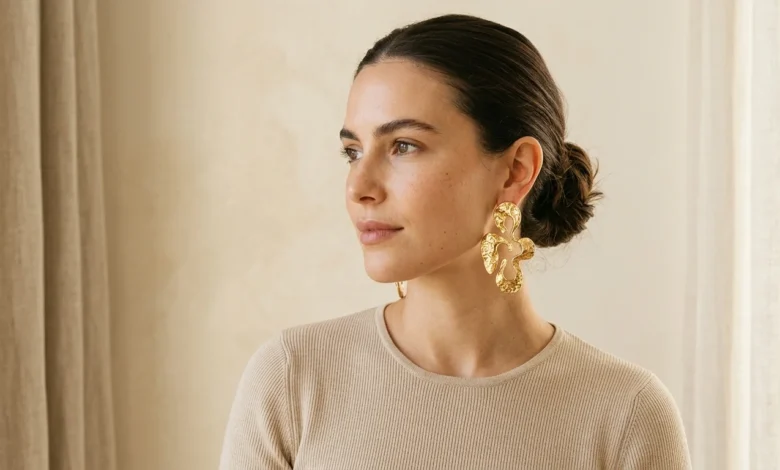
A single earring can end an outfit’s indecision faster than almost anything else in a jewelry box. Sculptural gold, an oversized hoop, a fringe drop that catches light every time you turn your head. One piece, and the rest of the look stops arguing with itself.
That is the appeal behind the 2026 return of statement earrings, and also the most common way people get them wrong. Scroll through any roundup on the topic and the advice sounds the same: go bold, go big, do not overthink it. What actually separates an earring that reads as a decision from one that reads like an accident has less to do with size and more to do with four things the product page never mentions: what else you are wearing, how heavy the piece actually is, what metal is touching your skin, and whether the shape works with your face or against it.
None of that requires rebuilding a jewelry box from scratch. It requires knowing which four questions to ask before checkout. And to be clear about the word choice in the headline here, “quiet” in this context means the rest of your look staying calm around one loud piece. It is a narrower idea than quiet luxury as a whole dressing philosophy, just a rule about not asking one outfit to make two loud arguments at once.
Statement earrings work when you do four things: drop the necklace so one piece leads, choose a weight you can wear for at least four hours without discomfort, check the metal against known skin sensitivities, and treat face shape as a helpful starting point rather than a fixed rule.
Skip the Necklace Before You Skip Anything Else
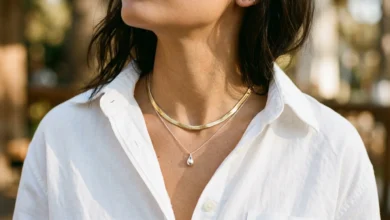
The fastest way to turn a statement earring into background noise is to surround it with competition. A busy neckline, a stack of rings, a necklace doing its own thing at the collarbone. All of it pulls attention away from the one piece that was supposed to carry the outfit.
Stylists who cover this topic repeatedly land on the same fix: when the earrings are the focal point, everything else stays simple. A bare neck or a single delicate chain. Rings kept to one hand, or skipped entirely. A bracelet only if it sits flat against the wrist instead of clinking with movement. The logic is not about minimalism as a philosophy, it is about not asking the eye to referee two arguments at once.
This is also where a lot of people talk themselves out of wearing statement pieces at all. They assume bold earrings need a bold outfit to match, so the earrings get saved for one dressy occasion a year. The opposite tends to work better in practice. A plain shirt or a solid color dress gives the earring somewhere to land, and a look that would otherwise be unremarkable gets its focal point for free.
What Counts as a Statement Earring Right Now
The current wave is less about size for its own sake and more about shape. On the Spring 2026 runways, Valentino sent out towering, shoulder length gold and diamond earrings, while Chloé went the other direction with flat, gold trimmed disk earrings that were simple by statement standards but still impossible to miss. Both looks came from a season where oversized, sculptural ear jewelry became one of the most talked about elements of the shows, alongside voluminous hair and saturated color.
Off the runway, the same instinct shows up on people whose outfits get photographed for a living: Emily Ratajkowski was recently seen pairing a leopard print coat with tortoise shell statement earrings for a public appearance, using the earring as the one loud element against an otherwise simple outfit.
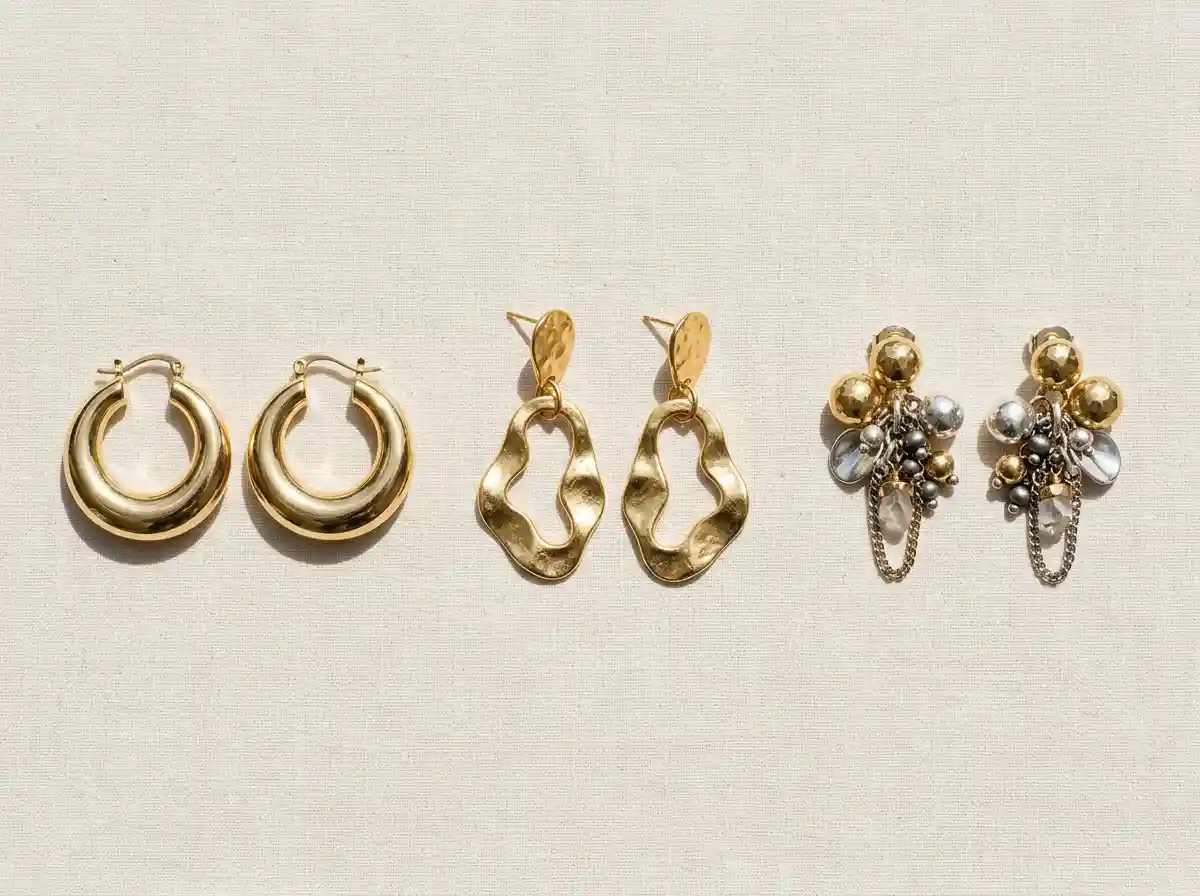
Chunky, high polish hoops are part of the current mix, alongside sculptural gold shapes borrowed from architecture and modern art, mixed metals worn together instead of matched to each other, and pearls reworked into tassels and clusters instead of a single strand. The old rule that said pick one metal and stay in it has mostly fallen away this year.
None of this means last year’s pair is suddenly wrong to wear. Shape and proportion age better than any single material trend, which is part of why a well made statement earring tends to earn its price over several seasons rather than one.
At a Glance: What You Get at Each Price Point
- Under $70 typically buys fast turnaround trend pieces, often resin, acrylic, or lightweight brass with plating that wears down under heavy rotation.
- Between $70 and $150 tends to mean solid construction, gold vermeil or gold filled options, and plating thick enough to hold up for a few years of regular wear.
- $150 and above usually reflects finer materials, closures built for the actual weight of the piece, and construction meant to outlast a single trend cycle.
| Price Tier | Example Brand | Starting Price | What You Are Paying For |
|---|---|---|---|
| Trend Tier | BaubleBar | About $38 | On-trend shapes you can replace each season without much loss |
| Everyday Statement | Kendra Scott | Around $75 | Consistent sizing and a house silhouette worth building a small collection around |
| Investment Tier | Lele Sadoughi | $75 to $245 | Heavier materials and more detailed construction meant to outlast one trend cycle |
BaubleBar was founded in 2011 by Amy Jain and Danielle Yacobovsky, two former investment bankers with Harvard MBAs who built the brand around fast turnaround, affordable statement pieces, which is part of why the trend tier moves so quickly from runway to shelf. Lele Sadoughi’s earrings at Nordstrom currently range from around $75 for simpler stud styles up to $245 for more elaborate drop designs, and Kendra Scott’s earring line at Macy’s starts at $75, putting it squarely between the two other tiers.
The Weight Problem the Product Page Never Mentions
Nobody lists the gram weight of a pair of earrings the way a coat lists its fill power, but weight is the single biggest reason a beautiful pair ends up sitting in a drawer after two wears.
Board certified dermatologist Kathleen Viscusi has said “heavy earrings that pull on the skin over time can cause stretched-out earlobes,” and the effect compounds with age rather than staying constant. Research published in the Aesthetic Surgery Journal found that the earlobe elongates by roughly 30 to 35 percent between ages 20 and 60, at an average rate of about 0.22 millimeters a year, and daily wear of heavy earrings accelerates that process well beyond what aging alone would cause.
A quick way to gauge tolerance before buying: hold the earring up to your ear and let it hang under its own weight for a full minute, rather than judging it by the two seconds most people spend in a fitting room mirror. If the lobe already feels the pull in that short window, four hours of wear later that evening will feel considerably worse.
None of this means retiring statement earrings altogether. It means checking two things before buying: whether the back is a screw back, a lever back, or a simple friction post, since heavier pieces need a back built to bear their weight, and whether the piece can actually be tolerated for a full afternoon rather than judged on first impression. A pair that feels fine at the counter can feel very different three hours into a wedding reception.
The Metal Touching Your Skin Matters More Than the Finish
Gold plated and gold filled sound similar and are not. Plating is a thin layer over a base metal that wears away with time and contact. Filled construction is a much thicker bonded layer that holds up to years of handling. Under the FTC’s Jewelry Guides, gold filled, gold plated, gold washed, and vermeil pieces each have to be described using those specific terms, and each one carries its own defined requirements for the thickness and composition of the gold layer, so the label on a listing is not just marketing language. It is a regulated claim, and a retailer using the wrong one is technically in violation of federal guidance.
Skin reaction is the other half of the equation. A widely cited medical review puts the rate of nickel allergy at up to 17 percent among women and about 3 percent among men. Older clinical surveys have landed on different figures depending on the population tested and the method used, with one earlier dermatology study finding closer to 6 percent of American adults testing positive on a routine skin test rather than the higher figure.
The range matters less than the pattern underneath it: women are affected at several times the rate of men, largely because of higher rates of ear piercing and repeated metal contact over a lifetime. For anyone whose earlobe has ever turned red or started itching after a night in inexpensive earrings, that history is worth mentioning to a sales associate before buying anything with an unlabeled base metal post. Titanium, niobium, and surgical steel posts are the safer starting point for a known reaction.
Face Shape Is a Starting Point, Not a Verdict
Blake Asaad, founder and creative director of the jewelry brand GOODSTONE, has said “face shape is one of the most overlooked factors when shopping for earrings,” and the general guidance around this is fairly consistent across stylists. Rounder faces tend to benefit from earrings with some vertical drop. Angular faces often soften with curved or rounded shapes. Heart shaped faces frequently work well with pieces that add width near the jaw rather than near the temple.
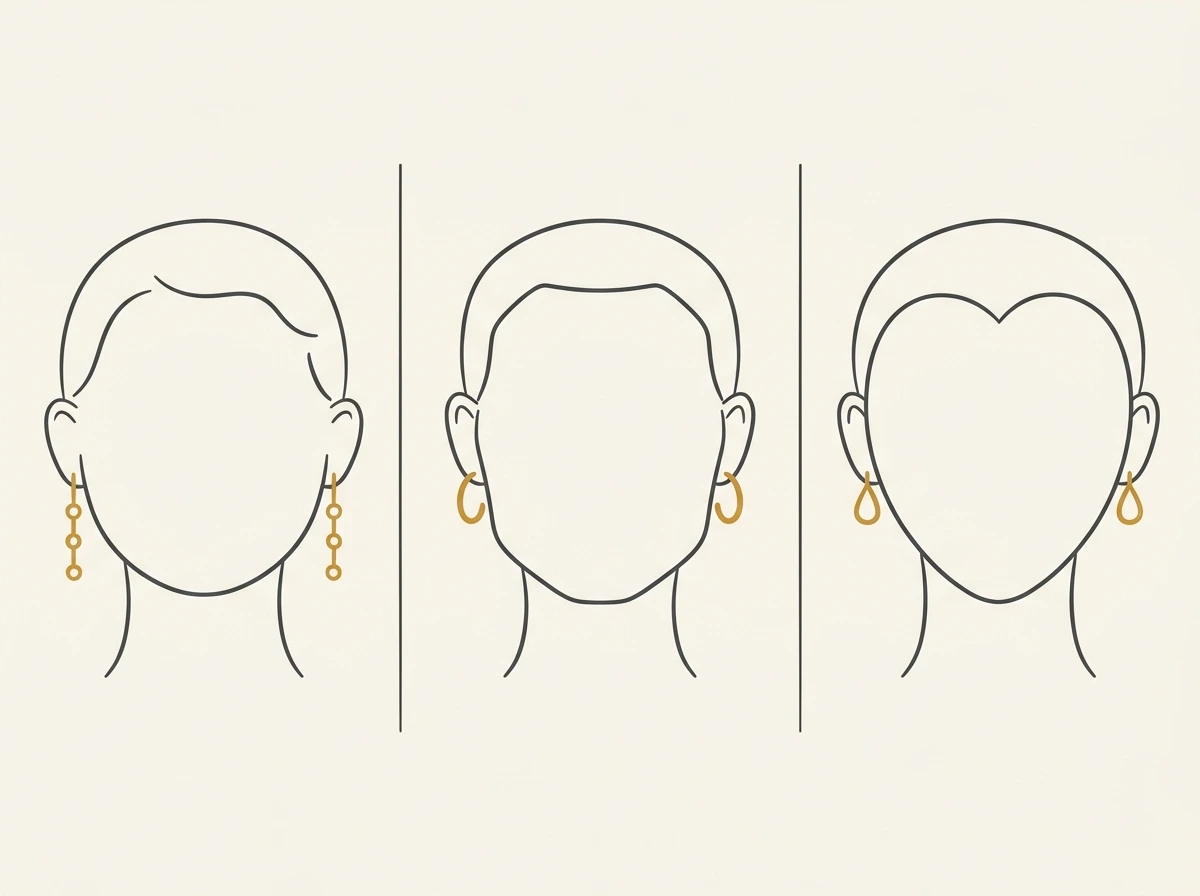
Treat that as a starting point rather than an instruction to follow strictly. The same stylists who map out these rules are usually the first to say a formula should never override a piece someone genuinely loves wearing. A face shape chart can shorten the search. It should not settle an argument with your own mirror, the same way knowing when to wear a belt is a useful default rather than a verdict on what you are allowed to wear.
| Backing Type | Good For | The Trade-off |
|---|---|---|
| Friction post | Lightweight studs and small drops | Can work loose over a long day, so heavier pieces risk slipping out |
| Screw back | Heavier drops and chandeliers | More secure, but slower to put on and take off than the alternatives |
| Lever back | Dangles that need to swing freely | Comfortable across long wear, though the hardware shows more than a plain post |
| Clip-on | Anyone without pierced ears | Opens up the widest range of statement styles, but pressure tends to build after a few hours |
If You Only Want to Own One Pair This Year
Buying one good statement earring instead of several trend pieces is a reasonable way to approach this category, especially for anyone who would rather spend once than replace something every season. It follows the same logic behind choosing one good handbag over several trend bags: spend once on the tier that actually holds up, and skip the tier in between. The everyday statement tier, priced somewhere between $75 and $150, tends to be the more defensible buy for that purpose. It sits above fast fashion plating that will not survive more than a couple of years of wear, without reaching the price point where the difference is mostly about brand name rather than material.
Pick a neutral metal tone that already matches what is in your jewelry box, a shape with some structure rather than something delicate, and a backing rated for the actual weight of the piece. That single pair should be able to carry a plain outfit through a dinner, a work event with the blazer swapped for something a little softer, and a weekend where the rest of the look stays simple on purpose.
Where Statement Earrings Fall Short
They are not built for every setting. Anyone on video calls most of the day, or wearing over-ear headphones for hours at a time, will find that oversized drops fight with both. Long earrings and thick headphone cups do not share space well. Conservative workplaces still read very large pieces as more evening than office, regardless of what the runway says this season. Plated trend pieces, while genuinely fun to rotate, are disposable by design. Treat that price point as seasonal spending rather than an investment, and there is no disappointment waiting when the plating starts to wear through.
Frequently Asked Questions About Statement Earrings
What actually makes an earring a statement earring?
Size and shape both play a role, but the defining feature is that the earring is meant to be the focal point of the look rather than a supporting piece, which is why stylists consistently pair them with simpler necklines and minimal other jewelry.
Can you wear statement earrings with glasses?
Yes, though frame width matters. Wider frames tend to pair better with earrings that sit closer to the lobe, while narrower frames leave more room for length and movement without visual crowding near the temple.
How do you keep heavy earrings from hurting your ears?
Match the backing to the weight, favor screw backs or lever backs over a plain friction post for anything with real heft, and give your ears a break between long wears rather than leaving heavy pieces in all day, every day.
Is gold plated jewelry worth buying for statement pieces?
For occasional wear or trend pieces expected to rotate out within a year or two, plating is a reasonable and affordable choice. For anything meant to become a repeat piece, gold filled or solid metal construction holds up to more frequent handling.
Are statement earrings appropriate for the office?
It depends heavily on the workplace. Smaller sculptural studs or moderate drops tend to translate well into most office settings, while shoulder grazing pieces still read as evening wear in more traditional environments.
One Pair, Worn on Purpose
Statement earrings are not complicated once the four variables are on the table: what else is on your body, how much the piece weighs, what metal is against your skin, and whether the shape works with your face rather than against it. Handle those four, and the earring does what it was bought to do instead of sitting in a drawer after one wear.
If a jewelry box needs one new thing this year, a well chosen pair of statement earrings is a reasonable place to start, provided the rest of the outfit already knows to stay quiet.
Sources
Official Sources
- Federal Trade Commission: Guides for the Jewelry, Precious Metals, and Pewter Industries (16 CFR Part 23) | https://www.ecfr.gov/current/title-16/chapter-I/subchapter-B/part-23 | Accessed July 26, 2026 | Tier 1
Research Sources
- PubMed / peer-reviewed review: “Metal allergy: a review on exposures, penetration, genetics, prevalence, and clinical implications” | https://pubmed.ncbi.nlm.nih.gov/19831422/ | Accessed July 26, 2026 | Tier 1
- ScienceDaily, reporting on Dr. Howard Maibach’s nickel-in-earrings study | https://www.sciencedaily.com/releases/2008/05/080512144306.htm | Accessed July 26, 2026 | Tier 2 (original study dated 2008; figure presented as an older data point, not current)
- Ynet, citing Aesthetic Surgery Journal earlobe elongation data | https://www.ynetnews.com/health_science/article/h111h00ptewl | Accessed July 26, 2026 | Tier 2
- AEDIT, dermatologist commentary from Dr. Kathleen Viscusi | https://aedit.com/aedition/dermal-filler-for-stretched-out-earlobes-piercings | Accessed July 26, 2026 | Tier 2
Industry Sources
- Nordstrom: Lele Sadoughi brand assortment and pricing | https://www.nordstrom.com/brands/lele-sadoughi–21454324 | Accessed July 26, 2026 | Tier 2
- Macy’s: Kendra Scott earrings pricing | https://www.macys.com/shop/brands/kendra-scott/kendra-scott-earrings?id=337759 | Accessed July 26, 2026 | Tier 2
- Bloomingdale’s: BaubleBar earrings pricing | https://www.bloomingdales.com/buy/baublebar-earrings | Accessed July 26, 2026 | Tier 2
- Shopbop editorial: BaubleBar founding story | https://www.shopbop.com/statement-stud-earring-baublebar/vp/v=1/1556842814.htm | Accessed July 26, 2026 | Tier 2
- Coveteur: Statement earrings trend, Valentino and Chloé Spring 2026 runway coverage | https://coveteur.com/statement-earrings-trend | Accessed July 26, 2026 | Tier 2
Additional Reading
- Yahoo Creators: Face shape and earring styling, quoting GOODSTONE founder Blake Asaad | https://creators.yahoo.com/lifestyle/story/how-to-pick-the-most-flattering-earrings-for-your-face-shape-according-to-a-jewelry-expert-152531323.html | Accessed July 26, 2026 | Tier 3