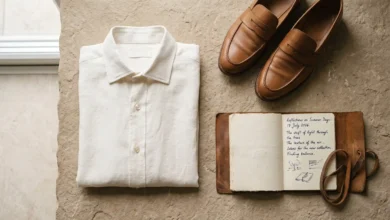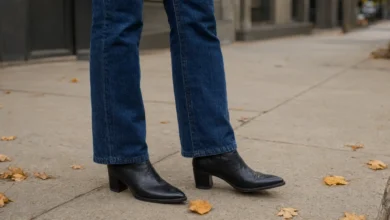

Some mornings you can pull a black knit, a pair of cream trousers, and a pair of black boots out of the closet and the outfit simply lands. Other mornings the same three pieces will not, and the reason is rarely the pieces themselves. Sandwich rule outfit styling, the trick British stylist Lydia Jane Tomlinson named in 2022 and that has since done laps of every fashion feed, explains the miss in one image, because an outfit is a sandwich and it holds together when the bread matches.
The idea travels under a few names, sandwich method, sandwich dressing, the fashion sandwich trick, but the mechanics stay the same. Two matched bookends, usually the top and the shoes, hold a contrasting middle. When the bookends disagree, the eye has nowhere to land and the outfit reads as three separate decisions made in a hurry.
What makes the rule worth writing about, rather than filing with the rest of the feed trends, is that it is not actually new. Working stylists have quietly bookended outfits for decades, matching a shoe color to a belt or a hem without naming it. Putting a name on the instinct is what made it teachable.
To style an outfit with the sandwich rule, match your top and your shoes in one color, weight, or formality level, let the piece in between contrast, and rebalance with a belt, scarf, or jacket when the two ends disagree. 1) Pick the bread: decide which color or weight your shoes and top will share. 2) Let the filling contrast: put pants or a skirt in a different shade or texture between them. 3) Check the ends in a mirror: if the shoes feel disconnected, echo them at the top with a belt, scarf, hat, or jacket. 4) Break the rule on purpose once you can see it working, because it is a baseline, not a law.
What the Sandwich Rule Is, in One Outfit
Picture the outfit Tomlinson uses to open her original video: chunky black boots, cream jeans, a white sweater. All three pieces are fine on their own, yet stacked like that the look tilts downward, because the only dark weight in the outfit sits at the floor. Add a black scarf or a black belt and the eye travels up and down instead of parking at the ankles. In her words, as PureWow reported, “If you think about a sandwich, it has the bread at the top, the bread at the bottom and something different in the middle. This in turn creates a balanced effect. And, the same rules can be applied to your outfits.”
The bread is whichever two pieces agree: top and shoes most often, though Tomlinson also points to coats and jackets as carriers for the echo when the top itself is light. The filling is the piece in between, and it should differ in color, weight, or proportion. When the middle matches the ends instead, you have built a column, which is a different tool with a different effect and a different mood.
Where the Sandwich Method Came From
Tomlinson, a British stylist and content creator, coined the term in 2022, and Vogue UK credits her with it. Glamour UK picked the video up, PureWow followed in July 2024, Real Simple framed the trick as a Gen Z staple, and Who What Wear has mined it for outfit formulas since. The cycle repeats every few months because the rule compresses into one sentence and works on the first try.
My read on why it stuck is that it named an instinct the trade already used. Color echoing, bookending, pulling a shoe color up into a belt, these are old stylist habits. The sandwich rule is the habit with a memorable lunch metaphor attached, which is also why it keeps surviving the feed that made it famous.
Why Sandwich Rule Outfit Styling Reads as Balanced
Tomlinson has compared sandwich dressing to architecture and interior design, where everything has to be balanced, and the visual arts agree with her. Repetition of one color at two heights builds a frame, and a contrasting middle gives that frame something to hold. The matched ends pull the eye vertically, so the outfit reads as one decision from collar to sole instead of three separate purchases.
The rule also fixes the most common real-world failure, the disconnected shoe. A neutral look with one unrelated shoe color is exactly the outfit people call boring without knowing why. The shoe is not the problem. The orphaned shoe is the problem. Give it a partner at the top and the same pieces start looking intentional.
This is also the place to say the quiet part. The sandwich rule cannot tell you which colors suit you or which fits flatter your frame. It only governs the relationship between pieces. Fit problems stay fit problems, and a balanced outfit in the wrong sizes still reads as off.
How to Build a Sandwich Rule Outfit With What You Own
No shopping required. The method rearranges what is already in the closet, which is most of its appeal and most of its staying power.
Start With Color Bookends
Pick the shoe first, then find its partner above the waist. Black loafers want a black knit, a black belt over a lighter top, or a black hem on a jacket. Cream sneakers want a cream sweater or an ecru shirt. The two ends do not need to share a dye lot. They need to read as one family from across the street, so a chocolate knit answers tan boots fine, while a washed mid-brown next to black still breaks the line, the same depth logic that governs brown trousers.
Let the Filling Contrast
The middle earns its keep by differing. If the ends are black, the middle goes cream, denim blue, grey, or a print that carries black in it. If the ends are cream, the middle goes indigo, olive, or chocolate. This is also where texture variety lives, and the same cap applies as in any texture work: two or three distinct surfaces per outfit before it tips from intentional into costume, the limit we hold to in our guide to mixing textures.
Balance Weight and Proportion, Not Just Color
Tomlinson’s second lesson is that bookends carry weight as well as hue. A chunky boot under a delicate top sinks the whole outfit, and the fix is a heavier knit or a structured jacket up top, or a more substantial shoe such as a tall boot or a lug sole under an oversized blazer. Her example for voluminous tops runs the other direction: a padded-shoulder sweater belted at the waist wants a slightly wider leg, because a skinny jean leaves all the volume at the shoulders and hollows out the waistline.
Use Formality as the Hidden Bookend
Once color and weight feel automatic, try bookending with formality. A satin midi skirt between a cotton tee and clean canvas sneakers reads deliberate because the two casual ends agree with each other. Reverse it and a silk blouse with tailored trousers and polished loafers holds a relaxed cardigan in place. The ends set the register, and the middle gets to be the exception.
| Bread (top) | Filling (middle) | Bread (shoes) | Why it holds together |
|---|---|---|---|
| Black rollneck knit | Cream wide-leg trousers | Black chunky loafers | The dark ends frame the light middle, so the waist reads as the center of the outfit. |
| White cotton poplin shirt | Mid-blue straight jeans | White leather sneakers | Same-family ends keep a loud denim wash from taking over the whole look. |
| Camel wool overshirt | Charcoal midi skirt | Camel suede boots | Tonal bookends let the middle shift shade without breaking the vertical line. |
| Chunky fisherman sweater | Slim black trousers | Black lug-sole boots | Weight does the matching here, not color: a heavy knit and a heavy sole balance a narrow middle. |

The Sandwich Rule for Statement Pants and Loud Pieces
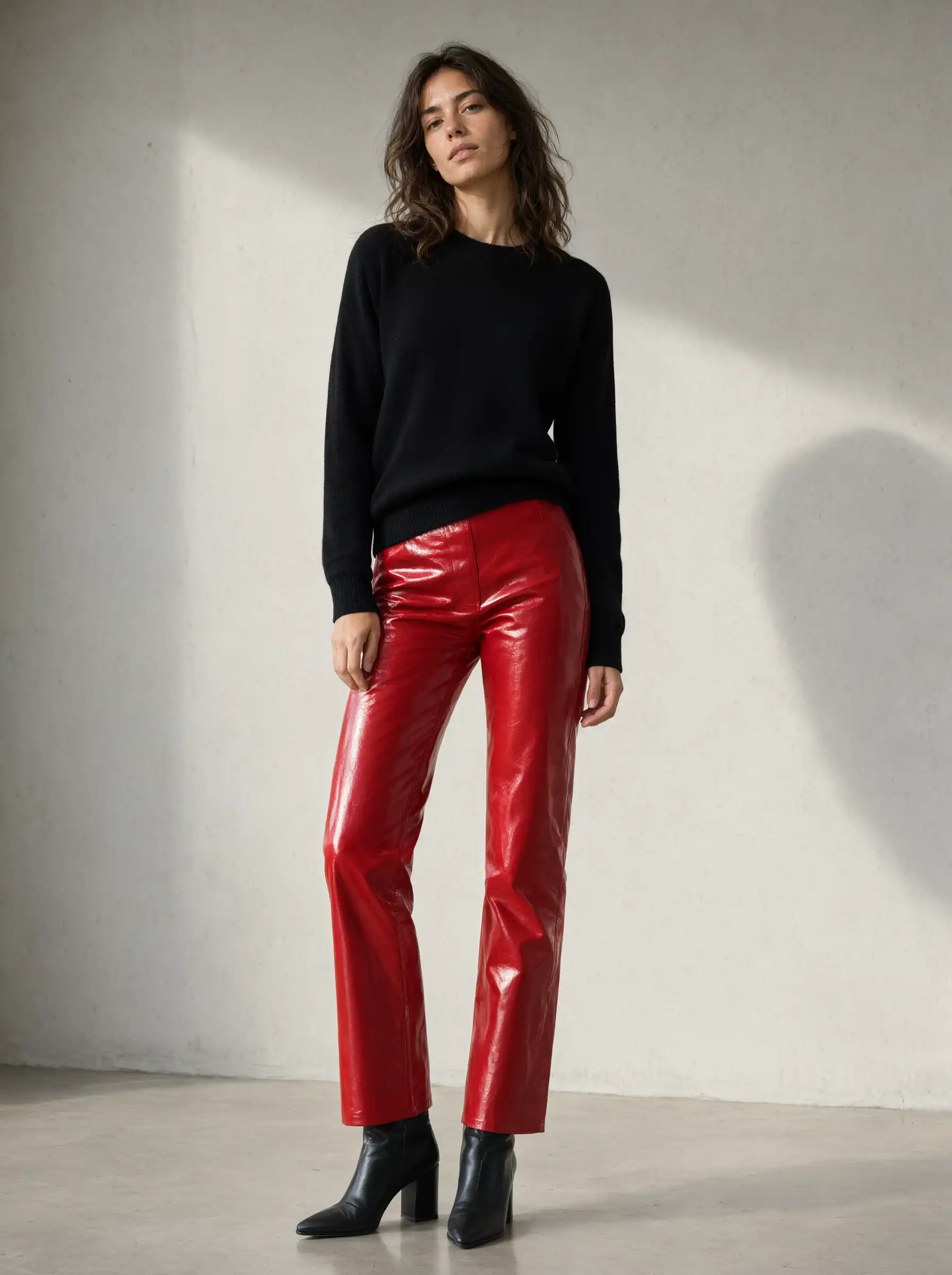
Statement pants are the filling’s finest hour. A loud pair, red leather, animal print, metallic, already owns the middle of the outfit, so the job of the bread is to agree quietly: the same neutral at both ends tells the eye the pants are the point, not an accident. Red leather trousers with a black rollneck and black boots land as a statement. The same pants with a green top and brown shoes land as a pile-up.
The reverse sandwich, quiet pants between two loud ends, is the advanced version, and I would caution against it as a daily move. Two competing loud bookends split the eye instead of framing it. Save that combination for one deliberate piece of outerwear over an otherwise monochrome base.
Dresses and Jumpsuits: Sandwiching a One-Piece
A one-piece occupies the top and the middle at once, so the bread moves to the edges of the silhouette: shoes plus whatever frames the upper half. A floral midi dress with white sneakers and a white denim jacket is a sandwich. The same dress with white sneakers and a black hat is a half sandwich, because the hat and the shoes disagree. Bags count only when they sit high; carried at the hip they read as middle, not bread.
When the Sandwich Rule Falls Flat
Vogue UK’s Olivia Allen made the counterargument worth taking seriously: the method looks sensible and considered, yes, but it can also read flat, and no formula rescues pieces you do not love. Her broader point is that style is developed gradually, through likes, dislikes, and a few embarrassing decisions, rather than hacked into existence. Diana Vreeland put it more bluntly in American Vogue back in 1976: “You maintain it. You radiate it.”
So the honest limitations list:
- If your wardrobe lives in one neutral family, there is nothing to contrast, and the sandwich collapses into a column.
- If you love friction, matched ends will feel tidy to the point of tame. The wrong shoe theory is the deliberate opposite, one calculated mismatch instead of two matched ends, and the two methods make a good pair: sandwich on days you want calm, wrong shoe on days you want a spark.
- If the pieces fit badly, balance will not fix them. Proportion tricks adjust relationships between garments. They do not alter hemlines or waistbands.
At a Glance: Picking Between the Sandwich Rule and the Wrong Shoe Theory
- Sandwich rule: two matched ends and a contrasting middle, for outfits that currently read as random.
- Wrong shoe theory: one deliberate mismatch, for outfits that read as too expected.
- Both assume clean, maintained pieces. A scuffed shoe is neglect, not friction.
- Neither corrects fit. A $60 alteration still outperforms a $200 replacement.
Using the Rule on Real Mornings
If you want the reasoning, not just the recipe: think in frame and filling. Every styling decision after this one gets easier once you can see vertical balance, because you stop judging pieces in isolation and start judging relationships. That shift is also the bridge to building a signature style, where repeatable formulas beat one-off outfits.
If you have five minutes and a small closet: memorize one bread pair, say a black knit and black boots, and let every pants choice become the filling. The decision count drops from three to one, which is the whole point of a rule like this.
If your closet just changed shape: after a size change, a move, or a new dress code, the sandwich gives you a scaffold for pieces that do not yet feel like you. Build the bookends first, add the middle last, and let the method hold things together until your eye catches up.
Frequently Asked Questions About the Sandwich Rule for Outfits
Is sandwich rule outfit styling the same as sandwich dressing?
Yes. Sandwich rule, sandwich method, and sandwich dressing all describe the same bookend technique. The naming shifted as the idea moved between platforms, but the mechanics, a matched top and shoes with a contrasting middle, never changed.
Does the sandwich method work with textures and proportions, not just color?
It does, and Tomlinson’s original examples lean on weight as much as hue. A chunky boot balanced by a heavy knit, or a voluminous sweater balanced by a wider leg, is the sandwich rule operating without a single shared color.
Do I need to buy new clothes to use the sandwich method?
No. The method rearranges existing pieces, and most people can build three or four sandwiches from a modest capsule on day one. New purchases enter only when you notice a recurring missing bookend, like owning dark shoes but no dark top.
Does the sandwich rule work for dresses and jumpsuits?
Yes, with the bread moved to the edges of the silhouette: shoes plus a jacket, a hat, or a bag carried high. The one-piece becomes the filling, and the two outer notes do the matching.
How can the sandwich rule help balance statement pants?
By making the loud pair the filling and keeping both ends in one quiet neutral. The matched bookends tell the eye the statement is deliberate, which is the difference between a statement and a pile-up.
A Rule Worth Breaking on Purpose
The real gift of the sandwich rule is not this week’s outfits. It is that you cannot unsee bookends once you have seen them, and every mirror check after that becomes a conversation about relationships instead of a panic about pieces. Use the sandwich method styling formula for three mornings, build the bread first and the filling second, and on the fourth morning break it with one deliberate wrong shoe. Noticing which version felt more like you is the point of the whole exercise.
Sources
Industry Sources
- Vogue UK: You Can’t Sandwich Method Your Way To Good Style, accessed August 11, 2026
- Who What Wear: The TikTok Sandwich Rule Has Given Us So Many Outfit Ideas, accessed August 11, 2026
- Glamour UK: Sandwich Dressing: Every Fashion Insider’s Secret Styling Hack, accessed August 11, 2026
- Real Simple: Gen Z TikTok Users Swear by the ‘Sandwich Rule’ for Styling Outfits, accessed August 11, 2026
- PureWow: What Is the Sandwich Rule? My Fave Viral Styling Trick, published July 25, 2024, accessed August 11, 2026