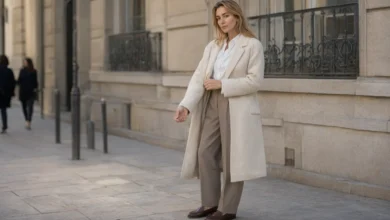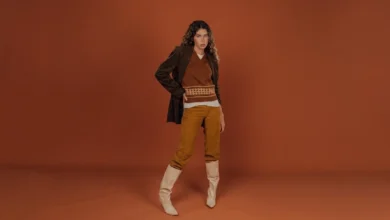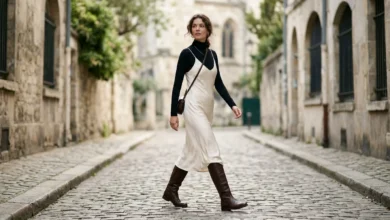
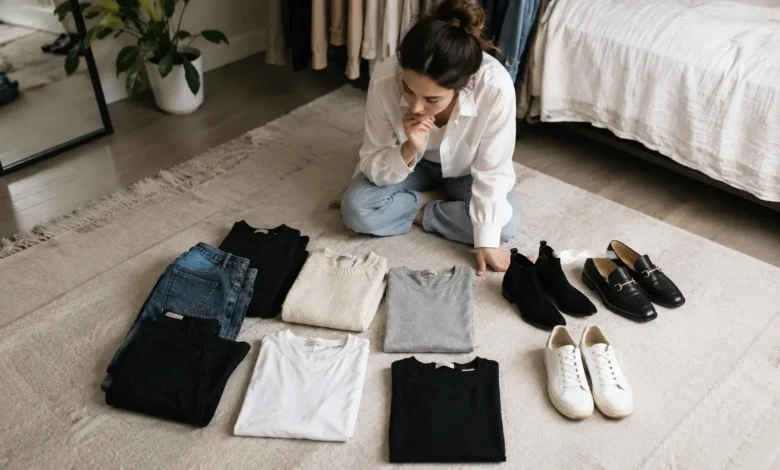
You have probably stood in front of a full closet and still felt like there was nothing to wear. The 333 method outfits challenge runs the opposite experiment on purpose: nine pieces pulled from that crowded closet, and a week of getting dressed that suddenly takes four minutes.
The format spread on TikTok in 2023 after creator Rachel Spencer posted her nine-piece fall wardrobe, and it has since doubled as a packing trick for carry-on travelers. The appeal is not minimalism as an aesthetic. It is the discovery that most wardrobes already contain far more workable outfits than their owners believe.
Done well, the challenge is a diagnostic, not a lifestyle. It shows you which pieces earn their hanger and which ones only occupy one. Here is how the math works, how to choose nine pieces that actually combine, and when the method is the wrong tool for your week.
The 333 method in short: 1) pick three tops, three bottoms, and three pairs of shoes that share one color story, 2) check that every shoe works with every bottom before you commit, 3) mix the nine pieces into up to 27 combinations, 4) wear only those pieces for a set week or trip, letting accessories and styling tricks keep the looks fresh.
Where 333 Method Outfits Came From
The rules fit in one sentence: choose three tops, three bottoms, and three pairs of shoes, then build every outfit for a set period from only those nine pieces. Rachel Spencer, the TikTok creator behind the challenge under the handle @rachspeed, did not invent it as a minimalism statement.
She built it to pack for a trip. “When I created the ‘333’ outfit challenge, I was styling myself for a trip to London,” Spencer explained in the video Refinery29 quoted. “Obviously I was working with a limited amount of space and realised the potential we all have in our wardrobes and how we can get so creative with it.”
Her fall 2023 version went viral, and the format split into two uses: an at-home styling challenge, usually run a week at a time, and a packing system for trips of any length. The Everygirl, which has written up the method in depth, calls it a bite-sized version of a capsule wardrobe, which is exactly right.
It helps to separate this from Project 333, the older challenge it constantly gets confused with. Courtney Carver launched Project 333 on her Be More with Less blog in 2010, and it asks for 33 items, counting clothing, accessories, jewelry, and shoes, worn for three months. Same number in the name, completely different game.
The two 333s at a glance
- The viral 333 method: nine pieces (three tops, three bottoms, three shoes), run for a week or a trip, accessories free to rotate.
- Project 333: 33 items including accessories and jewelry, run for three months, a minimalism practice more than a styling game.
The Outfit Math: 27 Combinations on Paper, About 19 in Real Life
The ceiling is simple multiplication. Three tops times three bottoms gives nine base outfits, and each of those can be worn with any of the three shoe options, which gets you to 27 combinations. That is the number The Everygirl lands on, and it is the number every headline repeats.
In practice nobody hits the ceiling, and that is fine. In the video Refinery29 reported on, Spencer herself styled 19 distinct looks from her nine pieces, because a few top-and-bottom pairings simply never looked right. Treat 27 as the mathematical ceiling and 15 to 20 as the honest working number for a week. Anyone promising you more is counting accessories as outfits.
Two levers push your real number toward the ceiling. The first is color coherence, which the next section covers. The second is styling range: a button-up cardigan worn open, closed, or off the shoulder reads as three different garments, and a skirt layered over a dress counts as a top. Spencer’s whole point, as Refinery29 framed it, was rethinking how each piece can be worn, not just what it can be worn with.
Accessories sit outside the nine and do quiet work. The Everygirl’s editors rotate belts, scarves, and jewelry through the same base outfits so a second week never feels like a repeat. That is also the answer for readers who find outfit repetition stressful: the base repeats, the read changes.
How to Pick Your Nine Pieces So the Math Holds Up
The count is the easy part. The combinations only exist if the pieces were chosen to combine, and this is where most attempts fall apart. The order of checks below borrows the same audit-first logic as the four-step capsule wardrobe method: decide what combines before you decide what to add.
Run a color story, not a piece count
Pick one dominant neutral family and let it own roughly seven of the nine slots, then spend the remaining two slots on accent color or pattern. That 70-30 split is the same ratio this site applies to jewelry metals and full capsule palettes, and it explains why one person’s nine pieces make 20 outfits while a rainbow nine makes six. Denim counts as a neutral here. It pairs with everything in this exercise.
Keep the weights compatible
A tissue-weight camisole under a heavy cable knit collapses under the knit, so the two never layer into a third look. Hold each top against each bottom and ask whether the heavier piece can sit over the lighter one without dragging it. When the weights sit in the same band, every piece can be a base or a layer, and the combination count climbs without a single new purchase.
Choose the shoes last, and make them pass a test
Each of the three pairs must work with all three bottoms, no exceptions. That test kills the shoe you love with one specific skirt, and it is why the method’s best shoe picks are boring on purpose: a clean white sneaker, a flat or low-block bootie, a loafer or Mary Jane. If a shoe passes only two of the three bottoms, swap the shoe, not the bottom. It is the same versatility-first logic behind the six-pair capsule shoe blueprint, where statements live outside the core rotation.
| Slot | Example piece | Why it earns the slot |
|---|---|---|
| Top 1 | White cotton poplin button-down | Wears open as a layer, closed for work, half-tucked at night |
| Top 2 | Cream ribbed tank | The base under everything else when the week runs warm |
| Top 3 | Breton or striped knit tee | The one pattern slot, kept quiet so both neutrals still match it |
| Bottom 1 | Straight-leg mid-blue denim | The anchor, equally happy with all three shoes |
| Bottom 2 | Cream or ecru wide-leg trouser | Dresses the tank up and the button-down down |
| Bottom 3 | Black midi skirt | The evening option, with the tank now reading as a going-out top |
| Shoe 1 | White leather sneakers | Passes every bottom without trying hard |
| Shoe 2 | Tan loafers | The work answer that still works on Saturday |
| Shoe 3 | Black low-block ankle bootie | Grounds the skirt and lengthens the trouser |
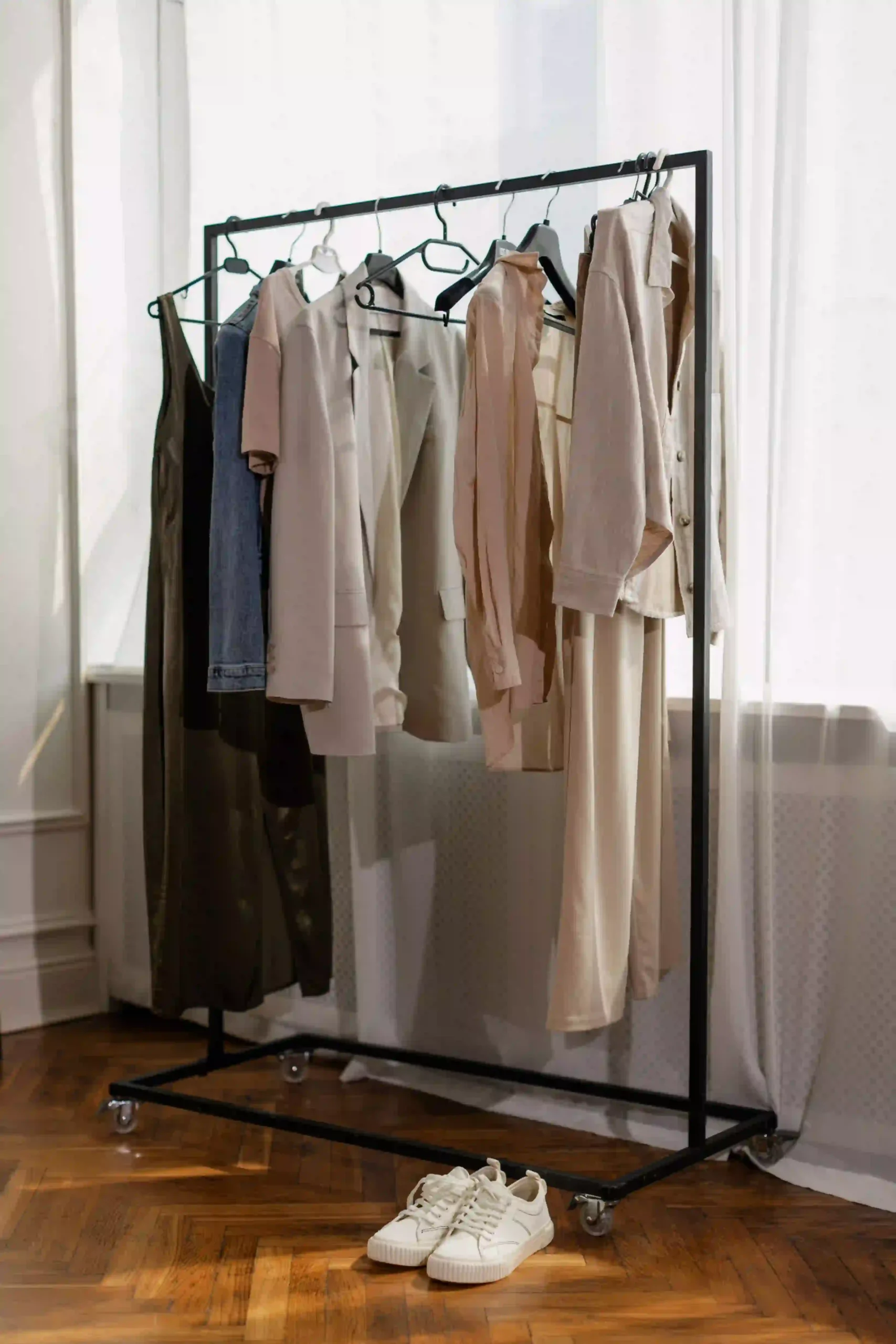
Swap slots, not the system, when the season changes:
| Season | Swap in | Swap out |
|---|---|---|
| Fall | A fine-gauge merino crew and a bootie with real grip | The tank, once layering season starts |
| Winter | One heavy knit counted as a top, plus a boot that fits over the trouser | The skirt, unless opaque tights solve it |
| Spring | An unlined jacket or trench worn as the third layer | Nothing, if your weights already sit in the mid band |
| Summer | A linen shirt and a strappy sandal that passes the three-bottom test | The loafer, which reads heavy in August |
The 333 Method as a Packing System
This is where the method is least controversial and most useful. Nine pieces fit in any carry-on with room left over, and the mix-and-match math covers a week without a checked bag. Explore.com’s write-up of the trend leans exactly here: fewer items means no checked-bag fee, no bag-carousel wait, and more room for what you buy at the destination.
Writers who have tested it on real trips report numbers that line up with the math. Travel + Leisure sent an outdoor writer to Scotland for 12 days on a carry-on built with the 333 method, and The Everygirl’s editor packed nine items for Europe and logged more than 16 outfits. For trips longer than a week, plan one laundry stop instead of more clothes.
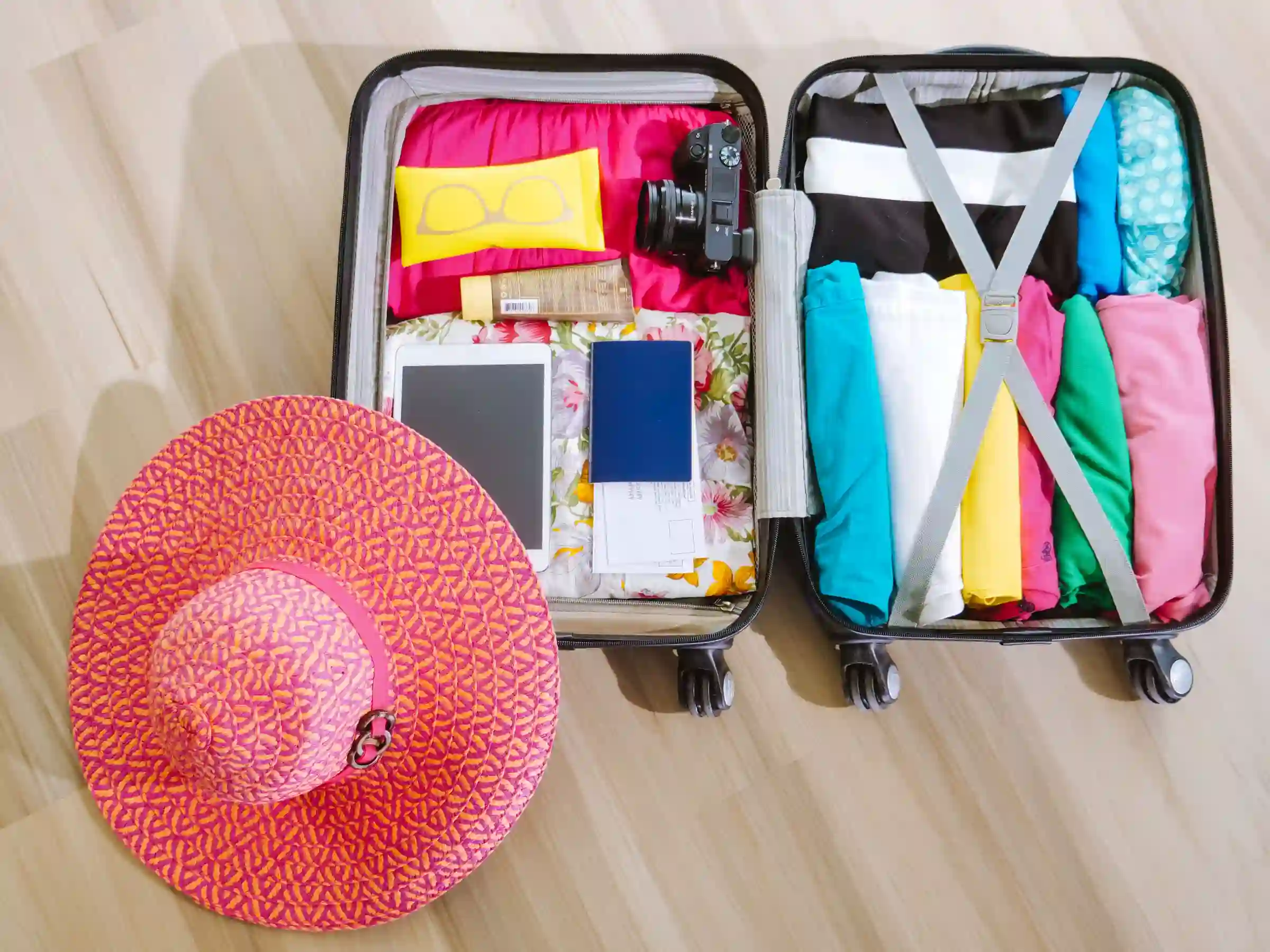
If nine feels too austere for a first attempt, the 5-4-3-2-1 packing rule is the gentler on-ramp: five tops, four bottoms, three dresses or rompers, three pairs of shoes, two swimsuits, two bags, one hat. Same discipline, more slack. And for the longer argument about what actually earns space in a suitcase, the travel wardrobe essentials guide makes the case at full length, including the fabric and repetition math.
Who the 333 Method Is Not For
Three situations where the challenge creates stress instead of clarity. If your job runs on a uniform or a strict dress code, nine pieces will fight your weekdays instead of simplifying them. If you are in a size or shape transition, a locked rotation is the wrong moment; rebuild first, then play the game. And if you produce content or client work that requires visible novelty, repetition is a professional problem, while repetition is this method’s core mechanic.
It is also worth saying plainly that restriction is not automatically a virtue. Some readers find a tight rotation calming and others find it suffocating, and neither response says anything about discipline. For the second group, the method is a two-week experiment at most.
Making the 333 Method Fit Your Actual Week
If you are packing a carry-on: run the method exactly as written, wear the bulkiest shoe on the plane, and plan the nine pieces around your coldest expected morning, not your average one.
If you are rebuilding a wardrobe from scratch: do not shop for the challenge. Pull the nine from what you own, note every gap you hit during the week, and let that gap list become your next three purchases. The challenge should feed your capsule, not your checkout cart.
If you already know your aesthetic: skip the neutral-default advice above and run the 70-30 split in your own palette. A head-to-toe color lover can make the method work with three shades of one family, because the rule is coherence, not beige.
Frequently Asked Questions About the 333 Method
What is the 333 method for outfits?
The 333 method outfits challenge asks you to pick three tops, three bottoms, and three pairs of shoes, then build every look for a set week or trip from only those nine pieces. TikTok creator Rachel Spencer coined the format in 2023, and the nine pieces can combine into up to 27 outfits.
How many outfits can you make with the 3-3-3 rule?
The mathematical ceiling is 27, because three tops times three bottoms times three shoes equals 27 combinations. In practice, Spencer styled 19 distinct looks in the video Refinery29 reported on, and 15 to 20 honest combinations is a typical working number before accessories add variety.
What is the difference between the 333 method and Project 333?
Project 333 is Courtney Carver’s 2010 minimalism challenge of dressing with 33 items, including accessories and jewelry, for three months. The viral 333 method uses nine clothing and shoe pieces for a week or a trip, leaves accessories free to rotate, and works as a styling and packing game rather than a minimalism practice.
Does the 333 packing method work for carry-on travel?
It is the method’s strongest use. Nine pieces fit in a carry-on with room left over, Travel + Leisure’s writer ran a 12-day Scotland trip on the system, and The Everygirl’s editor logged more than 16 outfits from nine items in Europe. For trips past a week, plan one laundry stop instead of extra clothes.
What clothes should you pick for a 333 capsule wardrobe?
Start from pieces you already wear weekly, hold them to one color story with a dominant neutral, keep the fabric weights compatible so everything can layer, and choose shoes last, keeping only pairs that work with all three bottoms.
The Point Is Not the Nine Pieces
The 333 method outfits challenge ends after a week, and most people return to their full closet. What stays is the information: the three pieces that carried five of your seven outfits, the shoe that worked with everything, the top that never left the hanger. That is an audit, a shopping list, and a small argument against buying anything new this month, all from one quiet week of nine pieces.
Run it once before your next trip or your next season, and let the repeats tell you what your wardrobe actually is.
Sources
Official Sources
Be More with Less: Project 333 Challenge, accessed August 15, 2026
Industry Sources
Refinery29: TikTok’s 333 Method Maximizes A Capsule Wardrobe, accessed August 15, 2026
Travel + Leisure: I Packed for 12 Days Using the 333 Packing Method, accessed August 15, 2026
The Everygirl: What Is the 333 Styling Method?, accessed August 15, 2026
Explore.com: TikTok Is Obsessing Over A Viral Packing Method That Saves Space and Style, accessed August 15, 2026