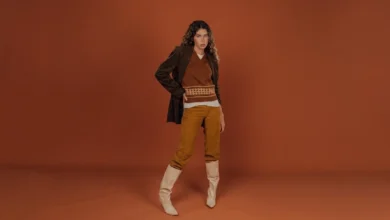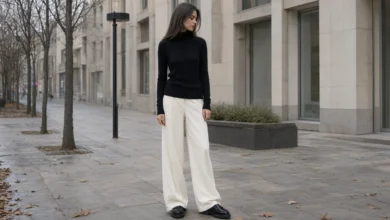
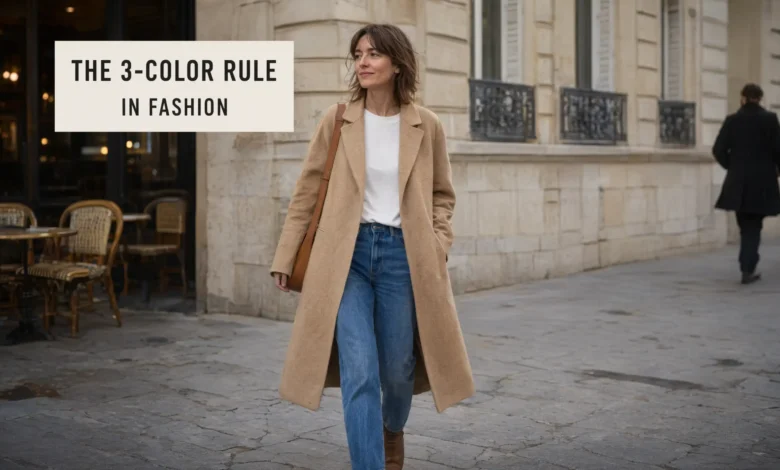
We have all had that mirror moment. You put on a camel coat, a crisp white shirt, and black trousers. Every single piece is objectively fine, but the reflection just looks like a pile of clothes rather than an outfit. Then you swap the black bag for a structured red one, and suddenly the whole thing looks deliberate. That gap between “fine” and “intentional” is almost always a color decision. It is also the exact gap the 3 color rule fashion formula was built to close.
Stylists keep coming back to this rule because it is one of the few styling tricks you can check in a hallway mirror without needing a color wheel. You just count the hues. If you hit four, something has to go. It survives for the same reason good kitchen rules survive: it turns a vague feeling of off into a countable, fixable problem.
Here is the working version of the rule, the very real debate about whether black and white actually count, the 60-30-10 ratio we borrowed from interior design, and the color wheel pairings that make three hues actually agree with each other. And because a styling rule that never gets broken is just a costume, we will also cover when wearing more than three colors is exactly the right call.
To use the 3 color rule in fashion, cap each outfit at three visible colors: a dominant color that covers the most surface area, a secondary color that supports it, and one accent that provides the pop. Count your shoes, your bag, and each separate hue in a print. Decide once whether neutrals like black and white take up a slot in your personal system, and keep the dominant color near 60 percent of the look so one hue clearly leads.
What the 3 Color Rule in Fashion Actually Says
The rule caps an outfit at three visible colors, and the word visible is doing a lot of heavy lifting here. Your shoes count. Your bag counts. The belt, the scarf, and the hat you grabbed on your way out the door all count. The rule cares about what a stranger sees on the street, not what you intended when you got dressed. Celebrity stylist Liz Teich, founder of The New York Stylist, sums it up perfectly in an interview with Parade: “If you are struggling with any outfit, if you stick to three colors maximum, it will work.”
Teich teaches this to her clients using a simple hierarchy: “most, less and least.” One hue appears the most and acts as the hero of the look. A second hue shows up a little less. The third acts as what she calls the cherry on top. In one of her own outfits, she cast brown as the hero, beige as the secondary, and gold as the accent. It issolid proof that the rule works just as well for people who barely wear color at all.
The three roles at a glance:
- Dominant: The hue covering the most surface area, usually your largest garment.
- Secondary: The supporting color, present at roughly half the dominant’s visual weight.
- Accent: The small pop at the collar, the wrist, the hand, or the hem.
Prints are where the math gets technical. The most honest way to count a pattern is by its separate hues. Teich’s shortcut is to let the print set the menu. If a dress carries black, red, and white, those become your three colors, and you just pull one shade out of the pattern to echo in a shoe or a bag. But a busy floral with seven distinct hues counts as seven. That is exactly why those prints feel so much harder to style. They are spending your entire color budget before you have even put on a shoe.
Do Black and White Count in the 3 Color Rule?
This is a genuine split in the styling world, not a settled fact, and you will find working professionals on both sides of it. One camp treats black and white as tones rather than true colors, meaning they sit outside the count and can be layered freely. That is the version style blogger Jo-Lynne Shane describes, where black and white act as exceptions you can mix in without adding to your tally.
The other camp counts every neutral that occupies real surface area, and Teich lands firmly in this group. “In my world, especially as a New Yorker, black is a color,” she noted in that same Parade interview. The fashion team at PureWow reports the exact same disagreement and ultimately sides with the count-them camp, pointing out that stylist Ellie Richards, who specializes in fashion psychology, builds her dominant, secondary, and accent slots with neutrals fully included in the tally.
The two counting conventions:
- Strict count: Black, white, and every neutral take up one of the three slots. An all-black outfit with a white shirt and a red bag is already at three.
- Neutrals exempt: Black and white sit outside the count, leaving the three slots strictly for colored hues.
- The part that actually matters: Pick one convention and stick to it. The rule collapses the second you switch systems mid-outfit.
My own practice sits with the strict camp for one very practical reason. The rule exists to limit visual busyness, and a head-to-toe look of black, white, grey, and camel can feel just as cluttered as an outfit in four loud hues. Denim is the one neutral I treat a bit more generously. A mid-blue jean behaves like a neutral base in most outfits the way black does, so I count it as a background tone unless the denim happens to be the loudest thing I am wearing.
The 60-30-10 Color Rule, Borrowed From Interior Design
The 60-30-10 ratio did not actually start in fashion. The Spruce describes it as a straightforward, timeless interior decorating tool where 60 percent of a room carries the dominant color, 30 percent takes a secondary color, and 10 percent acts as an accent. Fashion borrowed the math because the human eye reads a body the exact same way it reads a living room. Visual balance comes from one hue clearly leading the way, not from three equal shares fighting for attention.
|
Share of the look
|
Role
|
Where it usually lands
|
Worked example
|
|---|---|---|---|
|
60 percent
|
The dominant color, setting the tone
|
Your largest pieces, like a coat plus trousers, or a dress on its own
|
A camel coat over a cream sweater and cream trousers
|
|
30 percent
|
Secondary support, present but never competing
|
A contrasting bottom or a substantial mid-layer
|
A chocolate brown skirt swapped in under that same camel coat
|
|
10 percent
|
The accent, small enough to read as deliberate
|
Shoes, a bag, a scarf, jewelry, even a lip color
|
One red bag, with the heel echoing it quietly
|
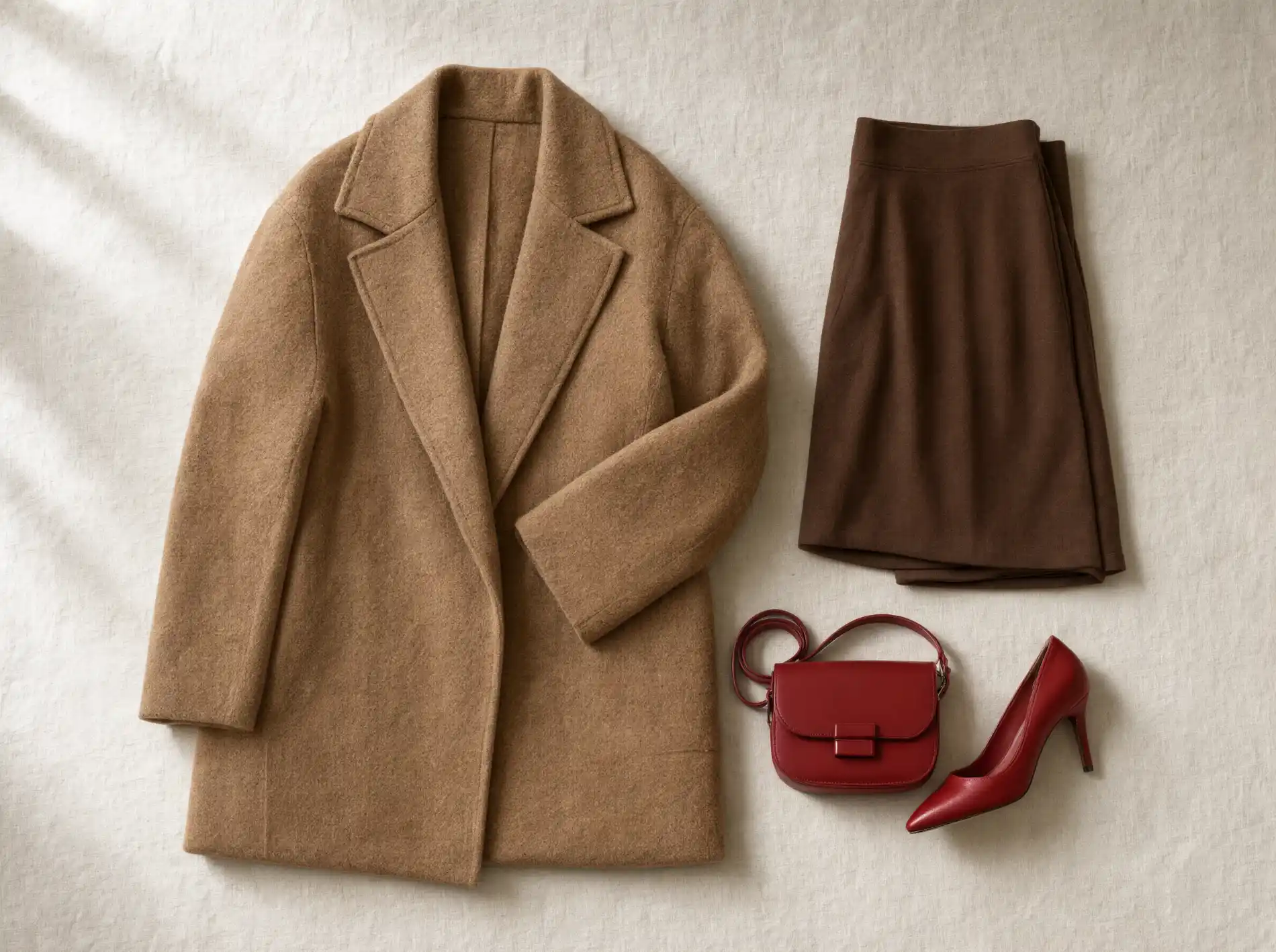
Treat these percentages as a direction for the eye, not a rigid measuring assignment. If you cannot tell at a glance which hue is your 60, the outfit has no leader. That leaderless feeling is exactly what people mean when they say a look feels mismatched. This ratio also explains why the exact same red bag finishes one outfit perfectly and completely wrecks another. In the first outfit, red had an empty 10 percent slot waiting for it. In the second, three other colors were already shouting.
How to Match Colors in Clothes With the Color Wheel
Once you have your three slots locked in, the color wheel decides which hues actually get along. Vogue’s fashion team lays out the core pairings plainly. Complementary colors sit opposite each other—think red and green, orange and blue, or yellow and purple—and they create the highest contrast available. Analogous colors are neighbors on the wheel and produce a much calmer, tonal effect. Monochromatic dressing runs one hue through several different shades, while triadic schemes space three hues evenly for days when color is the entire point of the outfit.
|
Scheme
|
How it sits on the wheel
|
Outfit example
|
When it tends to work
|
|---|---|---|---|
|
Complementary
|
Opposite pairs, blue against orange being the classic
|
Navy trousers with a cognac leather belt and bag
|
When you want real contrast from only two hues plus a neutral base
|
|
Analogous
|
Neighbors, like blue, teal, and green
|
A denim shirt under a teal knit with olive trousers
|
Quiet depth that still registers as separate colors, great for offices
|
|
Triadic
|
Three hues spaced evenly, red, yellow, and blue among them
|
A red skirt, a soft yellow cardigan, blue echoed in the scarf
|
Bolder days when the color is the statement and the cut stays simple
|
|
Monochromatic
|
One hue in several shades, cream through espresso
|
Head-to-toe camel with a darker boot and a lighter knit
|
When you want the rule to mostly retire, because one hue does all the work
|
Two small refinements make the wheel behave much better in real closets. First, keep the temperature consistent. Teich advises sticking to the same family of tones, meaning cool looks stay in blues, greens, and purples while warm looks live in reds, oranges, and yellows. Mixing temperatures is usually what makes two technically correct hues feel completely wrong together. Second, mute at least one member of any complementary pair. Full-strength red against full-strength green reads like a holiday costume. Brick red against olive, on the other hand, reads like a very good Tuesday outfit.
When More Than Three Colors Works, and When It Reads Busy
Wearing more than three colors fails when the hues arrive as equals, with each one demanding the exact same amount of attention. It succeeds when one element clearly leads and the rest fall into support. That is how printed dresses, intentional color blocking, and maximalist styling manage to carry four or five hues without descending into chaos. The rule is really just a baseline to break on purpose. It is the same instinct behind the sandwich rule, which balances where colors sit instead of counting how many you wear.
The rule also helps some closets a lot less than others. If you wear a uniform or adhere to a strict dress code, your color decisions are mostly made for you. If you dress monochromatically by preference, the rule has nothing to correct. And if your wardrobe leans heavily on large, multicolor prints, a head count becomes pretty arbitrary because one single garment spends the whole budget. None of that makes the rule wrong. It just makes it a diagnostic tool, useful exactly when an outfit feels off and you cannot quite say why.
Using the Rule in a Real Closet
If You Get Dressed in a Hurry Pre-decide your base so only one decision is left in the morning. A neutral base of black, white, or camel means the only color choice you have to make at 7 a.m. is the accent. Even a wrong accent still lands safely inside three colors. This is the fastest version of the rule because it reduces a styling decision down to a single variable.
If Your Closet Skews Neutral Neutral dressing is not an exemption from the rule, as Teich’s brown, beige, and gold outfit proves. Tonal neutrals still occupy the dominant, secondary, and accent slots, and the look improves vastly when you assign them on purpose instead of by accident. Restraint at this scale is also what makes a rare loud color actually land. Marie Claire has tracked how seldom orange, purple, or dark brown appear in Princess Kate’s wardrobe, and that rarity is precisely why those shades read as such strong statements when they do show up.
If You Are Rebuilding Your Wardrobe Choose the palette before you make the purchases. A capsule wardrobe built on a fixed 70 percent dominant and 30 percent accent palette means nearly every piece already agrees with nearly every other piece. The 3 color rule stops being a morning task because the math was settled at the store. Carried through for a season or two, that palette hardens into a signature style, at which point the rule has done its job and can quietly step aside.
Frequently Asked Questions About the 3 Color Rule
What is the 3 color rule in fashion?
It is a styling guideline that caps an outfit at three visible colors: a dominant hue, a secondary hue, and one accent. Shoes, bags, and each separate hue in a print all count toward the three. The goal is visual balance rather than strict arithmetic.
Do black and white count in the 3 color rule?
Stylists genuinely disagree on this. Some treat black and white as tones that sit outside the count, while others, including celebrity stylist Liz Teich, count black as a color like any other. Pick one convention and apply it consistently, because the rule falls apart when you switch systems mid-outfit.
What is the 60-30-10 rule in fashion?
It is a proportion formula borrowed from interior design. Roughly 60 percent of the look sits in the dominant color, 30 percent in a secondary color, and 10 percent in an accent. This ensures one hue clearly leads and the accent stays small enough to read as intentional.
What happens if you wear more than three colors?
Nothing catastrophic. The outfit simply reads busier, with each hue competing for attention. Prints, deliberate color blocking, and maximalist styling can easily carry four or more hues, and they work well when one element clearly leads and the rest support it.
How is the sandwich rule different from the 3 color rule?
The 3 color rule limits how many hues an outfit holds, while the sandwich rule balances where colors sit by bookending a contrasting middle with matching tones at the top and bottom. They stack well together, and neither is a hard law.
Why the Three Color Rule Keeps Coming Back
Most styling rules age out the second the trend that produced them fades away. This one persists because it describes how human eyes actually work, not how a particular season happened to look. One leading hue, a supporting cast, and a single loud note read as intention. Equal, competing hues just read as noise.
Used as a baseline, the 3 color rule fashion shorthand makes a closet infinitely more mixable and mornings measurably shorter. Used as a strict law, it would flatten every good instinct you have. Keep it where it belongs: in the mirror, at the exact moment an outfit feels off and you want to know why.
Try this for one week. Count the hues in what you actually wore, not what you planned to wear. The number you keep landing on is your real starting point, and the gap between that number and three is the entire rule.
Sources
Industry Sources
- Vogue: How to Master Color Theory in Clothing Like a Vogue Fashion Editor, Access Date: August 21, 2026
- The Spruce: Perfecting the 60-30-10 Rule in Your Living Space, Access Date: August 21, 2026
- Parade: ‘3-Color Rule’ To Follow, According to a Celebrity Stylist, Access Date: August 21, 2026
- PureWow: What Is the Three-Color Rule for Fashion?, Access Date: August 21, 2026
- Marie Claire: Princess Kate Rarely Wears These Three Colors, Access Date: August 21, 2026
Additional Reading
- Jo-Lynne Shane: Fashion Hacks: The 3-Color Rule, Access Date: August 21, 2026
- With a Touch of Luxe: How To Add Color to Your Outfits Using the 3 Color Rule, Access Date: August 21, 2026