
You know the fitting-room moment. The dress fits your shoulders, fits your hips, and hangs like a column between them, and you assume something is wrong with the dress, or with you. Neither is true. A rectangle body shape, sometimes called a straight or banana shape, carries its width evenly from shoulder to hip, which is why most guides on how to dress for a rectangle body shape open with a belt and close with a pep talk.
Here is the part those guides tend to skip: the straight line is exactly why tailored clothes look so expensive on you. Blazers, trenches, column dresses, and wide-leg trousers hang the way they were drafted, with no pulling at the bust and no straining at the hip. Dressing a rectangle is really two conversations, and you get to pick per outfit. Build a waist with construction, or keep the column and let it read as intentional.
This guide covers both directions, with the mechanics behind each move, the dress and denim cuts that do the work for you, and the few combinations that tend to fall flat on a straight frame.
To dress a rectangle body shape, put the waist in the garment instead of the body: 1) cinch with construction, meaning belts, wrap ties, peplum, and ruching; 2) add volume above and below the waistline with boat necks, puff sleeves, and A-line or flounced hems; 3) choose high-rise bottoms with curve in the leg, like bootcut, flare, and wide-leg; 4) on ease days, skip the waist entirely and let structured column pieces hang straight.
What Actually Counts as a Rectangle Body Shape
The working definition fit professionals use is proportional, not visual. In the measurement method popularized by fit expert Bradley Bayou and published on Oprah.com, a rectangle means your shoulder, bust, and hip measurements fall within 5 percent of each other, and your waist is less than 25 percent smaller than your bust or shoulders. Bayou’s own example does the math for you: if your shoulders measure 36 inches, a rectangle waist lands at 27 inches or more.
Calculator.net’s body type calculator runs a friendlier imperial version of the same idea, placing the waist at less than 9 inches smaller than the hip or bust. Run both on the same numbers and they largely agree, which is more consistency than you get from most body-shape quizzes.
If you have not measured lately, our guide on how to find your body shape in four simple steps walks the tape around shoulders, bust, waist, and hips without guesswork.
A few things the definition clears up right away. Rectangle is about ratios, not weight or clothing size, and plus-size rectangles are as common as slim ones. The shape also shows up constantly in fashion coverage: Cameron Diaz, Natalie Portman, Keira Knightley, and Kate Moss are all regularly cited as rectangle frames in stylist guides. And because the proportions are balanced, weight changes tend to land evenly or at the middle, which matters later when we get to ruching.
Two Directions, and Both Are Legitimate
Most rectangle advice rushes straight to curve-building and skips the part where the column is an asset. Professional stylist Elysha Lenkin, who has spent more than 20 years dressing clients, puts the range plainly on her site: “Many models have a rectangle body shape because pretty much every style works for this type.” That is the frame worth holding. A straight body is not a problem to be solved in every outfit. Some days the job is building a waist, and some days the job is letting a clean line do what only a clean line can.
At a glance: two directions for a straight frame
- Build a waist: belts, wrap ties, peplum, ruching, color blocking, tucked-in tops. Best when you want shape to be part of the story.
- Keep the column: structured blazers, shift dresses, trenches, straight-leg denim. Best when you want ease and a long, expensive-looking line.

The rest of this guide treats the first direction as the main event, because it is what most readers came here for. But notice which pieces appear in both columns. A belted trench and an open trench are the same garment doing two different jobs, and that flexibility is the rectangle’s quiet advantage.
How to Create a Waist With Construction, Not Compression
The fastest waist on a straight frame is a garment that arrives already nipped in. A belted jacket or trench does this with hardware and fabric instead of asking your body to supply the curve. The same goes for a blazer closed with a single button at the waist, a motorcycle jacket that ends at the hipbone, and any coat with a self-belt tied slightly off-center so the fabric breaks the straight line.
Our guide to when a belt earns its place covers width and placement in detail, and the short version for rectangles is that a medium belt worn at the natural waist over something structured outperforms a skinny belt worn over something shapeless.
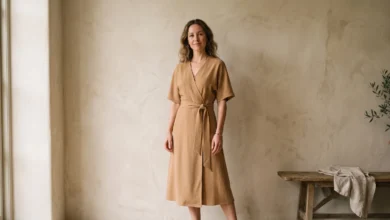
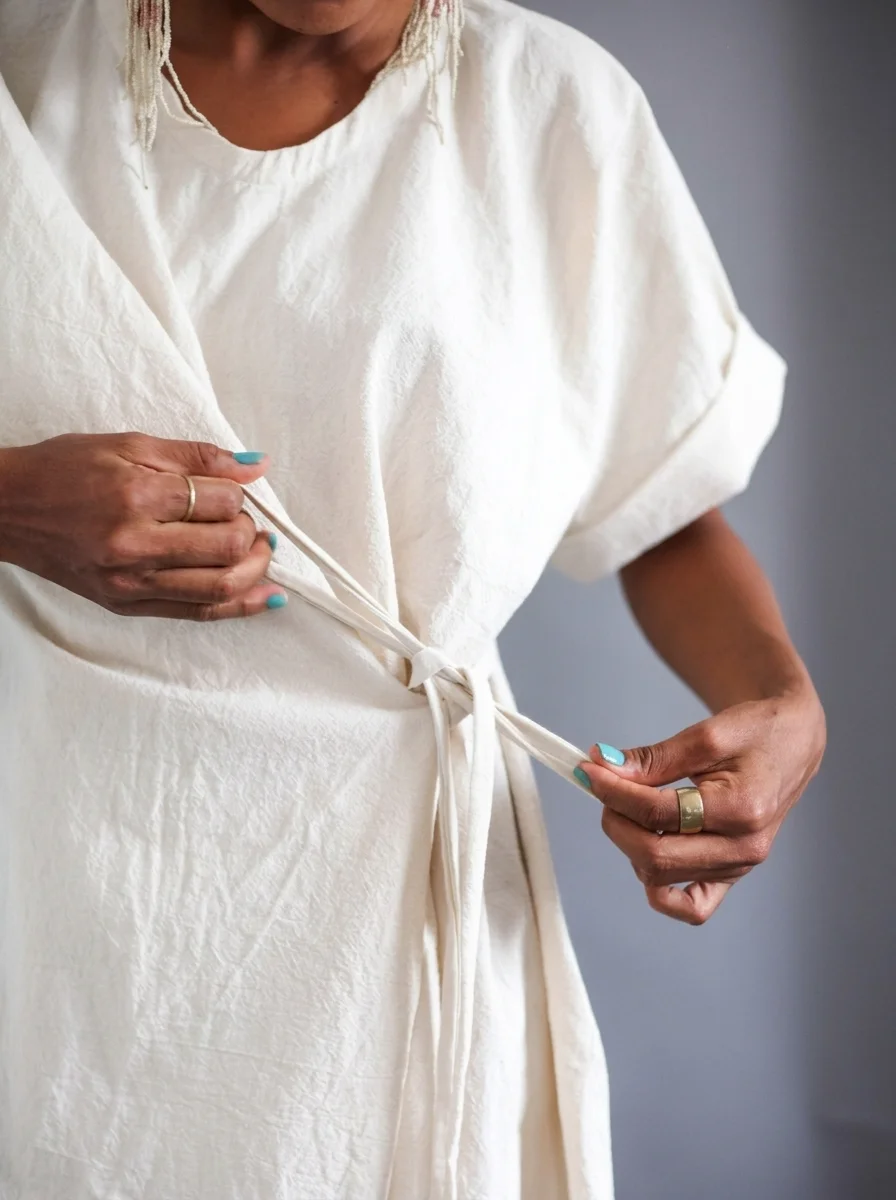
Wrap dresses and tie-waist tops are the second lever, and they matter more for rectangles than for any other shape because the tie lets you set the waist yourself, an inch higher or lower depending on the day. Ruching works the same way. Gathered fabric at the side seam implies a curve without needing one underneath, which is also why ruched one-pieces and side-shirred swimsuits show up so often in rectangle styling advice.
Then there is volume placement, the lever most people skip. A waist only reads as a waist by contrast, so adding width above and below the middle makes the middle narrow by comparison. Boat necks and off-shoulder lines widen the shoulder reading. Puff and flutter sleeves do the same job with less skin. Below the waist, peplum tops, flounced hems, and A-line skirts that start at the natural waist add the other half of the contrast. Worn together, a boat-neck top and an A-line midi skirt manufacture an hourglass outline out of two straight pieces.
Two quieter moves deserve mention. Color blocking with a darker band at the middle, say a charcoal belt over a cream dress, sharpens the waistline the way a frame sharpens a print. And tailoring is the rectangle’s best-kept secret. Taking a straight blazer or sheath dress in at the side seams is a small, inexpensive alteration because there is less reshaping involved than with a curvier frame. If you own one shapeless dress you love, a seamstress and an afternoon can give it princess seams.
The Dresses That Do the Work for You
Dress shopping is where rectangle frames feel the fit gap most acutely, because so many dresses are drafted assuming a waist suppression a straight body does not supply. The silhouettes below bring their own.
| Silhouette | What it does on a straight frame | What to look for on the rack |
|---|---|---|
| Wrap dress | Lets you tie the waist into existence at exactly your height | A true overlap front, not a faux wrap, with a tie long enough to double-knot |
| Fit-and-flare | Nips at the bodice, then adds hip volume your body does not have to supply | Seams that hit your natural waist rather than dropping an inch low |
| Belted shirt dress | Column when open, curve when belted, two outfits in one garment | Cotton poplin or crepe with enough body to hold the blouson |
| Peplum sheath | Draws the waist, then flares over the hip for instant contrast | A peplum starting at the waist seam; stiff ponte holds the flare best |
| Ruched bodycon | Gathering at the side seam implies the curve even under compression | Ruching placed at waist and hip, not scattered like a print |
Shift dresses get unfairly maligned in rectangle advice. On your frame a shift hangs the way it was intended to, which is more than most bodies can say. Keep it for column days and add a belt when you want the other story.
Rectangle Body Shape Jeans, Pants, and Tops
Denim follows the same logic as the dresses: add curve below the waist, or commit to the straight line on purpose. Bootcut and flare jeans widen from the knee, which throws the hip into relief and makes the waist read smaller by contrast, and wide-leg jeans do a bolder version of the same trick. Rise matters more for rectangles than for almost any other shape, because a waistband at the natural waist gives your tops and belts a real landmark to cinch against.

Democracy Clothing’s fit team makes a similar case for relaxed high-rise cuts like the mom jean, noting that a straighter leg balances a straighter torso. Our technical guide to buying jeans that fit goes deeper on rise, stretch, and denim weight when you are ready to shop.
Straight and skinny jeans are not forbidden. They are a column choice, and they look most intentional paired with something nipped or tucked up top. Low-rise straight cuts are the one combination that tends to work against you, because they visually lengthen an already balanced torso.
For trousers, the rectangle-friendly list runs to high-waisted wide-leg pants, pleated-front trousers that add volume below the waistband, and paperbag waists with their built-in cinch. For tops, the reliable moves are the ones already on the table: tuck or half-tuck anything that would otherwise hang untucked, crop to a high-rise waistband, and reach for detail at the shoulder or chest when a top is plain. Pocket details, ruffles, and a horizontal stripe across the bust all add the upper volume that makes a waist possible.
What Tends to Fall Flat on a Straight Frame
A few combinations consistently underdeliver for straight frames, and it helps to know why rather than memorize a list. Head-to-toe volume with no waist point, like an oversized drop-shoulder hoodie over wide-leg sweats, erases the frame entirely and reads as shapeless rather than relaxed.
An unbelted shift in a stiff fabric with no drape can do the same. Low-rise skinny jeans with an untucked boxy tee lengthen the torso and flatten the hip at once. And waistbands that sit an inch below the natural waist hover in the one place your body does not curve, which is why gaping and spilling both happen there on rectangles.
The fix in every case is the same: add one waist point, or commit fully to the column with structured fabric. Shapelessness is what happens in between.
Three Situations, Three Shortcuts
If you get dressed in five minutes: own one belted topper and one wrap dress per season and treat them as the default. A belted trench over a tucked tee and straight pants puts the waist in the hardware, not in your morning headspace.
If your body has changed and the old formulas stopped working: proportions usually stay rectangle even when sizes shift, so the framework still applies. Start with wrap ties and ruching, which adjust to you instead of demanding an exact waist measurement, and reintroduce tailored pieces when you feel like yourself again.
If you love minimal, tailored dressing: you do not need curves to look intentional. Keep the column with structured blazers and straight denim, and let one quiet waist point, a tucked shirt or a closed blazer button, do the work.
Frequently Asked Questions About Rectangle Body Shape Styling
How do I know if I have a rectangle body shape?
Measure your shoulders, bust, waist, and hips with a soft tape. If your shoulders, bust, and hips fall within 5 percent of each other and your waist is less than 25 percent smaller than your bust or shoulders, you land in rectangle territory. Calculator.net uses a simpler imperial shortcut: a waist less than 9 inches smaller than your hip or bust. Our four-step body shape guide walks the full measuring process.
Is a rectangle body shape the same as a banana or straight shape?
Yes. Rectangle, straight, banana, column, H-shape, and athletic all describe the same proportional pattern of nearly equal shoulders, bust, and hips with a subtle waist. The nicknames change by stylist and by decade, but the measurement rules behind them are identical.
What jeans are best for a rectangle body shape?
High-rise cuts with curve in the leg: bootcut, flare, and wide-leg. The widened hem throws the hip into relief so the waist reads smaller by contrast, and a high waistband gives belts and tucked tops a landmark. Straight and skinny jeans still work when you want the column look, paired with a nipped or tucked top.
What swimsuit works for a rectangle body shape?
Nearly everything in this guide on how to dress for a rectangle body shape transfers to the pool. Ruching at the waist, a color-blocked one-piece with a darker middle, a belted tankini, and high-waisted bottoms with a flounced or skirted hip all build the same contrast in swim fabric. Save the flat, sporty single-color cut for lap days when you want shape elsewhere.
Rectangle vs apple body shape: what’s the difference?
A rectangle carries its width evenly from shoulder to hip with a subtle waist, while an apple shape carries more through the middle with comparatively slimmer hips and legs. That difference changes the strategy. Apple styling flows fabric over the midsection with empire seams and open front layers, while rectangle styling either builds a waist with construction or celebrates the straight column.
The Straight Line Is the Asset
Every shape framework in fashion, including this one, is a sorting tool, not an identity. Its only job is to shorten your morning. For a rectangle frame, the whole skill fits in one sentence: put the waist in the garment when you want one, and trust the column when you do not. Measure once, pick two construction levers from this page, and give one beloved shapeless piece to a tailor for princess seams.
That single alteration tends to teach the system faster than any shopping trip, because you watch a straight line learn to curve under your own hands. From there, how to dress for a rectangle body shape stops being a rulebook and becomes what it should have been all along, a menu.
Sources
Industry Sources
- Democracy Clothing: Body Type 101: Best Jeans for Rectangle Body Shape, Access Date: August 6, 2026
- Oprah.com: What’s Your Body Shape? (Bradley Bayou measurement method), Access Date: August 6, 2026
- Elysha Lenkin: What To Wear When You Have A Rectangle Body Shape, Access Date: August 6, 2026
Additional Reading
- Calculator.net: Body Type Calculator, Access Date: August 6, 2026
- Gabrielle Arruda: Rectangle Body Shape: Guide to Building a Wardrobe, Access Date: August 6, 2026