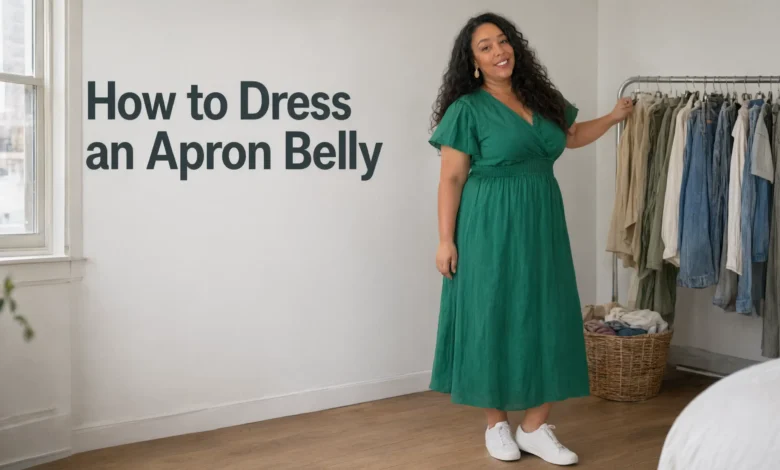
There is a specific fitting-room moment that sends most people searching for how to dress an apron belly. The jeans felt promising on the hanger, then the waistband folded over the lower belly or sliced straight across it, and suddenly the whole pair reads wrong. The pair is not the problem. The rise is.
An apron belly, called a pannus in clinical language, is the soft overhang of tissue below the navel. It arrives after pregnancy, after significant weight loss, around menopause, after surgery, or from plain genetics, and it is one of the most common body features I get asked about and one of the least accurately styled, because most advice jumps straight to compression before ever asking where a waistband should land.
So this is not an erasure guide. Some days you will want to skim and define, and some days you will wear the fitted thing and mean it, and both are fine. What follows is the mechanics for the days you want to skim: where the waistband sits, what the fabric weighs, and where the eye travels.
To dress an apron belly, follow four fit rules: 1) place the waistband above the overhang with a true high rise or below it with a low rise, and skip the mid rise that cuts across it; 2) choose fluid mid-weight fabrics, roughly 150 to 220 grams per square meter, that skim instead of clinging or tenting; 3) put waist definition above the belly with wrap ties, empire seams, peplums, or a belt at your smallest point; 4) treat shapewear as an optional smoothing add-on, never the foundation of the outfit.
What an Apron Belly Is, and Why It Is So Common
The overhang is normal anatomy, not a failure of discipline. In the United States, 32.4 percent of all 2024 births were cesarean deliveries according to the CDC’s National Center for Health Statistics, and a healing scar line changes how tissue settles for years afterward.
Research published in PubMed Central reports diastasis recti abdominis, the abdominal muscle separation that frequently accompanies the overhang, in 39.3 percent of women at six months postpartum and 32.6 percent at twelve months. Add menopause, which redistributes tissue toward the lower abdomen, and ordinary weight fluctuation, and the apron belly is less an exception than a standard feature of adult bodies.
Lola Rykiel, the designer behind Pompom Paris, put the framing perfectly in Vogue after her own C-section recovery: “I gave birth to another human, how am I supposed to look like someone who never did?” That is the stance this guide takes. The goal is choice, so you can skim on the days you want to and skip the squeeze on the days you do not.
How to Dress an Apron Belly: The Three Levers
Every skimming outfit I have ever liked on a client or on myself pulls one of three levers, and the first is rise. The waistband has only three places it can sit relative to the overhang: above it, below it, or across its fullest point. The first two skim. The third creates the exact shelf line people are trying to avoid, and it is the default position of most mid-rise pants, which is why so many wardrobes feel like they stopped working at the same moment the body changed.
The second lever is drape, and this is where the site’s usual fabric-weight logic applies directly. Fiber name matters less than weight and hand. A light jersey knit under 150 grams per square meter clings to every contour and shows the shelf edge. A fluid woven in the 150 to 220 range, think crepe, modal, or rayon, skims the overhang and falls straight. A structured woven from 220 to 300, like denim or a heavy poplin, holds its own line and bridges the curve entirely.
| Fabric feel and weight | What it does over a lower belly | Where it earns its hanger |
| Light knits under 150 grams per square meter, like jersey tees | Clings to every contour and shows the shelf edge | Fine under an open layer, risky on its own |
| Fluid wovens, 150 to 220 grams, like crepe, modal, and rayon | Skims the overhang and falls straight | Dresses, wrap tops, wide-leg trousers |
| Structured wovens, 220 to 300 grams, like denim and heavy poplin | Holds its own line and bridges the curve | High-rise jeans, A-line skirts, unstructured blazers |
| Stiff papery cotton at any weight | Tents outward from the belly even when the hem stands away | Usually the disappointing choice, sadly |
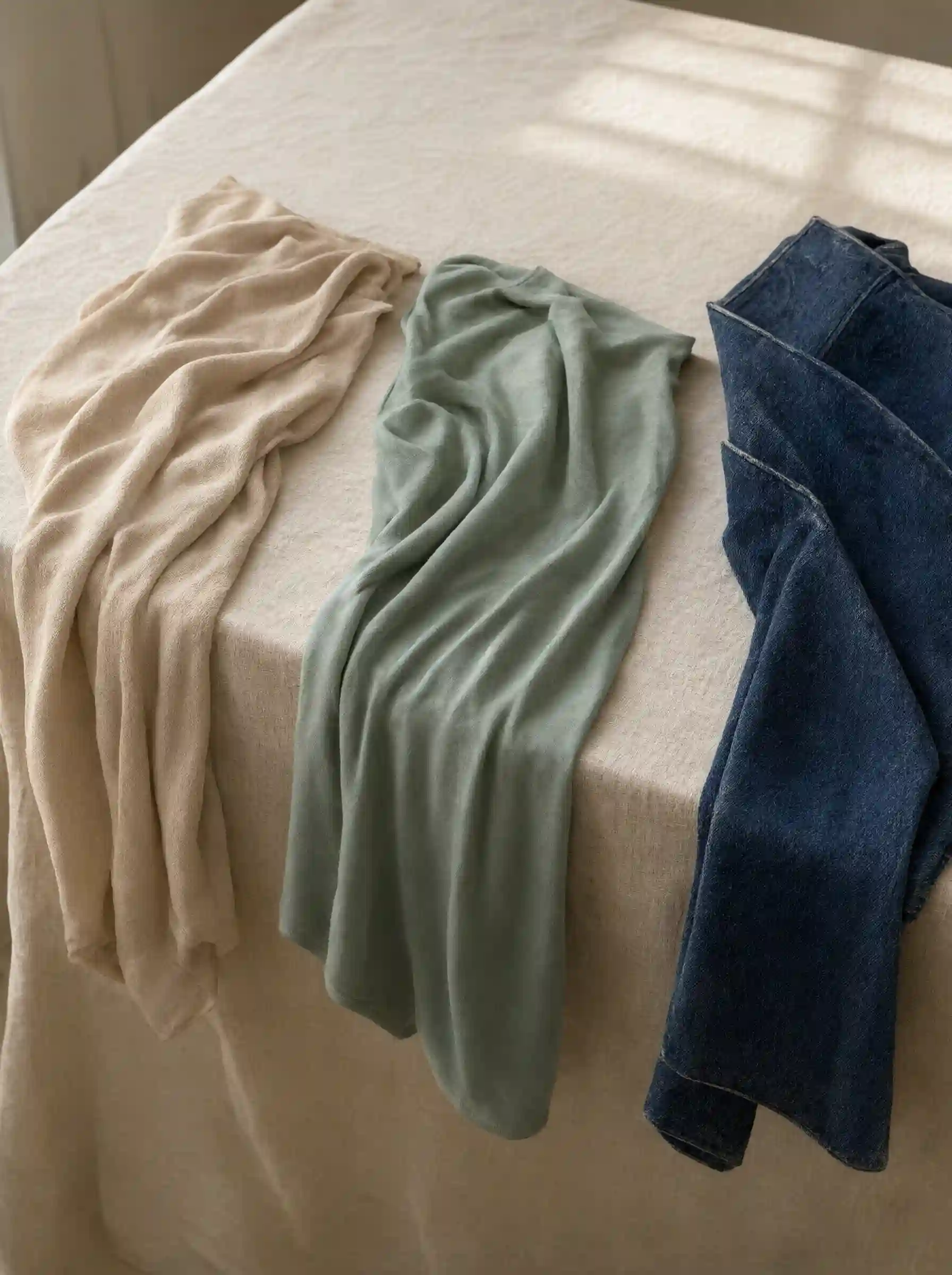
The third lever is definition, and the placement rule is the one people miss: define the waist above the belly, not at it. Wrap ties, empire seams, peplum flares, and a belt worn at your smallest point all tell the eye where your waist is before it can guess. This is the same logic our apple shape guide uses, where wrap and empire silhouettes do the real work of suggesting a waistline while heavy structuring mostly adds bulk.
Skim or squeeze, at a glance
- Skimming runs on rise placement, fabric weight, and definition above the belly.
- Squeezing runs on compression, which is a personal choice and not a prerequisite.
- Waistband position outranks the size on the tag.
- The eye goes where you send it, so neckline, earrings, and hem all count.
Waistbands: Above the Belly or Below It, Never on It
A true high rise with a front rise of 10 inches or more lands at the natural waist, above the overhang, and stays put. It is the same rise band we recommend for bridging hip dips elsewhere on the site, and for the same mechanical reason: a band that clears the curve gets to hold a straight line. A low rise that sits below the overhang is the other working option, and often the kindest one while a cesarean scar is still sensitive, because the belly rests over the band instead of being crossed by it.
The mid rise, roughly an 8 to 10 inch front rise, is the troublemaker for this shape, since the band lands directly on the fullest point. If a favorite pair only comes in mid rise, size the waist to the belly and let a tailor take in the rest. A ten-dollar waist alteration beats a returned pair of jeans every time.
Look for wide, soft waistbands, elasticated back panels, and pull-on styles with a flat front panel, all of which the dedicated plus-size brands build in as standard. Torrid runs its range from size 10 to 30 with exactly these waistband options, and Universal Standard cuts the same construction across sizes 00 to 40. And when your size is genuinely in motion, buying the next size up in a favorite bottom is a strategy, not a defeat. Jean Wang of Extra Petite has written about doing precisely this during postpartum weight fluctuation, and the advice holds for any changing body.
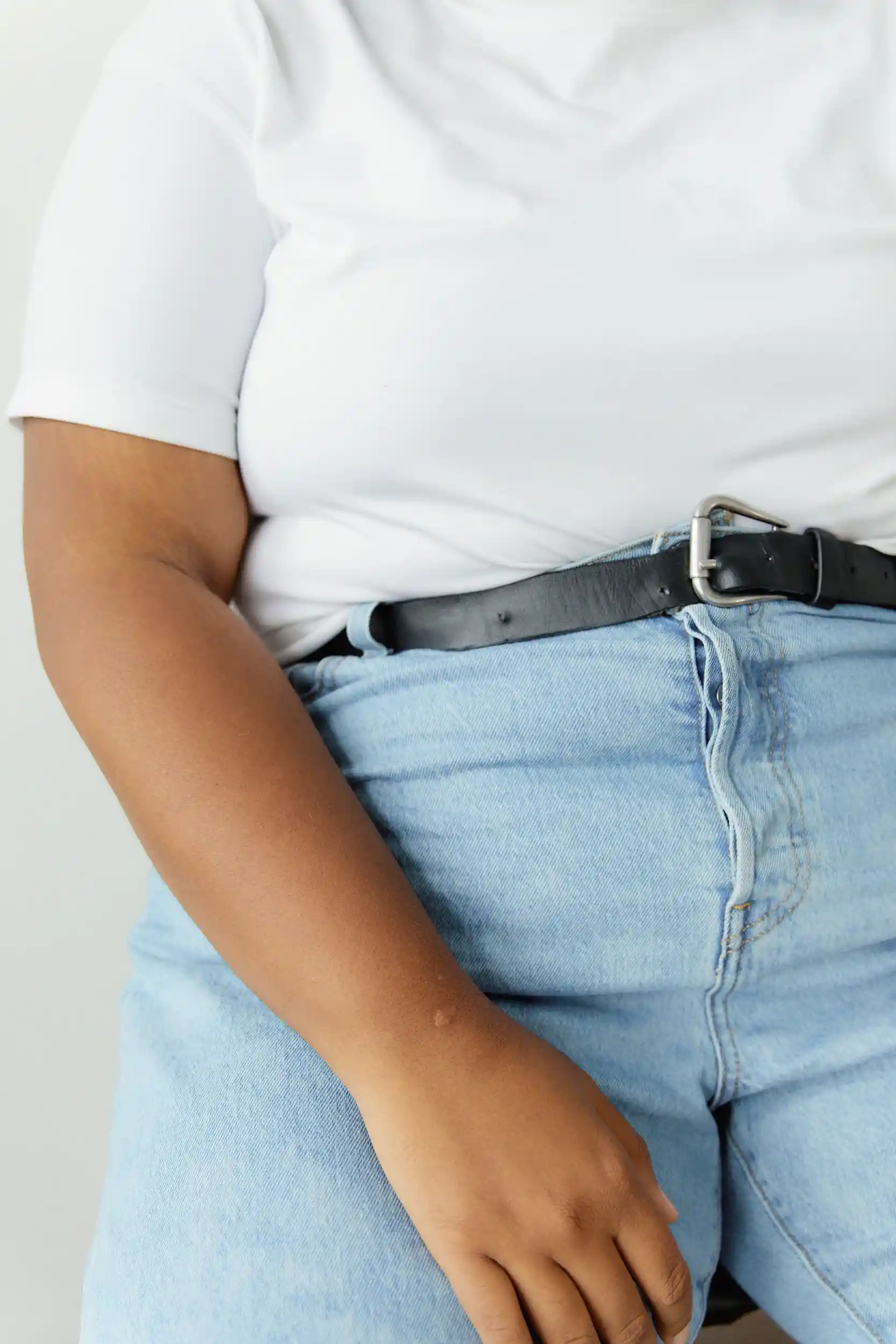
Below the waistband, leg shape does quiet balancing work. Straight and wide legs carry the eye down in one line, which is why they pair so well with a higher rise here. A very skinny leg can make the overhang read top-heavy by contrast. That is a default, not a law, and if you love a skinny jean with a tunic on top, keep it.
For the full rundown of rise measurements, stretch percentages, and waistband checks, our technical denim blueprint covers the numbers in depth.
Dresses That Skim a Lower Belly
Dresses are the easiest garment to get right over an apron belly, because the waistline is wherever the dress says it is. The four cuts that reliably work are the wrap, the empire, the fit-and-flare, and the A-line, and they all share the same mechanic: a definition point above the belly and a skirt that falls away from it.
Jean Wang of Extra Petite, who has written candidly about camouflaging a postpartum and bloated belly, describes the mechanic plainly: “The higher waistline is elongating on a petite frame, and allows the A-line skirt to flow freely over the belly and hips area.” Her one caution is worth carrying too. Empire seams can drift toward maternity-coded on some frames, so if that read bothers you, reach for the wrap or the A-line first.
Fabric decides whether any of these cuts actually skim. A wrap dress in a fluid crepe or modal drapes and moves with you, while the same pattern in a stiff cotton shift tents out from the belly and adds inches all the way around. Feel for drape before you feel for size. Hem length is the last quiet win: a midi that ends below the knee pulls the eye out and down the leg, which is a more flattering exit line than a hem that stops at the thigh.
Tops: Length, Eye Direction, and the Tuck Question
The top that flatters a lower belly is almost always a length story. A tunic or straight-cut top that ends below the hip clears the overhang entirely, while the top that announces the belly is the one whose hem stops at its fullest point. Check hems against your own belly in the mirror, not against the model, because torso length changes where a hem lands.
Peplum and wrap tops build the definition point into the garment, which is why they keep surviving every trend cycle. For eye direction, borrow the site’s usual tricks: a boat neck or collarbone-skimming neckline, a pair of statement earrings, or a scarf at the neck all park the eye at shoulder height, well above the midsection.
The tuck is not off-limits, it just has a precondition. A front tuck works when the waistband itself sits above or below the overhang, because the band handles the transition and the tuck only adds definition. When the band cuts across the belly, leave the top out or try a loose side tuck instead. An open third layer, an unbuttoned shirt or a light jacket, draws two clean vertical lines over any of these combinations and is the fastest fix in this entire guide.
Shapewear for an Apron Belly: Optional, and That Is the Point
Consistent with our lingerie types guide, the house position is that compression shapewear is an occasional choice that ranks behind garment construction, and nothing about an apron belly changes that. The mechanics above work without a single compressive layer. If you like shapewear, though, it is genuinely good at one job: smoothing the transition line between belly and hip under fitted clothing.
The shape matters more than the brand. A high-waisted short that ends mid-thigh smooths the whole transition, while a brief that ends at the belly simply creates a second shelf a few inches higher. For compression level, read the brand’s own scale rather than the adjective on the box.
Leonisa grades its shapewear into four levels, from super comfy through moderate and firm to extra firm, and Spanx runs five, from barely-there smoothing up to strong sculpting. Light to moderate is the honest everyday pick, firm is for long events in fitted clothing, and extra firm belongs to post-surgical protocols under medical guidance, not to Tuesday.
One comfort note that has nothing to do with hiding anything: bike shorts under dresses are the standard fix for chub rub, and in a hot summer they are worth more than any styling trick on this page. On a 90-degree day, every layer costs you, and skipping shapewear entirely is a legitimate style decision.
Outfit Formulas for Real Mornings
- If you are postpartum and your size is still moving: a pull-on high-rise or under-belly band, a stretchy modal maxi or midi dress, and an open shirt as the third layer. Buy the size that fits today, skip anything that requires a goal weight, and revisit the tailored waistband trick once things settle.
- If you want the belly to read as invisible at an event: build one color column from shoulder to hem. A true high rise above the belly, a fluid crepe dress or trouser set in the same family, a firm short underneath if you enjoy them, and a two-to-three-inch block heel to lengthen the line. Monochrome removes the horizontal breakpoints that outline the overhang.
- If you are hot, busy, and done fussing: one wrap dress in a 150 to 220 gram fabric, bike shorts underneath for friction control, clean sneakers, and statement earrings to send the eye north. It is five decisions, all made in advance, and it works on every body this site covers.
Who This Advice Is Not For
If you love a fitted silhouette, keep wearing it, because skimming is a preference and not a moral position, and plenty of the most stylish women I know wear the overhang in a body-con knit on purpose. If your waistband rolls because of torso length rather than the belly itself, your fix is a different rise conversation entirely, and sizing advice for a short torso will serve you better than anything above.
If shapewear feels like armor you resent, skip it, since the rise and drape mechanics carry the outfit without it. And if your clothing budget is currently zero, shop your own closet first: most wardrobes already contain at least three skimming pieces, they are just buried under the mid-rise ones.
Frequently Asked Questions About Dressing an Apron Belly
Does high-waisted clothing hide an apron belly?
Only when the rise is high enough to sit above the overhang at your natural waist. A true high rise with a front rise of 10 inches or more skims cleanly, while a mid rise labeled high waisted often cuts across the fullest point and creates the very shelf it was meant to hide. Check the front rise measurement, not the label.
What is the best shapewear for a large stomach?
A high-waisted short with moderate compression that ends mid-thigh. Brands grade compression differently, with Leonisa using four levels and Spanx using five, so shop the stated level rather than the marketing adjective. Shorts beat briefs because the leg prevents a second crease forming at the belly.
What kind of dresses hide a lower belly?
Wrap, empire, fit-and-flare, and A-line cuts in a fluid mid-weight fabric, because the definition point sits above the belly and the skirt falls away from it. A stiff cotton shift tents outward, so feel for drape before you feel for size.
How do I keep jeans from cutting into my apron belly?
Move the band off the fullest point. Go true high rise above it or low rise below it, and choose a wide soft waistband with stretch in the denim. If the waist gaps when you size for the belly, that is an inexpensive tailor fix, not a return.
Are fitted tops off-limits with an apron belly?
No. A fitted top over a bottom whose waistband sits above the belly reads clean, because the band handles the transition instead of the top. The unflattering combination is a fitted top ending exactly at the belly’s fullest point over a mid-rise band.
Closing
Dressing an apron belly turns out to be a placement question, not a penalty. Put the waistband above the overhang or below it, give the fabric enough weight to fall and enough drape to move, and define the waist where it actually is. The belly does not change, and it does not need to, because the variables that decide the outfit were always the ones you could control.
Pull five bottoms out of your closet this week and read the rise numbers on the tags. You will likely find the culprit in the first three pairs, and the fix costs nothing but a different hanger.
Sources
Official Sources
- Centers for Disease Control and Prevention: FastStats, Births, Method of Delivery, Access Date August 20, 2026
Research Sources
- National Library of Medicine, PubMed Central: Prevalence and Risk Factors for Diastasis Recti Abdominis (Cavalli, 2021), Access Date August 20, 2026
Industry Sources
- Leonisa: Shapewear for Apron Belly: Tips, Tricks and More, Access Date August 20, 2026
- Leonisa: Firm Control Shapewear, Compression Levels, Access Date August 20, 2026
- SPANX: Shapewear Compression Levels Explained, Access Date August 20, 2026
- Universal Standard: Size Guide and Size Chart, Access Date August 20, 2026
- Torrid: Official Size Guide for Torrid Clothing, Access Date August 20, 2026
Additional Reading
- Extra Petite: Style Tips for Camouflaging a Belly, Access Date August 20, 2026
- Vogue: What to Wear Postpartum: Outfits To Embrace Your Body After Baby, Access Date August 20, 2026