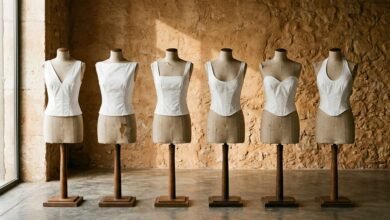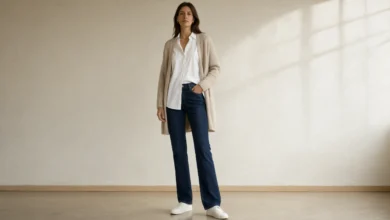

There is a fitting-room moment that belongs almost exclusively to the inverted triangle body shape. The blouse fits your shoulders like it was cut for you, because it basically was, and then it hangs straight down from the bust with no intention of ever meeting a hip curve. Button-ups pull across the back, and blazers that fit your shoulders swim everywhere else. If you have been searching how to dress an inverted triangle body shape, what you are really asking is how to make the bottom half of an outfit speak as loudly as the top half already does.
The good news is that this is a strong, athletic silhouette, the one swimmers, tennis players, and climbers tend to have, and it shows up on plenty of red carpets. Stylists regularly place Renee Zellweger, Demi Moore, Charlize Theron, Naomi Campbell, Amal Clooney, and Angelina Jolie in this category, and most of them dress it with real ease once you see the mechanics.
Those mechanics are this whole article. Four balance moves do the majority of the work, and none of them involve hiding your shoulders in a tent. One note before the rules: the five-shape system is a proportional sorting tool, not an identity, so if you sit between an inverted triangle and an hourglass or a rectangle, borrow freely from whichever guide matches your measurements.
To dress an inverted triangle body shape, follow four balance rules: 1) soften the shoulder line with narrow V, scoop, or asymmetric necklines and raglan or dolman sleeves, 2) add volume below the waist with A-line skirts and wide-leg, flare, or bootcut pants, 3) build a waistline with wrap ties, peplums, tucks, and belts, and 4) choose jackets that are single-breasted, collarless, or belted, with any detailing below the waist.
What an Inverted Triangle Body Shape Actually Is
The short definition is a shoulder or bust line that reads wider than your hip line, with little natural waist definition in between. The most concrete version of that definition comes from North Carolina State University, where Dr. Cindy Istook and her team analyzed body scans of more than 6,300 women and sorted them into seven shape categories. Nearly 14 percent of those women were inverted triangles, defined in the study as a bust measurement three or more inches larger than the hip measurement, while only 8 percent had the hourglass figure that most clothing is still cut for.
That mismatch is why the fitting room feels hostile. As Istook put it when the findings were published, “They just haven’t changed their sizing system to demonstrate it,” referring to manufacturers acknowledging the problem without redesigning their patterns. Your closet struggles are a pattern-making problem, not a personal one.
- Your shoulders, bust, or upper back measure wider than your hips, and the difference is obvious in a fitted tee.
- A tape measure puts your bust three or more inches over your hip measurement, matching the NC State cutoff.
- Waist definition stays subtle even at a weight where friends mention a waist.
- Toned legs and a strong upper back are the parts of your body people compliment first.
If some of that lands and some does not, you are probably blending two shapes, which is the norm rather than the exception. Our four-step body shape check settles the question in about ten minutes, and it is worth retaking after any major body change. Even working stylists treat the categories as overlapping maps: Elysha Lenkin, who has spent more than two decades in fashion styling, describes herself as primarily an hourglass with inverted triangle tendencies.
Rule 1: Soften the Shoulder Line
Necklines do the quietest and heaviest lifting in this whole system. A narrow V, a scoop, a U, or an asymmetric line all pull the eye down the center of the body and break the horizontal span of the shoulders, which is the opposite of what a boat neck, an off-the-shoulder line, or a wide square neck does. Our neckline guide for every body shape runs through the same geometry in more detail, and the short version for this shape is that diagonal and vertical lines are friends while wide horizontal lines are not.
Sleeves follow the same logic. Raglan sleeves, which set the seam diagonally from the collar toward the underarm, slope the shoulder instead of squaring it off, and dolman or kimono sleeves blur the shoulder point entirely. Puff sleeves, epaulets, and shoulder pads do the reverse. Spaghetti straps create a contrast that makes the shoulder line read even wider, so wider straps tend to look more proportionate on this frame.
Fabric weight matters up top more than people expect. Stiff poplin and heavy cable knits hold a sharp line across the back, while a soft modal tee or a fine-gauge merino drapes and quiets the same shoulder. Los Angeles stylist Erica Ball, whose practice is built around wardrobes for real life, says it plainly: “A lot of times it’s simple tops that work best with this body type.” That is permission to skip the ruffled, embellished blouse and move the budget below the waist instead.
At a glance, the upper-body swaps:
- Swap a boat neck for a narrow V or scoop, since the diagonal line breaks up the shoulder span.
- Trade puff sleeves for raglan or dolman cuts that slope the shoulder instead of squaring it.
- Choose wider straps over spaghetti straps, because a thin strap makes the shoulder read wider by contrast.
- Save prints, bright color, and horizontal stripes for below the waist, and keep the top half in quieter, darker tones.
Rule 2: Add Volume Below the Waist
This is the fun rule, because it is where the inverted triangle gets to shop the interesting pieces. A-line skirts, pleated skirts, circle skirts, and tiered or ruffled styles all add width at the exact spot the shape does not produce on its own, and details like pockets, panels, prints, and lighter colors on the bottom half pull the eye down on purpose. A dark, quiet top over a lighter, busier bottom is the single fastest version of this trick.
Pants work the same way. Wide-leg, palazzo, flare, and bootcut cuts all give the lower half a stronger line, and pleats, turn-ups, and cargo pockets add even more visual weight where you want it. In denim, reach for a bootcut or flare first: a pair like the Levi’s 725 High Rise Bootcut kicks out below the knee just enough to answer the shoulder line, and Madewell’s wide-leg jeans do the same job with a straighter, more relaxed sweep. Our guide on how to buy jeans that actually fit covers rise and fabric weight, but for this shape the leg opening is the decision that matters most.
Dresses that flare from the waist tend to read as balanced without any extra effort. Wrap dresses, fit-and-flare cuts, peplum dresses, and even a sheath with pocket or pleat detail at the hip all show up constantly in the celebrity looks stylists use to teach this shape, for exactly that reason.

What Should an Inverted Triangle Body Shape Wear? A Shopping Cheat Sheet
Condensed for the dressing-room mirror, here is the whole system in one table.
| Garment | What to look for | Why it works |
|---|---|---|
| A-line or pleated skirt | Anything that flares from the waist, with pockets or prints welcome | Adds width exactly where the shape lacks it |
| Wide-leg or palazzo trouser | Pleats, turn-ups, or cargo pockets, in lighter washes and colors | Builds a stronger lower line against broad shoulders |
| Bootcut or flare jean | A fitted rise that kicks out below the knee, like the Levi’s 725 High Rise Bootcut | The kick visually counters the shoulder line |
| Wrap or fit-and-flare dress | A tie at the waist and a skirt with real movement | Creates the waistline straight cuts rarely give this shape |
| Peplum top or jacket | A flare that starts at the waist, not the bust | Writes in a hip curve with fabric |
| V-neck or scoop tee | Narrow, vertical necklines in a soft, drapey cotton or modal | Draws the eye down the center instead of across the shoulders |
| Raglan or dolman sleeve knit | Fine gauge, with the seam set in from the neck | Softens the shoulder angle without adding bulk |
| One-piece swimsuit | A darker solid on top, a printed or side-tie bottom, substantial straps | Keeps the top quiet and gives the hip line something to say |
Rule 3: Build a Waistline Without Squeezing
An inverted triangle rarely gets a waistline from a straight cut, so the waistline has to come from construction. Wrap ties, peplum flares that start at the waist rather than the bust, ruching, and a belt worn over a fitted piece all write in a waist with fabric instead of compression, and a front tuck, even a loose one, does the same job for a casual tee.
Hem length is the overlooked half of this rule. Tops that end at the widest part of the hip extend the upper body’s line right into the place you are trying to build volume, while cropped hems that stop at the natural waist can make the top half look stacked and heavy. The middle path, a top that ends just below the hip bone or one that is tucked, keeps the proportions honest.
And if a dress or blazer you love has no waist definition at all, a tailor can add darts at the side seams for less than the cost of most new tops. It is the same argument we make in the rectangle and hourglass guides: definition should come from garment construction before it ever comes from shapewear.
Rule 4: Keep Jackets and Coats Quiet on Top
Jackets are where inverted triangle shopping goes to get humbling, because so much outerwear is decorated at the shoulder. The cuts that work are single-breasted styles with small lapels, collarless jackets, belted or nipped waists, and anything with pockets or detail at the hip. Length helps too, since a jacket that ends below the hip extends the silhouette past the shoulder line instead of stopping at it.
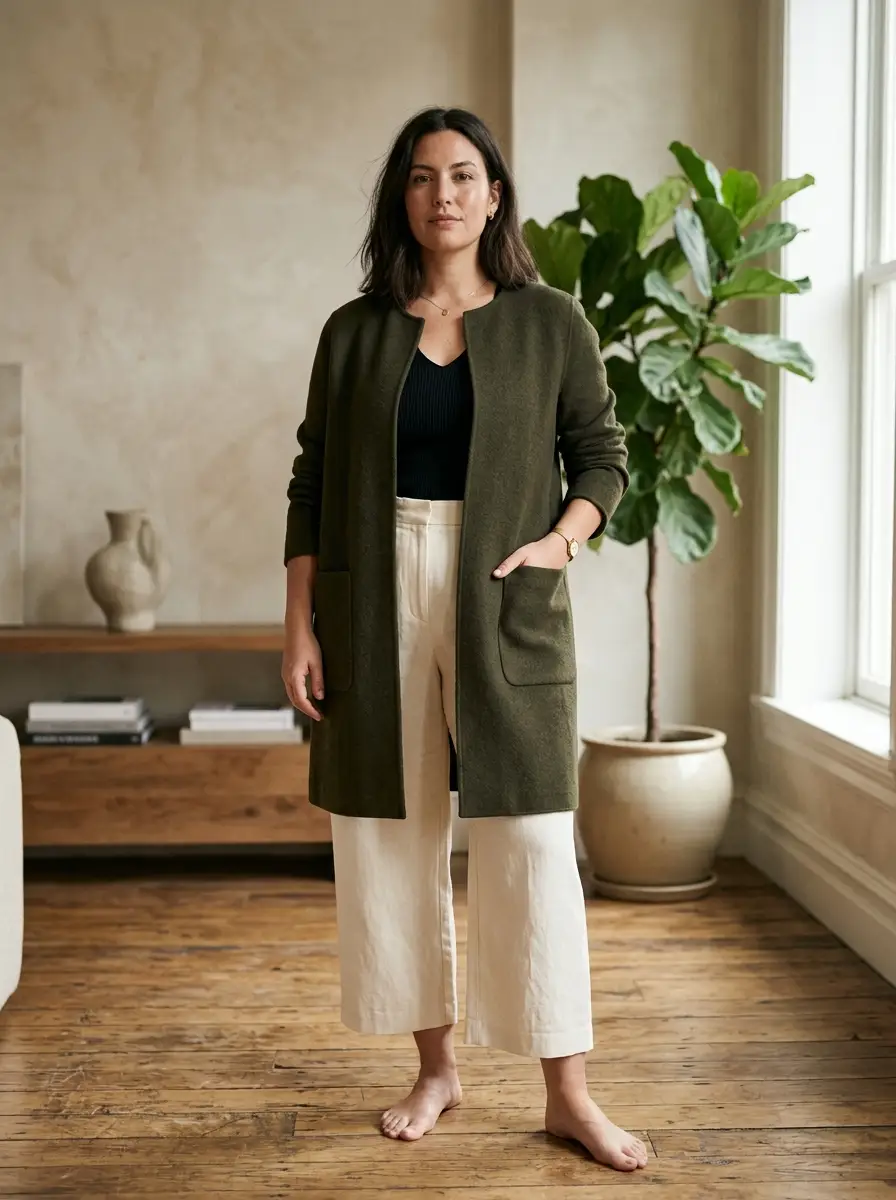
The avoid list here is short and specific: double-breasted buttoning, epaulets, big stiff collars, shoulder pads, and cropped boxy jackets worn over slim pants. There is one genuine exception, and it is the kind of detail only a working stylist points out. Gabrielle Arruda, whose wardrobe guides are built on exactly this shape, notes that a very narrow lapel can make broad shoulders look even bigger by comparison, so a softer, wider lapel in a fluid fabric can balance the shoulder better than a skinny one. Proportion is about contrast, not just coverage.
If oversized outerwear is your whole aesthetic, it can stay. The trick is keeping the base layer fitted and vertical underneath, and we worked through the exact mechanics of that, including the three-inch shoulder rule, in our oversized blazer guide.
What to Avoid, and When to Ignore the List
The condensed avoid list, the one repeated across every serious guide to this shape, is boat and bateau necks, off-the-shoulder cuts, wide square necks, puff sleeves, shoulder pads, epaulets, double-breasted jackets, chunky horizontal stripes across the chest, cropped boxy layers, and skinny jeans with no pocket detail. Each item either widens the shoulder line or narrows the hip line, which are the only two ways an outfit can go wrong on this shape.
Now the honest part. Balance is a choice, not a mandate. Arruda points out that a boat neck can work when the jacket over it has a soft shoulder and the rest of the silhouette carries volume, and plenty of inverted triangles, especially former swimmers and rowers, genuinely love showing their shoulders and should keep doing it in halters and strapless cuts. The avoid list is a set of defaults for the days when you want the silhouette balanced, not a prohibition for the days when you want it strong.
Three Situations Where the Rules Shift
If you are short on time in the morning: build a two-piece uniform and stop deciding anything before coffee. A V-neck or scoop tee in a dark solid, an A-line or pleated skirt in a lighter color or print, and a block heel or clean sneaker is the entire formula, and it carries into every season by swapping the tee for a fine-gauge knit.
If your shape changed after pregnancy, training, or a weight shift: remeasure before you shop again, because the shoulder-to-hip relationship can move more than people expect. A former pear who gained upper-body weight, or a former hourglass who built serious shoulder and back muscle in the gym, may have genuinely changed categories, and the four-step check settles it in one sitting.
If you love oversized or athletic styling: keep the volume on one side of the waist only. An oversized shirt worn open over a fitted V-neck reads as a vertical line instead of a boxy one, oversized pants with a fitted top lean into the athletic look on purpose, and statement shoes, boots especially, add lower-body weight without touching the silhouette at all.
Frequently Asked Questions About Dressing an Inverted Triangle Body Shape
What should an inverted triangle body shape avoid wearing?
The consistent list across stylists is wide horizontal necklines like boat and off-the-shoulder cuts, shoulder details like pads, epaulets, and puff sleeves, double-breasted and cropped boxy jackets, and skinny jeans without pocket detail. Treat it as a default list rather than a ban, since soft fabrics and volume on the bottom can rescue most of these on the right day.
Do inverted triangle body shapes always have a big bust?
No. The shape is defined by the shoulder-to-hip relationship, and the bust can be any size. A broad upper back and strong shoulders create the silhouette on their own, which is why athletes with modest busts often land in this category while some fuller-busted readers are actually closer to an apple or top-heavy hourglass.
Can the rules for how to dress an inverted triangle body shape work for plus sizes?
Yes, the mechanics are identical at every size, because they are about where volume sits rather than how much of it there is. A plus-size inverted triangle still benefits from a narrow V-neck up top and a full skirt or wide-leg pant below, and most plus-size lines carry those cuts in abundance.
Where does an inverted triangle body shape tend to gain weight first?
Stylists who work with this shape describe weight landing in the upper body first, around the bust, back, arms, and midsection, while the hips and seat stay comparatively narrow. That is also why an inverted triangle who has gained weight can get misread as an apple shape, and why remeasuring after any big body change is worth the ten minutes.
Is an inverted triangle the same as an apple shape?
Close relatives, not twins. An apple shape carries its fullest point around the midsection, often with slimmer arms and legs, while an inverted triangle carries its width across the shoulders and upper back with toned limbs and usually a flatter middle. If your midsection reads as the widest part of your body, the apple shape guide will serve you better than this one.
The Bottom Line
Dressing an inverted triangle body shape well is not about shrinking your shoulders. It is about giving the rest of the outfit enough voice that the shoulders stop doing all the talking. Start with one neckline swap and one leg-opening swap, a V-neck and a bootcut jean, and look in the mirror before you change anything else, because that single combination usually makes the whole system click. From there, the pleats, peplums, and belted jackets are just variations on a balance you already understand.
Sources
Research Sources
- Newswise: Fashion Designers Ignoring Shapes of Women’s Bodies, Access Date: August 10, 2026. Reports Dr. Cindy Istook’s North Carolina State University analysis of more than 6,300 body scans, including the 14 percent inverted triangle figure and the three-inch bust-over-hip definition.
Industry Sources
- Erica Ball Style: How To Style An Inverted Triangle Body Type, Access Date: August 10, 2026. Los Angeles personal stylist Erica Ball’s celebrity-look breakdowns and the simple-tops guidance quoted above.
- Elysha Lenkin: What To Wear When You Have An Inverted Triangle Body Shape, Access Date: August 10, 2026. The collarless and single-breasted jacket list and the soft, draping fabric guidance.
- Gabrielle Arruda: The Inverted Triangle Body Shape: Building a Wardrobe, Access Date: August 10, 2026. The lapel-contrast exception and the detailed neckline, sleeve, and bottom silhouettes.
Additional Reading
- The Concept Wardrobe: Inverted Triangle Body Shape: A Comprehensive Guide, Access Date: August 10, 2026.