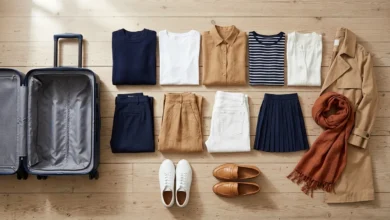
You probably own more clothes than you think you need, and that is exactly why some mornings still end with everything pulled off the hangers and nothing chosen. A minimalist wardrobe promises to fix that, but if you’re searching for how to create a minimalist wardrobe, most explanations skip straight to a number: thirty pieces, fifty pieces, a capsule of exactly this many tops and that many pairs of shoes. The number is not really the point. The point is a closet that stops asking you to make a decision every single day.
Building one is less about buying a curated set of items and more about a process. What you already own gets audited honestly, sorted by category, and trimmed to what actually earns its place, and only then do any real gaps get filled, slowly. That process is what this guide walks through, along with the specific point where a minimalist wardrobe stops making sense for certain lives.
The short version: start with an honest audit of the closet you already have, not a shopping list. Keep the neutral, easy-to-mix pieces, sort everything into a handful of categories (tops, bottoms, layering, outerwear, shoes), then fill only the gaps that are real, one purchase at a time, and revisit the whole thing each season instead of building it once and forgetting about it. Done well, most people land somewhere between 30 and 50 pieces, not because that number is magic, but because that is roughly where a closet stops requiring decisions.
What a Minimalist Wardrobe Actually Solves
Most people who search for this are not actually trying to own fewer things. They are trying to stop standing in front of a full closet feeling like nothing works. That distinction matters, because the fix for a full-but-frustrating closet is not always subtraction. Sometimes it is organization. Sometimes it is genuinely too many similar mid-weight basics and not enough of the two or three pieces that pull an outfit together.
Writer Courtney Carver ran into this exact problem in 2010, when she created Project 333, a challenge to wear only 33 items for three months. Her own account of why she started it had little to do with style at all. She has said she wanted relief from running late in the morning after trying on several outfits. That is the actual target: not a smaller closet for its own sake, but fewer decisions standing between waking up and leaving the house.
Start With an Audit, Not a Purge
Pull everything out of the closet and drawers at once, not a section at a time. Sort into three honest piles: worn in the last year, not worn but still fits and still liked, and everything else. That third pile is usually the biggest one, and it is where most of a crowded, indecisive closet actually lives.
For anything landing in the middle pile, ask why it has not been worn. A fit that changed, a fabric that pills, a color that never matched anything else already owned. These are useful data points, not failures. They tell you what to avoid buying again more clearly than any style guide can.
Checking the care label while sorting is worth the extra minute too, since a piece that pills or shrinks after one wash rarely earns a second chance. Learning to read a clothing label before the next purchase prevents the same problem from repeating.
The Core Categories Worth Building Around
Once the audit is done, what is left usually falls into five categories. The exact count in each matters less than making sure every category has at least one piece that actually gets reached for.
| Category | Realistic Range | What to Actually Look For |
|---|---|---|
| Tops | 8 to 12 pieces | Two or three neckline shapes you already reach for, in fabrics that layer without adding bulk |
| Bottoms | 4 to 6 pieces | One dark wash, one lighter wash, and a trouser or skirt that isn’t jeans |
| Layering | 4 to 5 pieces | A cardigan and a blazer earn their spot more often than a third sweater does |
| Outerwear | 2 to 3 pieces | Weight and warmth matter more than color here, since it’s what actually gets seen from across a room |
| Shoes | 4 to 6 pairs | Comfort for standing all day usually beats a fifth pair of the same silhouette in a different color |
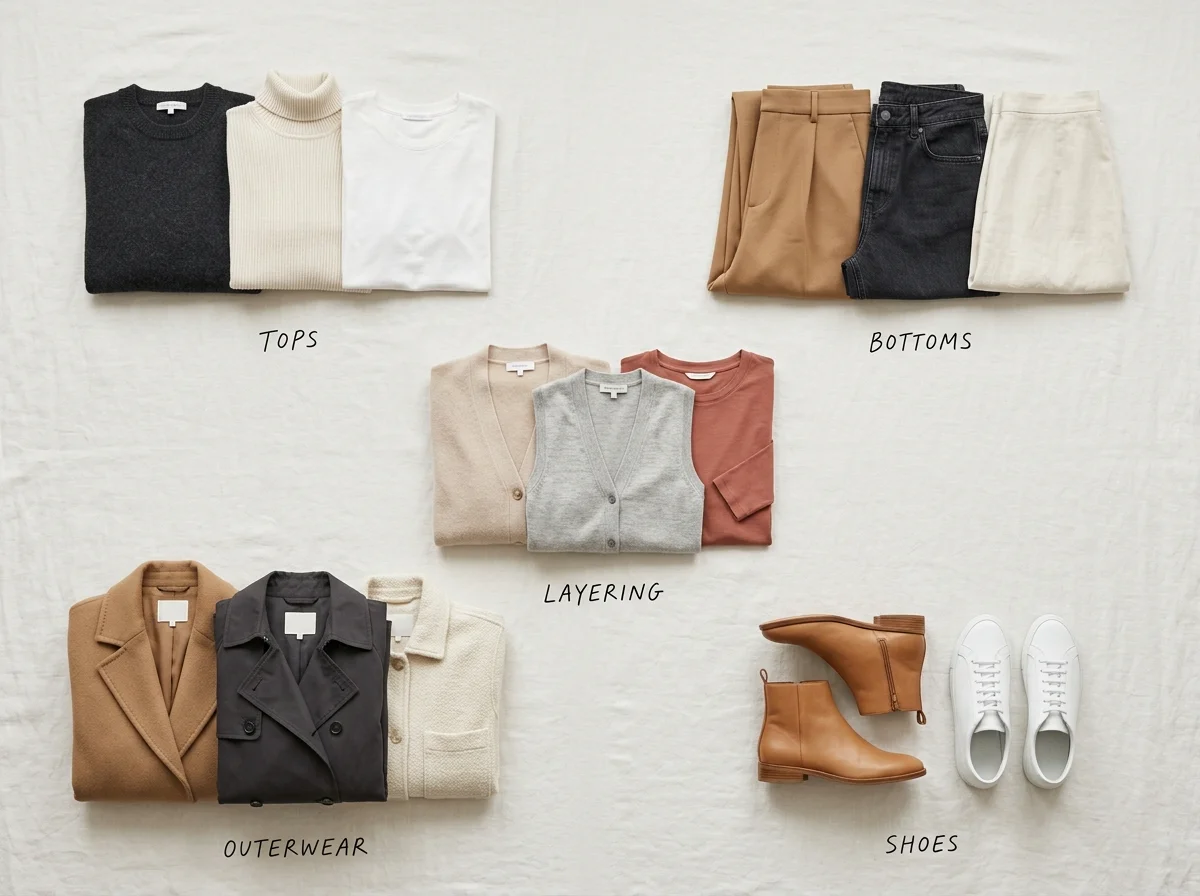
Understanding these ranges is key when learning how to create a minimalist wardrobe that works for your daily routine. They assume one climate and a fairly typical mix of casual and workdays. Anyone splitting time between two very different climates, or dressing for a physically demanding job, will reasonably need more in specific categories, and that’s fine. The ranges are a starting point, not a ceiling.
At a Glance: Audit vs. Shopping List
- An audit starts with everything already in the closet, sorted by what actually got worn in the past year.
- A shopping list starts with a mood board and a credit card, which is how most closets got crowded in the first place.
- One produces a wardrobe built around real habits. The other produces a wardrobe built around aspiration.
For a more prescriptive, step-by-step version of this same idea, built around versatility math rather than a full closet audit, building a true capsule wardrobe is the closer cousin worth reading next.
Buying Fewer, Better Pieces Actually Matters
There is a practical reason to slow down on replacing what gets cut, beyond convenience. The EPA’s most recent full accounting of textile waste, from 2018, put total generation in the United States at 17 million tons, with 11.3 million tons landfilled and only 14.7 percent recycled. A separate federal review by the Government Accountability Office found that textile waste in the U.S. grew more than 50 percent between 2000 and 2018.
None of that means every purchase carries guilt. It means a wardrobe built around fewer, better-made pieces that actually get worn is doing something a closet full of barely-worn basics is not, whatever the original price tag happened to be.
The Real Reason Fewer Choices Feels Easier
The instinct that a smaller, simpler closet is easier to get dressed from isn’t just an aesthetic preference. It tracks with a broader body of research on how repeated decisions wear down decision quality over the course of a day. The most cited example has nothing to do with clothing: a 2011 study of Israeli parole boards found judges granted favorable rulings in roughly 65 percent of cases early in a session, a rate that dropped close to zero by the end of a session and jumped back to about 65 percent after a food break.
Later researchers argued the effect could partly reflect how cases were scheduled rather than pure mental fatigue, and how much of that swing was decision fatigue specifically is still debated. The broader pattern it points to, that a long string of small decisions wears down the quality of the next one, is the same logic behind trimming the number of outfit decisions a closet demands before eight in the morning.
When a Minimalist Wardrobe Isn’t the Right Fit
A pared-down closet is not the right move for everyone, and pretending otherwise isn’t useful. Anyone whose job puts them on camera regularly, or in front of the same clients or students every day, often needs more visible variety than a 30-to-50-piece closet comfortably provides, since repeating outfits reads differently in those settings than it does at a desk job.
Splitting time between two sharply different climates each year, rather than one place with four seasons, usually means maintaining something closer to two smaller wardrobes than one minimal one. And anyone working with a genuinely tight budget right now is often better served making the most of what’s already owned, rather than treating a fresh audit and a round of replacement purchases as this month’s priority.
Building Yours From Where You Actually Are

For a Packed Closet:
Start with the audit above before buying anything new. A packed closet almost always has enough raw material inside it already; the work is subtraction and better pairing, not acquisition. Give yourself a full weekend for the first pass, then a shorter follow-up a month later once you can see what’s genuinely been missed.
Starting Fresh:
Moving out for the first time, rebuilding after a move, or simply owning very little makes the category table more useful as a checklist than the audit does. Fill neutrals first, one category at a time, and resist buying a full closet in a single weekend. A slower build gets more chances to notice what’s actually missing instead of guessing. Building a wardrobe from scratch covers this specific starting point in more depth.
Life Transitions:
A new job, a move to a different climate, or a body that fits differently than it used to all mean the audit above will turn up a lot in that third, “everything else” pile, and that’s expected rather than a sign anything went wrong. Keep only what fits and gets worn now. Storing pieces “for later” tends to just recreate the crowded closet this whole process is meant to fix.
Frequently Asked Questions on How to Create a Minimalist Wardrobe
How many pieces should a minimalist wardrobe actually have?
There’s no fixed number, but most people land somewhere between 30 and 50 pieces once tops, bottoms, layering, outerwear, and shoes are all counted. That range isn’t a rule; it’s roughly where a well-built closet stops requiring extra decisions each morning.
Is a minimalist wardrobe the same thing as a capsule wardrobe?
They overlap but aren’t identical. A capsule wardrobe is usually a fixed, deliberately versatile mini-collection built around specific math, like Project 333’s 33 items. A minimalist wardrobe is the broader goal of owning only what earns its place; a capsule is one structured way to get there, not the only one.
How long does it realistically take to build one?
The audit itself can happen in a weekend. Filling the real gaps well usually takes a season or two of noticing what’s actually missing, rather than replacing an entire closet in one trip.
What should happen to the clothes that get cut?
Anything still wearable is worth donating locally or through a textile take-back program before it ends up in a landfill; only 14.7 percent of textile waste in the U.S. gets recycled, so keeping wearable pieces in circulation matters more than it might seem.
Where This Actually Starts
A minimalist wardrobe isn’t a finished project so much as a habit of asking, before anything new comes in, whether it earns a spot next to what’s already working. That habit does more than any single shopping trip could. Start smaller than the whole closet this weekend: pick one drawer, sort it honestly, and let that be the first real step toward a wardrobe you actually want to get dressed from.
Sources
Official Sources
- U.S. Environmental Protection Agency: Textiles: Material-Specific Data, Accessed July 29, 2026
- U.S. Government Accountability Office: Textile Waste: Federal Entities Should Collaborate on Reduction and Recycling Efforts, Accessed July 29, 2026
Research Sources
- Danziger, S., Levav, J., and Avnaim-Pesso, L.: Extraneous Factors in Judicial Decisions, Proceedings of the National Academy of Sciences, Accessed July 29, 2026
Additional Reading
- Courtney Carver: Capsule Wardrobe Inspiration, Be More With Less, Accessed July 29, 2026