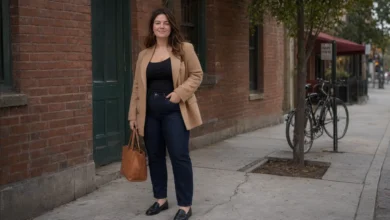

There is a specific fitting-room moment that belongs to this proportion alone. The jeans fit your thighs, your seat, and your inseam all at once, and then the waistband closes somewhere near your ribs. You look in the mirror and the outfit reads as all legs. That is not a flaw in you, and it is not a flaw in the jeans. It is a proportion problem, and how to dress a short torso with long legs comes down to moving one visible line, the waistline, down by an inch or two.
Much of the advice for this body type arrives as a list of bans: no high-waisted jeans, no cropped tops, no belts. Bans are not a wardrobe. The readers I hear from want to keep wearing the clothes they already love, so the useful question is mechanical. Where does each garment place your waistline, and what does that do to the ratio above and below it?
The good news is that stylists tend to call this the forgiving proportion, because long legs carry almost any hemline and the torso only needs a little returned length. Here is the system, in the order it matters.
To dress a short torso with long legs, move the visual waistline down and keep the upper half open: 1) choose a mid-rise bottom with a front rise of about 8 to 10 inches, 2) let tops end an inch or two below the waistband instead of tucking, 3) add length above the waist with lower necklines and open, hip-length layers, 4) save high-rise and belts for outfits where the top stays untucked and tonal.
First, Confirm the Proportion, Because the Fitting Room Lies
Plenty of people who believe they have a short torso actually have a short rise, or a high natural waist, or simply a wardrobe cut for a different body. The quickest check I trust comes from Imogen Lamport, the image consultant behind Inside Out Style, who has written about body proportions for close to two decades. Place one hand snugly under your bust and count how many hand-widths fit between the bottom of that hand and your waist. Fewer than two hand-widths reads as a short waist, two as balanced, and more than two as long.
A second check comes from your pants. If a rise labeled regular or mid already lands at your navel or above, your torso is running short against the size block the brand cut for, which is why so many off-the-rack waistlines feel like they were placed by someone else. And note that your narrowest point may not be your natural waist, which changes where belts and ties should sit.
One framing note before the rules. A proportion like this is a sorting tool, not an identity, the same way the five body shapes are. Kibbe’s system describes the long-leg effect as a strong vertical line, and the rule of thirds borrowed from composition asks an outfit to break near a third rather than at the middle. Different vocabularies, same destination: keep the lines long and the waistline low. If you have not mapped your shape yet, our guide to how to find your body shape in four simple steps is the starting point I would use.
How to Dress a Short Torso With Long Legs From the Waistband Down
The rise, the seam measurement from the crotch to the top of the waistband, is the single number that controls where the eye thinks your torso ends. It is also the number most shoppers never read. Jo-Lynne Shane, who has tested denim fits for over a decade, puts mid-rise at a front rise of about 8 to 9.75 inches, sitting just below the navel, and high-rise at 10 to 12 inches or more, hitting at or above it. Her take on the current mid-rise return is blunt: “Mid-rise styles can help balance proportions and make front-tucking and wearing belts a lot easier.”
On a short torso, that one to two inch difference is the entire game. A high-rise waistband parks at your ribs and hands the torso nothing. A mid-rise waistband sits low enough to leave open space between your bust and your pants, which is precisely the space that reads as torso.
| Rise | Typical front rise | Where the waistband lands | What it does on a short torso |
|---|---|---|---|
| Low | 7 to 8 inches | On the hip bone | Maximum torso length, but the least hold through sitting and bending, so a situational pick. |
| Mid | 8 to 10 inches | Just below the navel | The default. Enough open space above the waistband to read as torso, enough hold to feel finished. |
| High | 10 to 12 inches and up | At or above the navel | Moves the waistline to the ribs. Fine untucked and tonal, shortening when tucked and contrasted. |

Low-rise is the most lengthening option and the least secure, so be honest about your day before committing to it. High-rise stays in the rotation, but on your terms, which the next sections cover.
One habit pays for itself: when a rise works, write the number down. Elements of Image, a studio of image consultants, recommends measuring the rise of any pant that fits and hunting that same measurement online later. Our technical guide on how to buy jeans that fit goes deeper on rise, stretch, and denim weight when you are ready to shop with the number in hand.
At a glance: mid-rise vs. high-rise on a short torso
- Mid-rise, 8 to 10 inch front rise: waistband below the navel, torso reads longer, tucks and belts still possible.
- High-rise, 10 to 12 inches: waistband at the ribs, legs read even longer, only works when the top stays untucked or tonal.
- Low-rise, 7 to 8 inches: maximum torso length, minimum hold, a situational pick rather than a default.
Tops and Necklines That Give the Torso Its Inches Back
Hem length beats every color trick in the book. The top that ends an inch or two below the waistband is the one that makes this proportion look intentional, because it covers the seam where your torso supposedly ends and redraws the line lower. The top that ends exactly at the waistband, which is where most cropped and waist-length jackets land, is the one that reads as cut in half.
Open layers do quiet, structural work here. A longline cardigan, an open shirt-jacket, or a hip-length blazer draws two vertical lines down either side of the body while pushing the horizontal break down to the hip. Elements of Image makes the same call for knitwear, recommending hip-length jackets and sweaters over cropped or waist-length versions for short-waisted clients.
Necklines follow the same logic in reverse. V and scoop necks keep the eye traveling up and down the torso, which is why they show up in nearly every stylist’s list for this proportion. The boat neck is the one that works against you, because it draws a horizontal line across the shoulders and shortens the distance between neck and waist. If you love a high neck in winter, a long pendant or a skinny scarf redraws the V for you.
And keep some detail at the hip. Patch pockets, a hip-level seam, or a thin belt worn low and loose all add visual weight below the natural waist, weight borrowed from the legs and handed to the torso. As one consultant at Elements of Image puts it, a mid or low rise gives you “a lot more open space from your bust-line to the top of your pants,” and the goal of every top choice here is simply to use that space.
Tucked, half-tucked, untucked at a glance
- Full tuck into high-rise: the hardest combination on a short torso, since it exposes the entire rib-to-hip distance.
- Front tuck into mid-rise: workable, because the loose fabric falls back over the waistband at the sides.
- Untucked, ending below the waistband: the reliable default, and the easiest to get right on a rushed morning.
Dresses, Belts, and the Column of Color
One-piece dressing is where this proportion gets to relax, because a dress either removes the waistline or lets you place it yourself. Shift dresses skip the seam entirely. Drop-waist styles move it down toward the hip, exactly the direction you want. Nathalie Neuilly, the capsule wardrobe coach behind Dressarte Paris, ranks shift and wrap dresses among the strongest cuts for a short torso with long legs, and the wrap earns its spot for a second reason: the tie sits where you put it, so you can cinch a half-inch lower than the pattern intended.
The empire seam is the one dress detail to treat with suspicion. By parking the waistline under the bust, it erases the little torso you have and announces the proportion you are working with. If a dress you love runs empire, an open layer over it breaks the seam into two verticals and takes most of the sting out.
Belts deserve the same care. A wide, contrasting belt at the natural waist is a pair of scissors, cutting the body at its shortest segment. If belts are your thing, the workarounds are real: match the belt to your top instead of your bottom, keep it thin and worn loosely so it dips into a V, or wear it low on the hip. Our guide to when to wear a belt covers the placement logic in full, including when a belt is the right proportion tool and when it is fighting you.
Finally, the column of color. A monochromatic outfit, or even a low-contrast top and bottom, removes the hard stop at the waistband, so the eye glides past the place where your torso supposedly ends. This is the quiet reason tonal outfits feel so good on this proportion, and it is also the loophole that makes high-rise wearable, which brings us to the rules you are allowed to break.
What to Skip, and the Right Ways to Break Every Rule Here
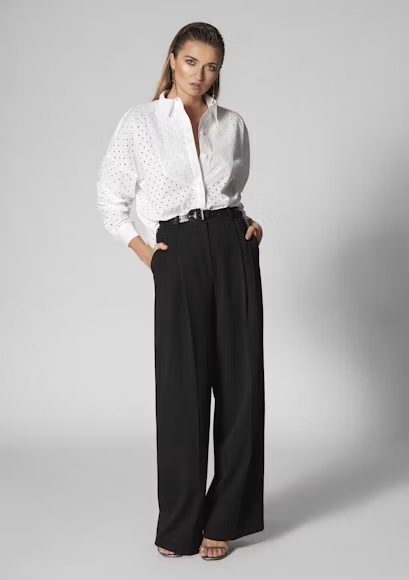
The genuine troublemakers are the combinations that stack the same shortening effect: high-rise plus a tucked-in top plus a contrasting belt is three waistlines drawn at your ribs at once. Cropped tops that end above the waistband do the same thing from the other direction, and Dressarte’s stylists also flag thigh-high boots as a leg-lengthener worth skipping when the hemline is already short.
But each ban has a clean workaround, and knowing them is what turns this from a rulebook into a system. A cropped jacket works beautifully over a top that continues two inches past the waistband, because the jacket supplies the horizontal at the hip while the longer top keeps the vertical going. A high-rise jean works with an untucked top in a matching tone, because the column swallows the waistband. A crop top over a same-color high-rise waistband reads as one unit instead of two segments.
So treat everything above as a default, not a law. If cropped tops are your signature, keep them and borrow the open layer. If you feel most like yourself in a tucked shirt, tuck into mid-rise and add a long necklace. The proportion responds to the total, not to any single piece.
If Your Situation Complicates the Formula
If you are petite as well as short-waisted: the open-space tricks can swallow a smaller frame, so keep layers narrow and the column tonal. A longline cardigan in a heavy drape will wear you. In a finer gauge it adds the vertical without the volume.
If your closet is already mostly high-rise: do not purge it. Change the top half first, untucked hems, open layers, tonal pairings, and the rise stops announcing itself. Most people find they can keep eight of ten pairs without buying anything.
If you are re-dressing after a body change: pregnancy, weight change, and age all shift where the waist sits, so rerun the hand-width test before you shop. The rise that flattered you three years ago may still be right, but the waistline it meets is not the same one.
Frequently Asked Questions About Dressing a Short Torso With Long Legs
Is there a simple formula for how to dress a short torso with long legs?
Yes. Lower the visual waistline and keep the upper half open: mid-rise bottoms, tops that end below the waistband, lower necklines, open layers, and no wide belt at the natural waist. Everything else in this article is variation on that sentence.
What should you not wear if you have a short torso and long legs?
The stacking combinations are the issue: high-rise with a tucked-in top, wide contrasting belts at the natural waist, empire seams, and cropped tops that end above the waistband. None is banned on its own. They become a problem when two or three show up in one outfit.
Can someone with a short torso wear high-waisted jeans?
Yes, with an untucked or tonal top. The jeans alone are never the problem. It is the jeans plus a visible break at the ribs that shortens you. Match the top to the denim, or let it fall below the waistband, and high-rise stops working against you.
What style of dress is most flattering for a short torso and long legs?
Shift and drop-waist dresses, because they remove the waistline or move it down. A wrap dress also works when the tie sits at your narrow point rather than under the bust. Empire is the seam to skip.
How do you tell a short torso from a short rise?
A short torso is the space between your rib cage and hip bone. A short rise is the distance from crotch to waist, and it changes which pant rise fits, not which one flatters. If mid-rise jeans sit on you like high-rise, that is a rise issue, and sizing and cut will solve it without any proportion styling at all.
The Legs Were Never the Problem
Long legs are the headline of this proportion, the part most people with a short torso spend years not realizing they would trade for. The torso does not need fixing. It needs an inch or two of returned visual length, and that inch lives in decisions small enough to make on a Tuesday morning: the rise you choose, the hem you leave out, the belt you skip.
So start with the two checks that cost nothing. Run the hand-width test tonight, and read the rise on your three most-worn pairs of jeans. If the numbers surprise you, our technical denim guide will turn them into a pair that behaves. That is how to dress a short torso with long legs without giving up a single thing you love wearing.
Sources
- Sumissura: Short Torso, Long Legs? Here’s How to Dress for Balance, Access Date: August 14, 2026
- Dressarte Paris: Dressing for Proportions: Long Legs, Short Torso, Access Date: August 14, 2026
- Elements of Image: 6 Style Tips for Short Waisted Women, Access Date: August 14, 2026
- Inside Out Style (Imogen Lamport): How to Tell if You Have a Balanced, Short or Long Waist, Access Date: August 14, 2026
- Jo-Lynne Shane: Mid-Rise vs. High-Waisted Jeans, Access Date: August 14, 2026