There is a specific fitting-room moment most midsize bodies know well. The size 12 blouse pulls at the buttons while the size 14 floats at the waist. The jeans fit your thighs and gap at the back. You leave with nothing and assume the problem is your body. It is not. Midsize body type outfits fail mostly because of how clothing is graded, and once you understand the grading, you can shop around it.
Midsize, in US women’s sizing, generally means the stretch between a 10 and a 16, the range that sits above straight sizes and below plus sizes. It is one of the least served ranges in retail, which is ironic given where it sits relative to the national average. Research published in the International Journal of Fashion Design, Technology and Education found that the average American woman wears a Misses 16 to 18, so the midsize range is not an edge case. It is the middle of the bell curve.
This guide gives you the outfit formulas that hold up in real life, the fit mechanics behind each one, and the brands whose pattern blocks actually account for the middle sizes.
To build midsize body type outfits that work: 1) buy for your largest measurement and tailor the rest, 2) put waist definition in the garment’s construction rather than in compression, 3) choose high-rise, straight-leg denim cut for curves, 4) run a monochrome column when in doubt, and 5) shop the brands that grade their middle sizes instead of scaling them.
What Midsize Means in US Sizing, and What It Doesn’t
Most stylists and retailers describe midsize as US sizes 10 to 16, though you will also see 10 to 14 and 12 to 16 depending on the source. Stitch Fix stylist Ashley Sanchez describes it as the range that straddles straight and extended sizes, and New York stylist Mac Rose put it more bluntly in an interview with Today: if you are too big to fit into straight-sized stores like Zara but too small for size-inclusive stores like Torrid, you most likely fall in the mid-size range. The “mid” means middle, not medium. A size 12 is midsize on the number line regardless of how it looks on any one frame.
That distinction matters because size and shape are separate variables. Two people who both wear a 12 can have completely different proportions, one pear-leaning, one rectangular, and they will need different cuts from this exact same size range. Treat midsize as a shopping category that tells you which brands’ blocks are likely to fail you, then do the shape work separately. Our guide to finding your body shape in four simple steps pairs with this article for exactly that reason.
At a glance
- Straight sizes: roughly 0 to 8, graded from a smaller sample block
- Midsize: roughly 10 to 16, still cut on the straight block at many brands, which is where the fit problems begin
- Plus sizes: 14W to 24W and up, usually drafted from a separate, curvier block
Why the Middle Sizes Get the Worst Fit Off the Rack
Most labels develop a single sample size and scale the pattern up and down in fixed increments. Scaling behaves reasonably for a size or two in either direction, then proportion drift sets in: armholes drop, torsos lengthen, button placement lands wrong. Midsize shoppers sit exactly where the straight block starts to break down but before the plus block takes over. The result is the classic midsize complaint list, buttons gapping at the bust, a waistband that gaps at the back, and a shapeless middle on anything untailored.
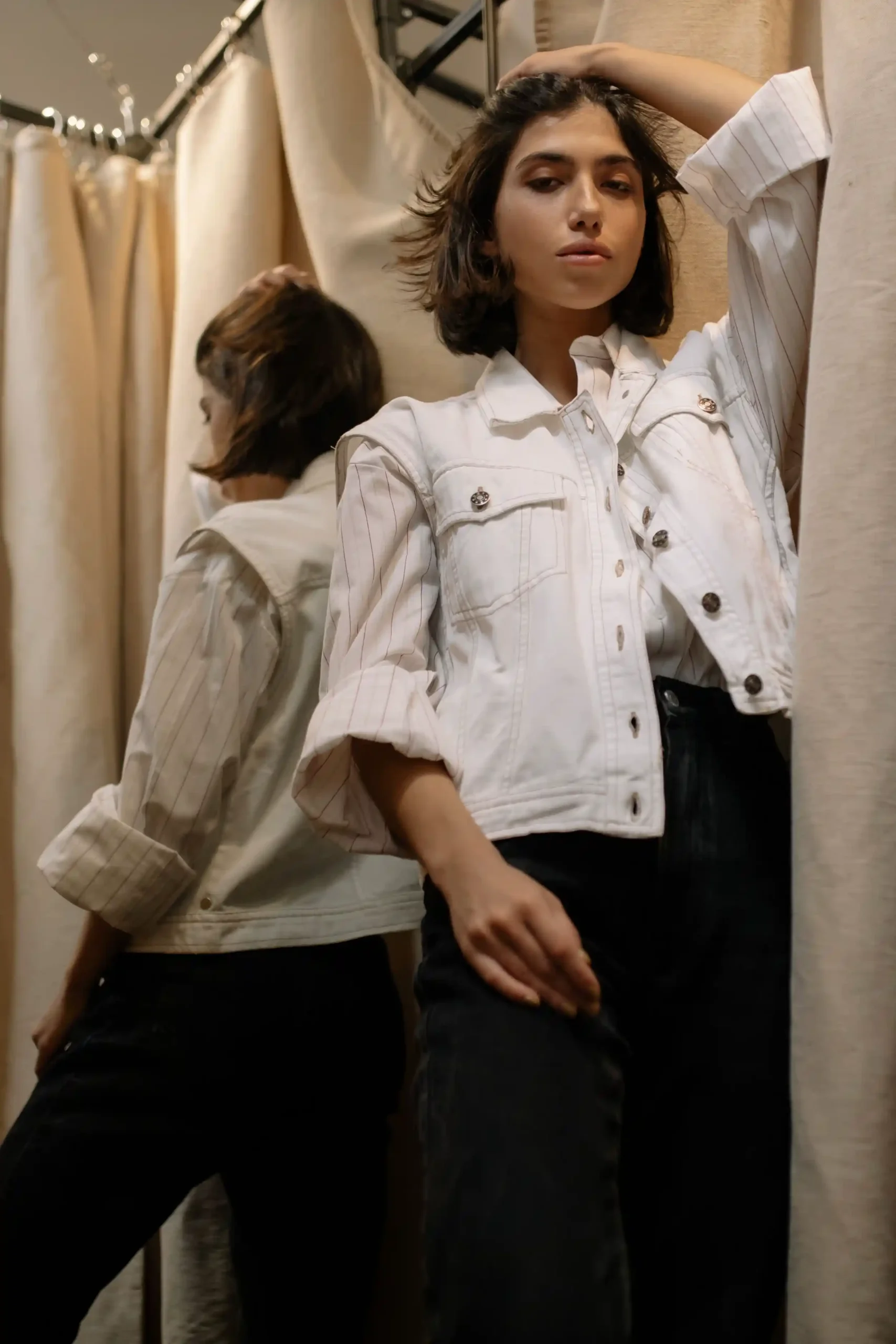
The brands that solved this did it with separate cuts, not bigger numbers. Abercrombie’s Curve Love denim adds two inches through the hip and thigh specifically to eliminate waist gap, on a size run that reaches a 37 with five inseam lengths.
Good American engineers its denim from a 00 to 32 range with enough stretch to serve a curvier hip. When a brand does that work, a 12 or 14 fits like it was meant for you, because for once it was. Where they haven’t done it, remember that no two brands assign the same meaning to the same number, and let your measurements, not the tag, make the final call.
Four Outfit Formulas That Work on a Midsize Frame
These are the combinations I return to, because each one controls proportion first and lets trend ride along second.
The casual column: high-rise straight-leg jeans and a half-tucked poplin
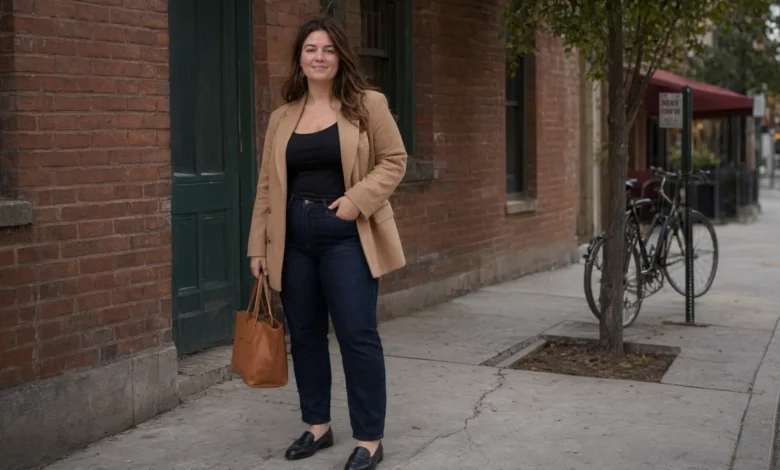
Start with a high-rise straight-leg jean, a front rise of 10 to 12 inches, in 11 to 13 ounce denim with a little elastane. Add a cotton poplin shirt or fitted tee with a front tuck, and a structured jacket that ends at the high hip. Keep the palette tonal and the leg line unbroken, and finish with clean sneakers or a pointed flat.
The rise sits at your natural waist, the straight leg skims the thigh instead of clinging to it, and the tuck marks the waistline without any compression. If denim shopping has been a series of betrayals, our technical blueprint for buying jeans that fit walks through the measurements this formula depends on.
The office formula: darted blouse, tailored trouser, structured blazer
For business casual, the enemy is the boxy untucked shirt. Swap it for a blouse with actual darts or a wrap front, a mid-to-high rise trouser with a touch of back elastic or side adjusters, and a blazer with a defined shoulder. Buy the blazer for the shoulders and let a tailor handle the waist. Dark, unripped denim can stand in for the trouser in offices with a situational dress code.
The wedding guest: wrap or fit-and-flare in a heavier crepe
A wrap dress or fit-and-flare in lined crepe, or a satin with real weight behind it, drapes over the middle instead of clinging to it. Pear-leaning frames do well with a basque waist or an A-line skirt that starts at the natural waist. Put your budget into fabric weight and a block heel. For season-specific picks, our summer wedding guest dress guide covers the rent-versus-buy math for one-off invites.
The alternative lean: dark monochrome with one structured layer
If your style runs darker, the column still works in black: straight-leg black denim, a fitted rib top, one cropped structured jacket, and mixed metal hardware as the only accent. The silhouette does the flattering, so the aesthetic stays yours.
The Fit Rules Doing the Real Work
Every formula above runs on the same small set of mechanical variables. When an outfit misses, one of these is usually the cause.
| The complaint | The mechanical fix |
|---|---|
| Buttons gap at the bust | Buy for the bust, then add waist darts for 15 to 30 dollars at a tailor, or skip the fight with a wrap front. |
| The waistband gaps at the back | Look for a curvy cut that adds room through hip and thigh, the two-inch adjustment Abercrombie built into Curve Love. |
| Tops hang like a tent from the chest | Check torso length, not just the size number. A front tuck or a shorter hem restores the waistline. |
| The middle reads shapeless | Put definition in construction: wrap ties, darts, a belt over a looped high-rise waistline. Compression is the last resort, not the first. |
| Jeans bag at the knees by lunch | Denim weight. An 11 to 13 ounce fabric with a little stretch holds its shape, while anything under 10 ounces bags out. |
On proportion, keep visual breaks near a third of your height rather than a half. A cropped jacket over a longer line, or a higher rise under a longer top, reads intentional, while a jacket and hem that meet at the same point cut the column in half. And when a piece fits everywhere except one seam, tailoring is a legitimate shopping strategy, not a concession. A 20 dollar dart turns a maybe into a yes.
Brands Whose Pattern Blocks Account for the Middle
Size ranges shift season to season, so confirm against the current chart, but these labels have consistently graded through the middle rather than tacking it on.
| Brand | Size run | What to know |
|---|---|---|
| Abercrombie and Fitch | Jeans 24 to 37, five inseams | Curve Love adds two inches through hip and thigh to close the waist gap. |
| Good American | 00 to 32 | Denim engineered for a curvier hip, and the Always Fits line covers four sizes per tag. |
| Universal Standard | 00 to 40 | Every style in every size, fitted on a size 18 sample, so the middle is graded rather than guessed. |
| Madewell | Denim 23 to 37, clothing to 3X | Petite and tall inseams help shorter and longer torsos land the rise correctly. |
| Reformation | Extended 14 to 24 | The popular dresses, not just basics, come in the extended run. |
| Eileen Fisher | 0 to 18 plus 16W to 24W | Quiet, washable pieces, and a thrift favorite for the middle sizes. |
Where This Advice Falls Short
Above a 16, the plus block is your friend and this article’s brand table narrows to the labels that run both blocks, like Universal Standard and Eileen Fisher. Below a 10 with a curvier shape, the shape guides on this site will outperform any size-category advice, because proportion, not the number, is your variable.
Tailoring also costs real money, and a final-sale piece that needs shoulder or bust work was never a deal, so run the alteration math before the purchase, not after. And treat the midsize label as a sorting tool for shopping, not a verdict on your body. The categories exist to serve the closet, not the other way around.
If Your Situation Is a Little Different
- If you sit between two sizes at checkout: buy the larger and tailor the smaller points. A darted waist or a taken-in side seam costs less than a second garment and fits better than the size that pulls.
- If your body has changed recently: start with a wrap dress and a stretch woven trouser, two anchors that fit a moving measurement, and hold off on a full closet rebuild until things settle. Rebuilding mid-change is how closets fill with clothes that fit a body you no longer have.
- If your budget is tight right now: shop your own closet for the column first, since most people already own a high-rise bottom and a fitted top that can form one. Then add one thrifted Eileen Fisher or Madewell piece and one tailoring visit per month, which beats three fast-fashion guesses.
Frequently Asked Questions About Midsize Body Type Outfits
What dress size is considered a midsize body type?
Most stylists and retailers describe midsize as US sizes 10 to 16, with some using 10 to 14 or 12 to 16. It is the range between straight sizes and plus sizes, and the exact boundary shifts by brand.
What is the difference between straight size, midsize, and plus size?
Straight sizes are cut from a smaller sample block, plus sizes from a separate curvier block, and midsize is the in-between range that often still wears the straight block. That grading gap is why a 12 can fit worse than an 18W.
What are the best clothing brands for midsize women?
Abercrombie and Fitch, Good American, Universal Standard, Madewell, Reformation’s extended line, and Eileen Fisher all grade through the middle sizes rather than tacking them on. Check each brand’s current size chart, because ranges shift.
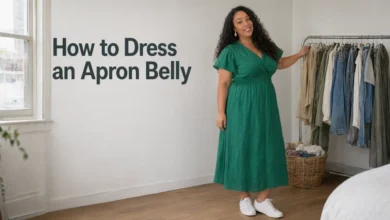
How do I dress a midsize belly without shapewear?
Place the waistline above or below the belly, never on it, and let construction do the defining with a wrap tie, an empire seam, or a peplum. Fabric weight matters too, since wovens in the 150 to 220 GSM range skim while lighter knits cling.
How do I dress midsize for a business casual office?
Pair a darted or wrap blouse with a mid-rise tailored trouser and a blazer that fits the shoulders, letting a tailor handle the rest. Dark, unripped denim passes in many offices under a situational dress code.
Last Words
The midsize range was never the problem. The grading was. Once you know that the button gap and the waistband gap are pattern-block failures rather than body failures, midsize outfit ideas stop being a scavenger hunt and become a short list of mechanical checks: the right rise, weight in the fabric, definition in the construction, and a brand that drafted for you in the first place. Start this week by writing down your bust, waist, and hip measurements, matching them to one brand chart from the table above, and building a single casual column around a high-rise straight leg. One formula that fits teaches you more than a cart of maybes.
Sources
Research Sources
- International Journal of Fashion Design, Technology and Education: Average American women’s clothing size: comparing National Health and Nutritional Examination Surveys 1988 to 2010 to ASTM International Misses and Women’s Plus Size clothing, Access Date: August 20, 2026
Industry Sources
- Today: What Is Mid-Size Fashion? Experts Explain, Access Date: August 20, 2026
- New York Magazine, The Strategist: I Tried All the Jeans at Abercrombie and Fitch, Access Date: August 20, 2026
- Forbes: Madewell Dramatically Expands Size Range, Access Date: August 20, 2026
- Marie Claire: Reformation’s Permanent Plus Size Collection, Access Date: August 20, 2026
- Good American: Always Fits, Access Date: August 20, 2026
- Universal Standard: Size Guide and Size Chart, Access Date: August 20, 2026
- Abercrombie and Fitch: Women’s Jeans and Denim Styles, Access Date: August 20, 2026
Additional Reading
- Wardrobe Oxygen: Where to Shop When You Are Midsize, Access Date: August 20, 2026