How the clothing choices landing in your local retail stores arrive often feels like total, unpredictable chaos. It is easy to look at a sudden wave of new silhouettes and assume someone pulled them out of thin air to force an immediate purchase. Behind that apparent marketplace static sits a highly calculated, predictable structure driven by clear economic vectors and sociological frameworks. Demystifying how fashion trends start shifts the leverage back to you, turning what feels like a retail mandate into an optional styling filter for a stable, deliberate wardrobe.
how fashion trends start?
Fashion trends originate through three primary distribution vectors: trickle-down (elite design to mass markets), trickle-up (grassroots subcultures to luxury runways), and trickle-across (simultaneous horizontal adoption across market tiers via mass media). Modern online curation algorithms accelerate this lifecycle, compressing historical timelines down to short, hyper-fleeting style loops.
1. The Traditional Mechanics: How Fashion Trends Start Through Cultural Diffusion
Historically, garments did not achieve widespread popularity by accident. Factual research into fashion distribution shows that styles move through culture using three distinct transmission vectors: trickle-down, trickle-up, and trickle-across. Understanding these traditional directions reveals that design evolution is a structured conversation between different layers of society rather than a series of random decisions made by a solitary designer.
The structural breakdown of these pathways illustrates how visual patterns migrate through different economic brackets over time.
When looking at this graphic, look for the interconnected loops that show how individual design elements circulate through society. The circular flow demonstrates that no single tier operates in isolation; an aesthetic shift in one quadrant inevitably triggers an adaptation in the others.
The Trickle-Down Vector: The Classic Runway Pipeline
This is the vertical pipeline most people recognize. A high-fashion design house introduces a new concept during seasonal runway shows, targeting elite consumers who value exclusivity. As other market layers observe these premium releases, garment manufacturers create simplified versions for mid-tier department stores. Eventually, the silhouette undergoes mass reproduction at budget-friendly price points.
This top-down model relies on a desire for social distinction. Elite tiers adopt a look, mass production makes it accessible, and the originators shift to a new look to maintain spacing. The modern rise of the Old Money aesthetic operates similarly, utilizing heritage-coded dressing and muted palettes to signal status before mass retailers replicate the look without the luxury fabric quality.
The Trickle-Up Movement: How Subcultures Influence High Fashion
Innovation frequently travels in the opposite direction. The trickle-up framework explains how styles originating within grassroots communities, countercultures, or working-class utility wear travel upward to reshape luxury collections. Consider how heavy denim, combat boots, or graphic street wear moved from functional, daily uniforms into high-tier editorial lines.
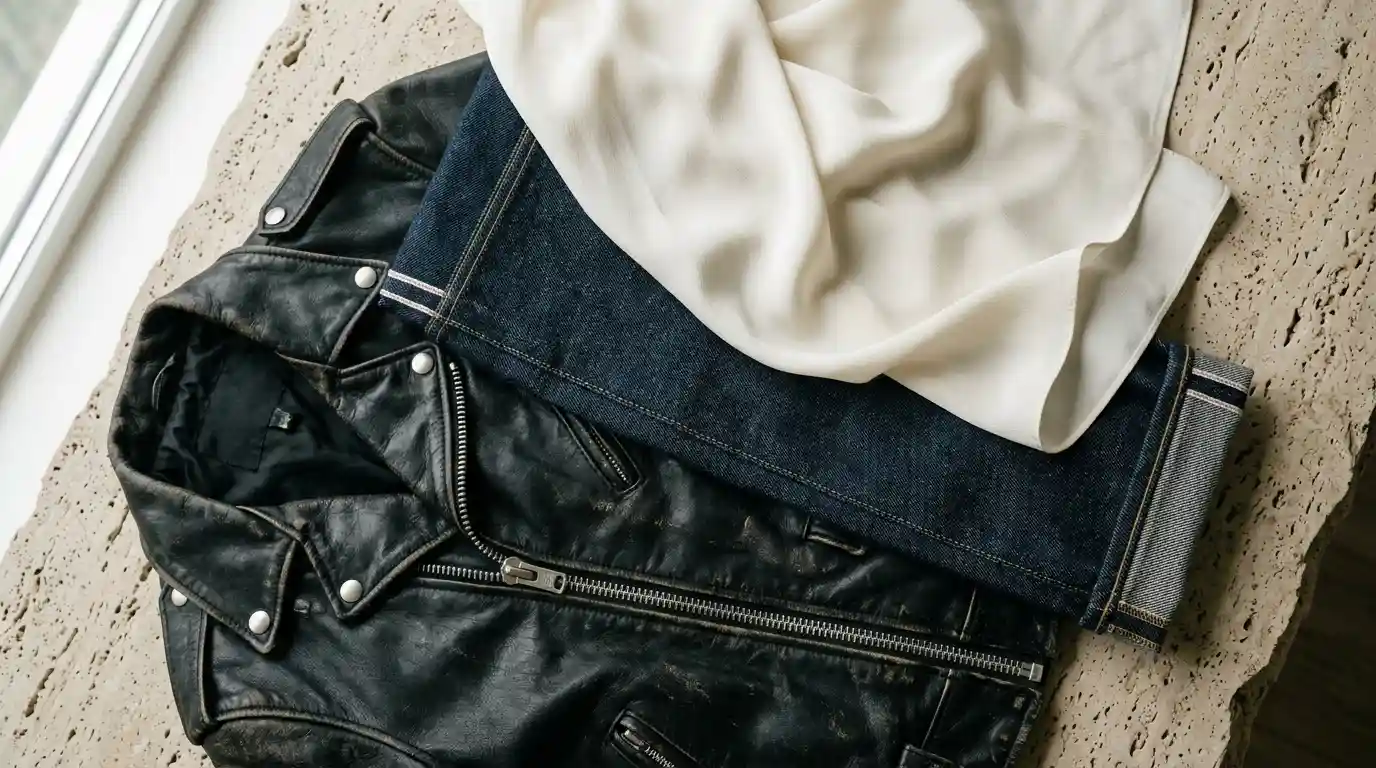
To see this in practice, look at how the classic leather motorcycle jacket traveled. It began as functional safety gear for pilots and motorcyclists, offering wind resistance and physical protection. Grassroots music subcultures later adopted the jacket as a symbol of rebellion, modifying it with metal hardware. Design houses eventually noticed this persistent aesthetic uniformity and introduced their own high-end interpretations on global runways, charging premium prices for a silhouette born out of practical utility.
The Trickle-Across Reality: Horizontal Style Diffusion
The modern landscape relies heavily on horizontal transmission. The trickle-across model occurs when a style appears simultaneously across distinct market tiers, driven by rapid communications networks and mass media production. Instead of waiting for a high-fashion house to pass down a concept, retailers across all economic levels gain access to global forecasting data concurrently. A contemporary designer brand and a mass-market retail chain can produce their own versions of a specific silhouette within the exact same season, allowing shoppers of various budget brackets to adopt a look at the same time.
2. The Modern Speed Loop: How Algorithms Change the Fashion Lifecycle
While the traditional transmission vectors still exist, modern internet platforms have introduced an unprecedented dynamic known as algorithmic curation intensity. The structural mechanics of how fashion trends start no longer rely solely on a predictable, multi-year progression from sketch to store shelf. Today, data-driven platforms track micro-interactions to instantly amplify specific visual motifs, rewriting the traditional industry timeline. Industry reporting from retail analysts notes that this data loops back directly to manufacturers, allowing them to bypass traditional 18-month production timelines entirely.
This algorithmic architecture alters the structural duration of style movements. Factual tracking indicates that modern distribution engines compress the traditional 20-year nostalgia loop down to a mere 5 to 10 years for structural silhouettes. More starkly, hyper-focused internet micro-trends complete their entire operational cycle within a few weeks. When a specific aesthetic gains tracking momentum online, ultra-fast fashion supply chains respond instantly. Industrial data shows that these automated production pipelines add roughly 10,000 new individual apparel items daily to their digital storefronts to capture fleeting consumer focus.
Consider the horizontal transmission of the modern minimalist aesthetic. A movement like Quiet Luxury traditionally relied on long-term appreciation for fine materials and construction quality. However, social algorithms stripped away the emphasis on garment durability, translating the look into pure visual currency. As digital feeds filled with images of structured tailoring, fast-fashion factories rapidly churned out polyester versions, utilizing synthetic Satin fabrics that mimicked the glossy face of real silk but lacked the breathability and longevity. The lifecycle of the trend accelerated dramatically, moving from niche appreciation to digital saturation, and finally to retail clearance bins in record time.
To understand how fundamentally this digital loop shifts away from historic design paths, we can analyze the core dimensions of the industry side by side.
| System Dimension | Traditional Fashion Engine | Modern Algorithmic Loop |
| Design Lifecycle | Takes 12 to 18 months from sketch to store shelf | Completed in 3 to 10 days via real-time data loops |
| Production Volume | Fixed seasonal collections with limited drops | Roughly 10,000 unique styles uploaded daily |
| Vector Control | Governed by editorial boards and design directors | Directed by user interaction metrics and feeds |
| Primary Material Focus | Emphasizes structural tailoring and durable textiles | Prioritizes fast visual reproduction using synthetics |
3. The Staying-Power Assessment: Separating Micro-Trends from Macro-Silhouettes
For the intentional dresser, observing how fashion trends start is only the baseline step; the deeper challenge lies in deciding which style updates warrant a permanent place in the closet. Industry analysis confirms that a healthy macro-silhouette transitions systematically through 5 distinct operational phases: introduction, rise, peak, decline, and obsolescence.
Micro-trends, by contrast, are shallow visual overlays that bypass a genuine introduction phase. To avoid the common mistake of buying into a fleeting internet fad, consumers can apply an objective pattern tool used by professional forecasters: the rule of three. In trend tracking circles, it is a commonly understood practice that when a specific visual motif, unique detail, or unusual pairing surfaces across three entirely independent cultural sources, such as a street style report, a contemporary runway collection, and a localized art movement, it indicates a stable trend rather than a manufactured algorithm spike. If the item only appears on a single algorithmic feed, it is likely a short-lived digital aesthetic.
Many people make the mistake of assuming that high online visibility equals longevity. When your feed is flooded with a specific piece, it is easy to confuse high intensity for structural staying power. This saturation actually signals that the trend has already entered its peak phase, meaning mass saturation is imminent and decline will quickly follow. Buying a highly specific piece during this peak phase ensures that the garment will look dated within a few months. A classic Midi hem length, which ends predictably mid-calf, represents a stable structural baseline; an identical skirt covered in hyper-specific, seasonal digital prints represents a volatile micro-trend prone to rapid obsolescence.
4. Navigating the System: How to Integrate Trends Without Buying a New Closet
Stepping off the continuous consumption treadmill does not require you to ignore contemporary style. Field observations suggest that managing your wardrobe should be treated as a change in styling rather than a change in purchasing. By using the clothes you already own in new combinations, you can reflect modern proportions without supporting hyper-fast production models. Protecting your identity allows you to navigate changing aesthetics while anchoring your personal style blueprint against external industry updates.
If you are working to anchor your wardrobe, learning how to build a timeless capsule wardrobe provides the steady foundation needed to resist algorithmic hype. Once that base is secure, you can evaluate modern shifts with critical detachment. Instead of buying a completely new set of apparel, use this structured action plan to audit incoming trends against your existing assets.

Closet Integration Action Plan
-
Isolate the structural change: Strip away the styling hyperbole and look at the actual shape. Determine if the movement is introducing a real structural shift like a lower waist or an exaggerated shoulder line.
-
Audit your existing baseline: Look through your personal collection for items that share similar proportions or can be modified. A timeless Linen Blend button-down shirt can be worn open over a knit top or tucked into high-waisted trousers to shift the silhouette without buying a new top.
-
Focus on styling adjustments over acquisitions: Often, updating a look is simply a matter of changing how you combine pieces. Experiment with unexpected pairings, like wearing a structured blazer with casual flat shoes, to achieve a contemporary look using your current wardrobe.
-
Apply a construction quality check: If you do choose to purchase a new piece to anchor a shifting silhouette, look past the brand label. Take time to evaluate the underlying construction quality of a garment by checking the seam straightness, fabric weight, and hem allowances to ensure the piece lasts beyond the current season.
Who decides what clothing styles are in fashion?
Traditional fashion trends are shaped by forecasting networks, historic textile houses, and design studios. Modern micro-trends are increasingly driven by algorithmic curation metrics that track real-time visual engagement on social media feeds.
What is the structural difference between a macro-trend and a micro-trend?
A macro-trend represents a durable, multi-year shift in silhouette or lifestyle utility, such as the transition from slim tailoring to relaxed fits. A micro-trend is a shallow, short-lived digital aesthetic that typically completes its lifecycle within a few weeks.
How can I update my personal look without constantly purchasing new clothing?
Focus on styling updates rather than retail consumption. Alter visual proportions by experimenting with layering techniques, adjusting waist silhouettes, or combining structured baselines with casual pieces already present in your current closet.
Sources
Research Sources
- The AMag | From Microtrend to Fast Fashion Pipeline | https://theamag.com/9909/culture/microtrend-to-fast-fashion-pipeline/ | July 2026 | Tier 4
Industry Sources
- SlideShare | Theories of Fashion | https://www.slideshare.net/slideshow/theories-of-fashion/250311230 | July 2026 | Tier 5
- Heuritech | Five Stages of the Fashion Trend Life Cycle | https://heuritech.com/articles/five-stages-of-fashion-trend-life-cycle/ | July 2026 | Tier 5
- Textile Tech | The Fashion Life Cycle Explained | https://www.textiletechinsight.com/article/fashion-life-cycle/ | July 2026 | Tier 5
- VICE | How the 20-Year Trend Cycle Collapsed | https://www.vice.com/en/article/how-the-20-year-trend-cycle-collapsed/ | July 2026 | Tier 5
- With Love Mimi | Has TikTok Killed the Trend Cycle? | https://www.withlovemimi.co.uk/post/has-tiktok-killed-the-trend-cycle-who-actually-decides-what-s-in-right-now | July 2026 | Tier 5
- Vogue College of Fashion | What is a Fashion Trend? | https://www.voguecollege.com/articles/madrid/what-is-a-fashion-trend-a-guide-to-understanding-the-future-of-the-industry/ | July 2026 | Tier 5