
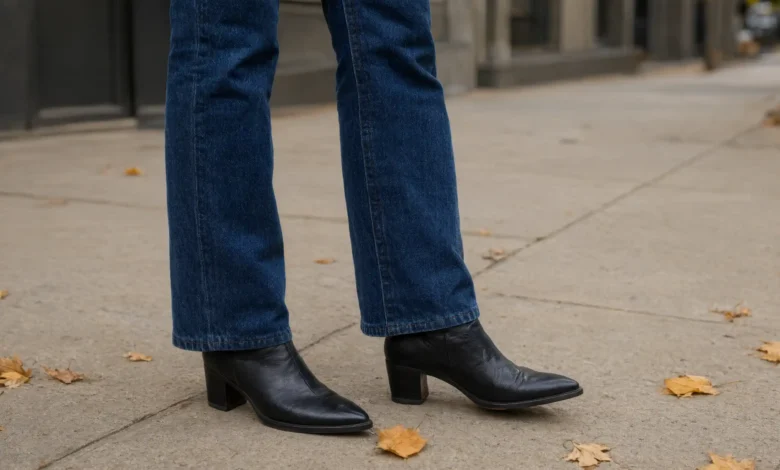
There is a specific moment every fall when you stand in front of the mirror wearing jeans, wearing boots, and staring at the two inches of bare ankle between them, wondering why the outfit reads off instead of intentional. Figuring out how to wear ankle boots well is rarely about the boots themselves. It is about where the hem lands, and how badly the boot interrupts the line of your leg.
The good news is that the pairing rules are mechanical, not mystical. Once you know what each pant cut asks of the shaft and the toe, the same pair of black booties can handle skinny denim, a fluid wide-leg trouser, and a cropped office pant without any of the three outfits feeling forced. Vogue’s fall styling guide treats the ankle boot as an any-day shoe for exactly this reason, running suede stompers and stacked heels through skirts, denim, and tailoring alike.
What follows is the whole system, organized by hem.
To wear ankle boots well, match the hem to the shaft: tuck skinny jeans in or let them meet the boot top, keep straight-leg hems grazing the shaft or falling about an inch over it, let wide-leg pants cover the shaft entirely with a pointed toe peeking out, and keep cropped dress pants tonal with a slim shaft. Then let toe shape and heel height do the lengthening, because a pointed toe on a 2- to 3-inch block heel reads longer than a round toe on a flat sole every time.
The Leg Line Is the Whole Game
Every pairing rule in this guide is a version of one principle: the outfit works better the less the boot chops your vertical line. Celebrity stylist Brenda Cooper puts it plainly in Parade’s guide to wearing ankle boots over 40: “A smooth, uninterrupted line, where the pant either skims over or tucks neatly into the boot, is best as it creates a more refined, intentional and flattering appearance.” That is the entire game. Tucking, cuffing, covering, and tone-matching are just four ways of protecting that line against four different pant cuts.
Celebrity stylist Adeel Khan frames the same idea from the denim side, calling jeans falling over the boot the most flattering silhouette because the pant leg flows into the boot instead of being cut off by it. So before you decide over or under, ask what the hem is doing. If it is bunching, bulging, or floating a strip of bare skin above the shaft, the line is broken, and no amount of nice leather fixes that.
How to Wear Ankle Boots With Skinny Jeans
Skinny denim is the one cut where the boot and the pant have to negotiate the same territory, since both end at the same place on your leg. You get three clean options, and the right one depends on the shaft.
- Tuck them when the ankle opening is narrow enough to slide in without bunching. Dark denim into a black shaft reads as one continuous leg, especially with a heeled bootie.
- Let the hem meet the top when the jeans are cropped or hit right at the shaft, so denim kisses leather with no skin and no stacking.
- Cuff once, narrowly, when the jeans run a touch long, because a single tight roll keeps the line while a thick double roll cuts your leg in half.
What fails is bulk. Heavy denim stacking over a slim shaft adds exactly the bunching Cooper warns against, and a tall shaft under a rolled hem chops the leg twice, which is why most boot-and-jeans guides repeat the same fix: the shorter the shaft, the safer the roll.
Skinny jeans and booties at a glance
- Narrow ankle opening plus any shaft: tuck.
- Cropped hem that meets the shaft: let them kiss, no skin.
- Long hem plus short shaft: one narrow cuff.
- Long hem plus tall shaft: skip the cuff and switch to a taller boot.
Where a Straight-Leg Hem Should Land
Straight-leg denim is the easiest cut to pair with ankle boots, because the opening is usually wide enough to fall over the shaft without bunching and narrow enough not to swallow the shoe. The target is a hem that grazes the boot top when you stand, or falls about an inch over it. One styling desk keeps the outer bound at roughly an inch of daylight between hem and boot, and less is always safer, since the gap grows when you sit and the hem rides up.
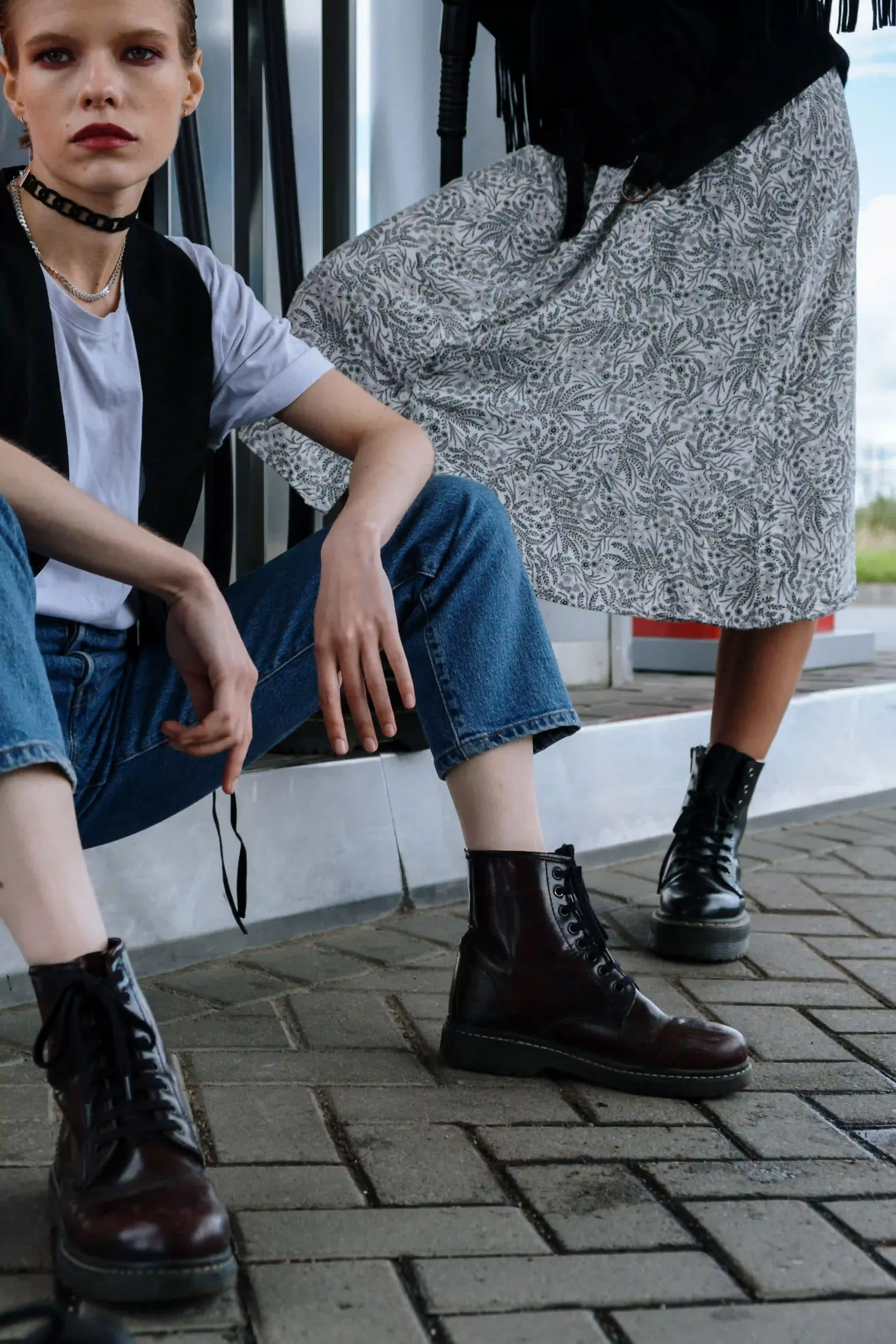
If your straight-legs run long, Khan’s fix is the good one: roll the cuff so it hits right at the top of the ankle boot, which reads vintage instead of accidental. Keep the roll tight and let it sit at the shaft, not three inches above it.
This is also the cut where a Chelsea boot shines, because the flat side panels slip under the hem without adding bulk. And if you are still sorting out which denim silhouettes belong in your rotation, our guide to how jeans should actually fit covers the leg-opening measurements that make this pairing easy.

Wide-Leg Pants and the Covered Shaft
Wide-leg trousers flip the rule. The hem should cover most or all of the shaft, and the boot’s job is to add height and a sharp toe under the fabric, not to be seen. Think of the boot as hidden architecture: a 2- to 3-inch block heel under a full-length wide-leg pant gives you the posture of a heel with nothing visible but a pointed toe stepping out mid-stride.
Two details decide whether this looks expensive or sloppy. The hem has to be long enough to cover the shaft while you walk, not just while you stand, and the boot needs to be streamlined rather than chunky, since a bulky shaft under fluid fabric bulges at the ankle and fights the drape, the same reason tailoring-focused guides steer wide trousers toward sleek ankle boots. Suede or smooth leather with a narrow toe keeps the line clean.
Cropped Dress Pants and Office Trousers
This is the pairing that makes people nervous, and it is where the advice genuinely splits. Some stylists love a cropped trouser with a bootie for work, while Cooper is openly cautious, because a flat ankle boot under a cropped hem creates a visual break at the ankle that shortens the leg line. The resolution is not to ban the pairing. It is to control the break.
Three moves do that. First, heel over flat, since even a 2-inch block heel continues the line upward instead of stopping it at the floor. Second, keep the shaft slimmer than the pant leg, which is the rule stylist Jess Keys builds her cropped-pant looks around, and The Cut makes the same point in its boot edit for cropped pants, reaching for longer shafts that sit close to the leg. Third, close the color distance, because a black boot under a black cropped trouser reads as continuation while a tan boot under a gray hem reads as interruption. That tonal logic is also why slim, closed, pointy-toe shoes dominate Corporette’s guidance for ankle-length work pants.
In a business casual office, a sleek black bootie under a tailored ankle pant usually reads more considered than a tired pump, which is worth knowing before you default to the shoe drawer you already own. Our practical breakdown of the business casual dress code covers where footwear formality actually lands in offices that no longer write any of this down.
How to Wear Ankle Boots Without Looking Short
The shortening people complain about is almost never the boot. It is the contrast breaks around it. Four levers fix it.
- Point the toe. A pointed or almond toe extends the leg line forward, and it is the most repeated lengthening rule in boot styling, from petite guides to footwear brands’ own fit notes.
- Match the tone. Black boot with black denim, tan boot with a cream trouser, because the lower the contrast at the ankle, the longer the leg reads.
- Add a little heel. A 2- to 3-inch block heel changes your posture and your sightline without a stiletto’s wobble. Sam Edelman’s Saige bootie, a repeat favorite in fall boot roundups, lands around a 2.75 inch demi-block heel, which is exactly the workable range, and Madewell’s Idris side-zip bootie, which Glamour lists among the best block-heel ankle boots at 228 dollars, is the shape to look for even if you buy elsewhere.
- Close the gap. Bare skin between hem and shaft is the most expensive inch in styling, because it announces the break. If you want to show ankle, show it on purpose with a skirt or dress, not by accident with a too-short pant.
Petite readers ask this most often, and the honest answer is that ankle boots work fine on shorter legs. The failures come from round toes, flat soles, and high-contrast gaps stacking on top of each other. Fix two of the three and the boot stops fighting you.
The Hem and Boot Cheat Sheet
| Pant cut | Where the hem lands | Boot that works | The failure to avoid |
|---|---|---|---|
| Skinny jeans | Tucked, or meeting the boot top | Slim shaft, any toe | Thick denim stacking over the shaft |
| Straight-leg jeans | Grazing the shaft, or an inch over it | Chelsea or block-heel bootie | A rolled cuff floating three inches high |
| Wide-leg pants | Covering the shaft entirely, mid-stride included | Streamlined pointed toe on a block heel | A chunky shaft bulging under fluid fabric |
| Cropped dress pants | A small, deliberate gap with matched tones | Slim shaft, 2- to 3-inch heel | A flat sole stopping the line at the floor |
| Midi skirt or dress | Anywhere from mid-calf down | Sock boot or pointed-toe heel | A wide shaft fighting a full skirt |
When Ankle Boots Are the Wrong Call
A few honest exclusions. Floor-length hems swallow the boot entirely, so if most of your pants are maxis, the boot you need is a taller one. A heavy lug sole under a fluid wide-leg trouser fights the drape. And if your office leans formal enough that a pump is the quiet choice, a bootie under a cropped hem will still read casual on the days you need it not to. Ankle boots are a workhorse, but a workhorse is not every horse.
Choosing the One Pair Worth Buying First

If your closet runs to wide-leg and straight denim: buy a black pointed-toe bootie on a 2- to 3-inch block heel. It disappears under the wide leg and grazes cleanly under the straight leg, which covers most of a modern denim drawer in one purchase.
If you dress for a business casual office: choose a slim black shaft in smooth leather over suede, because it survives rain and reads sharper under a cropped trouser, and keep the heel at 2 inches or taller so the line holds through a day of sitting and standing.
If you are rebuilding your wardrobe and the budget is one pair: skip the flat round-toe bootie even though it feels safe. The pointed toe and low block heel are what make the boot work with dresses, cropped pants, and every jean cut above, which is the entire point of buying one pair. The same logic drives our wider advice on building a signature style around repeatable pieces instead of one-off purchases.

Frequently Asked Questions About Wearing Ankle Boots
Do you tuck skinny jeans into ankle boots?
Tuck them when the ankle opening is narrow enough to slide in without bunching. If the denim stacks or bulges over the shaft, let the hem meet the boot top instead, or cuff it once, narrowly.
How much gap should there be between ankle pants and boots?
As little as possible, and never more than about an inch. The gap grows when you sit, so a hem that floats over the shaft while standing reads as an accident by lunchtime.
Can you wear ankle boots with wide-leg dress pants?
Yes, and it is one of the best pairings, as long as the hem covers the shaft while you walk and the boot is streamlined with a pointed toe. The boot should be felt as height, not seen as bulk.
How do you wear ankle boots over 40 without looking dated?
The same rules apply at every age: keep the line unbroken, skip a thick rolled cuff over a tall shaft, and let clean leather and a low block heel carry the outfit. Stylists who field this question directly point out that proportion, not age, is what makes the look work.
Is it okay for pants to cover ankle boots?
With a wide leg, covering is the correct call, because the hem should hide most of the shaft and show the toe mid-stride. With a skinny or straight leg, covering usually means bunching, and that is the version to avoid.
Start With the Hem
Every question about how to wear ankle boots, from jeans to dress pants to not looking shorter than you are, collapses into the same thirty-second check: stand in front of a mirror and watch where the hem meets the shaft. Tuck it, graze it, cover it, or tone-match it, and the boot stops being a problem piece. If you are also shifting seasons right now, the same hem logic slots neatly into moving lighter clothes into fall, where closed-toe footwear does the quiet work of making summer fabric read autumnal.
Buy for the hem you own, not the boot you like, and the pair will earn its keep from October through March.
Sources
Industry Sources
- Vogue: How to Style Ankle Boots for Fall, Access Date: August 12, 2026
- The Cut: These Are the Best Boots to Wear With Cropped Pants, Access Date: August 12, 2026
- Glamour: 24 Best Ankle Boots for Styling With Jeans and Tights, Access Date: August 12, 2026
- Parade: How To Wear Ankle Boots Over 40, According to a Celebrity Stylist, Access Date: August 12, 2026
- Yahoo Shopping: A Celebrity Stylist Reveals: 7 Best Ways To Wear Ankle Boots With Jeans, Access Date: August 12, 2026
Additional Reading
- Corporette: How to Wear Ankle Length Pants to Work, Access Date: August 12, 2026
- Jess Keys: How to Style Ankle Boots with Cropped Pants, Access Date: August 12, 2026
- Jo-Lynne Shane: The Ultimate Boot Guide for Fall and Winter 2025, Access Date: August 12, 2026
- Saint and Sofia: Best Boots To Wear With Wide Leg Trousers, Access Date: August 12, 2026
- Shoezone: A How to: Ankle Boots and Styles, Access Date: August 12, 2026