The Carry-On Business Trip Packing Guide: Professional Capsule Layouts
Unpacking your suitcase at 11:15 PM in a midwestern hotel room only to discover your primary presentation blazer looks like a crumpled accordion is a distinct corporate hazard. Your presentation is at 8:00 AM, the hotel iron has a corroded faceplate, and there are no steamers in sight. This high-friction logistical failure is exactly why a systematic business trip packing guide is a professional necessity rather than an optional task.
Moving your wardrobe architecture from a bedroom closet into a single rolling cabin bag requires shifting away from emotional packing. True efficiency relies on strict spatial geometry, deliberate textile selections, and an interchangeable layout that adapts to changing schedules without cluttering your bag.
For domestic US flights, a business trip carry-on suitcase must not exceed 22 x 14 x 9 inches including handles and wheels. Pack a six-piece interchangeable capsule focused on high-twist crepe and tropical wool fabrics. Roll soft knits into tight cylinders and use the protective inside-out fold for structured blazers to eliminate compression wrinkles.
Cabin Spatial Constraints: Airline Dimensions and Luggage Rules
Air travel operates within rigid spatial boundaries that dictate garment selection before you even unzip your suitcase. Major domestic network carriers, including Delta Air Lines, enforce a strict dimension threshold for overhead luggage to ensure equitable cabin stowing.
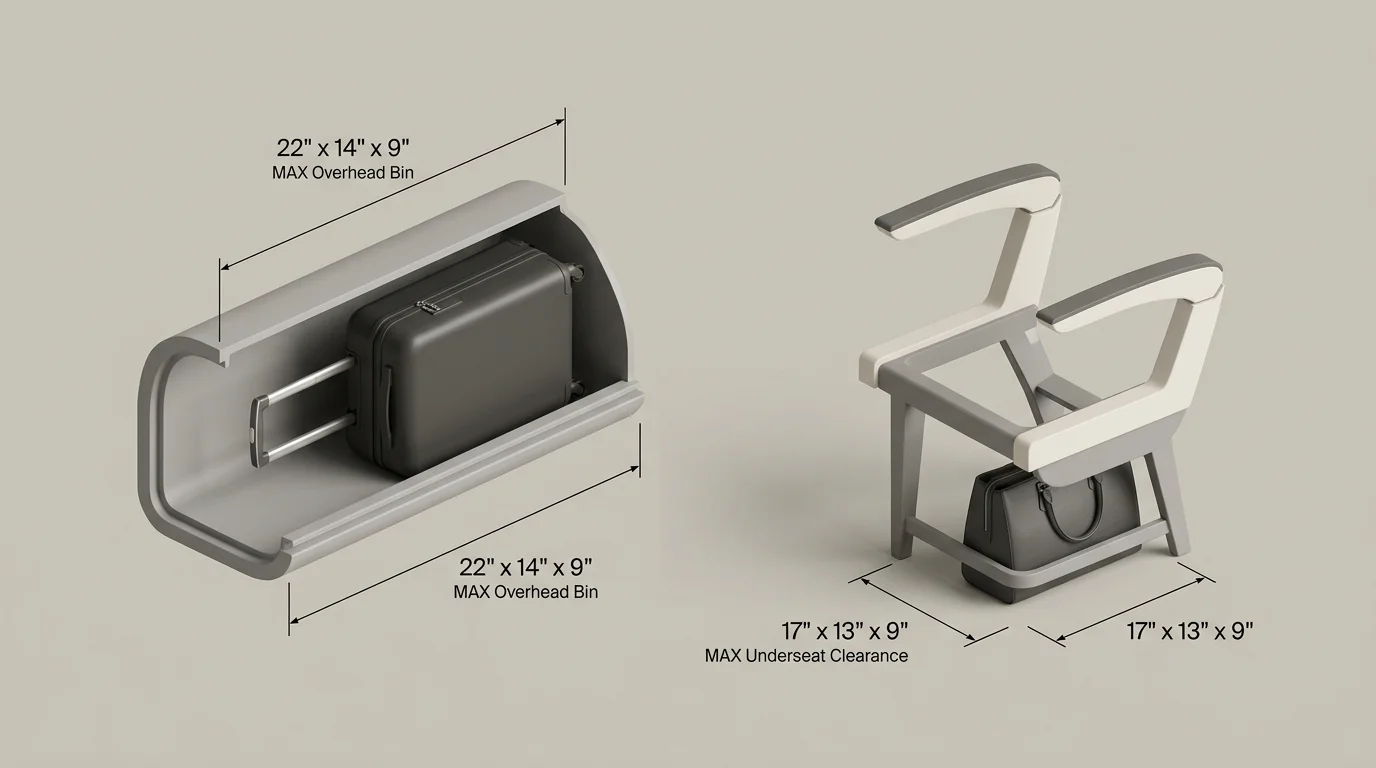
Overhead Bin Architecture (22″ x 14″ x 9″)
Standard overhead roller suitcases are restricted to 22″ x 14″ x 9″ inclusive of handles, wheels, and side pockets. Choosing a bag with a rigid exterior frame ensures these boundaries are never breached by overstuffed internal pockets. A minor variance of a half-inch can result in a forced gate-check on smaller regional jets, transferring your delicate tailoring into a high-abrasion cargo hold.
Underseat Space Optimization (17″ x 13″ x 9″)
The secondary stowing zone beneath the seat frame is limited to 17″ x 13″ x 9″ across most mainline fleets. This personal item zone should be reserved exclusively for mission-critical professional tools.
At-a-Glance Cabin Thresholds
- Overhead Suitcase: 22″ x 14″ x 9″ maximum clearance. Best for clothing capsules and footwear.
- Underseat Bag: 17″ x 13″ x 9″ maximum clearance. Best for electronics, documents, and transit cosmetics.
When main cabin bins fill up quickly, flight crews automatically pivot to gate-checking rolling luggage. Splitting your gear ensures that even if your primary suitcase is stowed in the cargo hold, your presentation notes and computer remain with you in the cabin.
The 4-Day Travel Capsule: 6 Interchangeable Workwear Pieces
Building a mobile professional wardrobe requires selecting garments that cross corporate style boundaries easily. You need items that transition smoothly between reliable business casual baselines and evening client dinners without repeating identical look profiles or adding bulk. Relying on interchangeable capsule wardrobe principles allows six specific items to yield an entire workweek of unique outfits.
Deconstructing the Core Garment Matrix
The ideal travel capsule avoids single-use statements. Instead, it balances structure with flexibility:
- The Unstructured Blazer: A soft-shouldered tailoring piece in navy or deep charcoal that resists wrinkles and layers easily over knits.
- The High-Twist Trousers: A tailored straight fit silhouette that holds its shape through hours of sitting in transit.
- The Cotton Poplin Button-Down: A crisp, high-grade white or blue shirt that provides a sharp baseline for formal morning meetings.
- The Crepe Midi Dress: A single-piece solution that rolls tightly and transitions seamlessly from afternoon workshops to dinners.
- The Fine-Gauge Knit Top: A fluid, lightweight crewneck that functions as a base layer or a standalone top.
- The Low Block Heel or Loafer: Polished leather footwear that supports high airport mileage while remaining professional on the boardroom floor.
The Itinerary Rotation Matrix
This matrix demonstrates how these six modular elements distribute across a multi-day corporate schedule, keeping your presentation fresh without expanding your luggage footprint.
| Trip Day | Itinerary Focus | Garment Configuration | Style Classification |
| Day 1 | Flight Transit & Team Briefing | Unstructured Blazer, High-Twist Trousers, Fine-Gauge Knit, Loafers | Smart Casual |
| Day 2 | Primary Boardroom Panels | Unstructured Blazer, Crepe Midi Dress, Low Block Heels | Business Casual |
| Day 3 | Client Workshops & Dinner | Cotton Poplin Button-Down, High-Twist Trousers, Low Block Heels | Business Casual |
| Day 4 | Morning Review & Return Flight | Fine-Gauge Knit, High-Twist Trousers, Unstructured Blazer, Loafers | Smart Casual |
A small, coordinated palette allows every top to pair with every bottom. If your travel schedule demands navigating sudden climate shifts or you are figuring out how to transition a professional capsule wardrobe from summer to fall, this modular approach accommodates layering without forcing you to pack extra outerwear.
Textile Intelligence: Selecting Crease-Resistant Fabrics for High-Pressure Transit
Suitcases are high-compression environments that trap residual heat and moisture, creating the perfect conditions for deep fabric creases. The physical survival of your clothing during transit depends entirely on the yarn structure and weave style of your garments.
High-twist yarns function like miniature internal springs inside your clothing. In fabrics like tropical wool or high-twist crepe, the fibers are twisted tightly during production, which gives them a natural elasticity. They can bend under intense suitcase compression but pop back into their original shape once hung in a hotel closet for an hour. On the other hand, traditional low-twist wovens, like standard lightweight cotton poplin, absorb creases permanently when subjected to the weight of a packed suitcase.
| Fabric Type | Crease Resistance | Thermal Breathability | Ideal Garment Application |
| High-Twist Crepe | High | Medium-High | Tailored Dresses, Soft Blouses, Fluid Trousers |
| Tropical Wool | High | High | Structured Blazers, Year-Round Workwear Pants |
| Cotton Poplin | Low | High | Crisp Button-Downs, Structured Morning Shirts |
| Silk Satin | Medium | Medium | Layering Shells, Evening Coordinate Accents |
When researching professional workwear fabrics for hot summer conferences, choosing a linen blend or a high-twist rayon variant can be tricky. While linen offers excellent cooling properties, it creases instantly under compression. Opt for a linen blend mixed with silk or viscose to get the breathability of natural fibers with a fluid drape that minimizes iron reliance.
The Geometric Packing Method: Executing Your Business Trip Packing Guide Layout
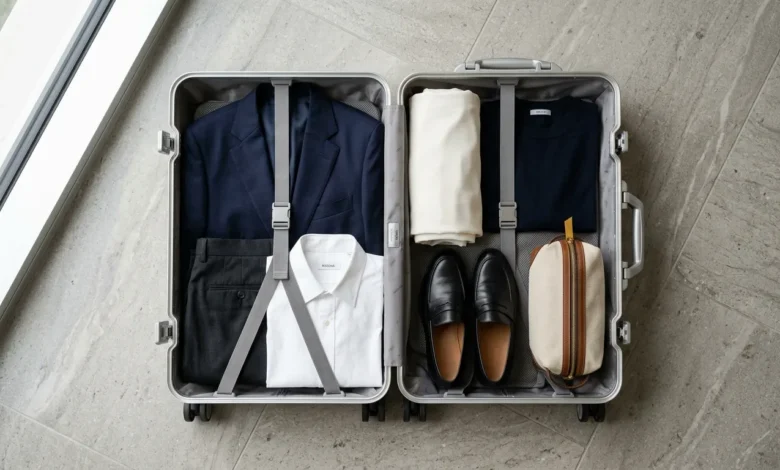
Standard square folding works well for a fixed closet shelf, but it creates deep horizontal crease lines when subjected to luggage pressure. True wrinkle prevention relies on geometric nesting and directional rolling.
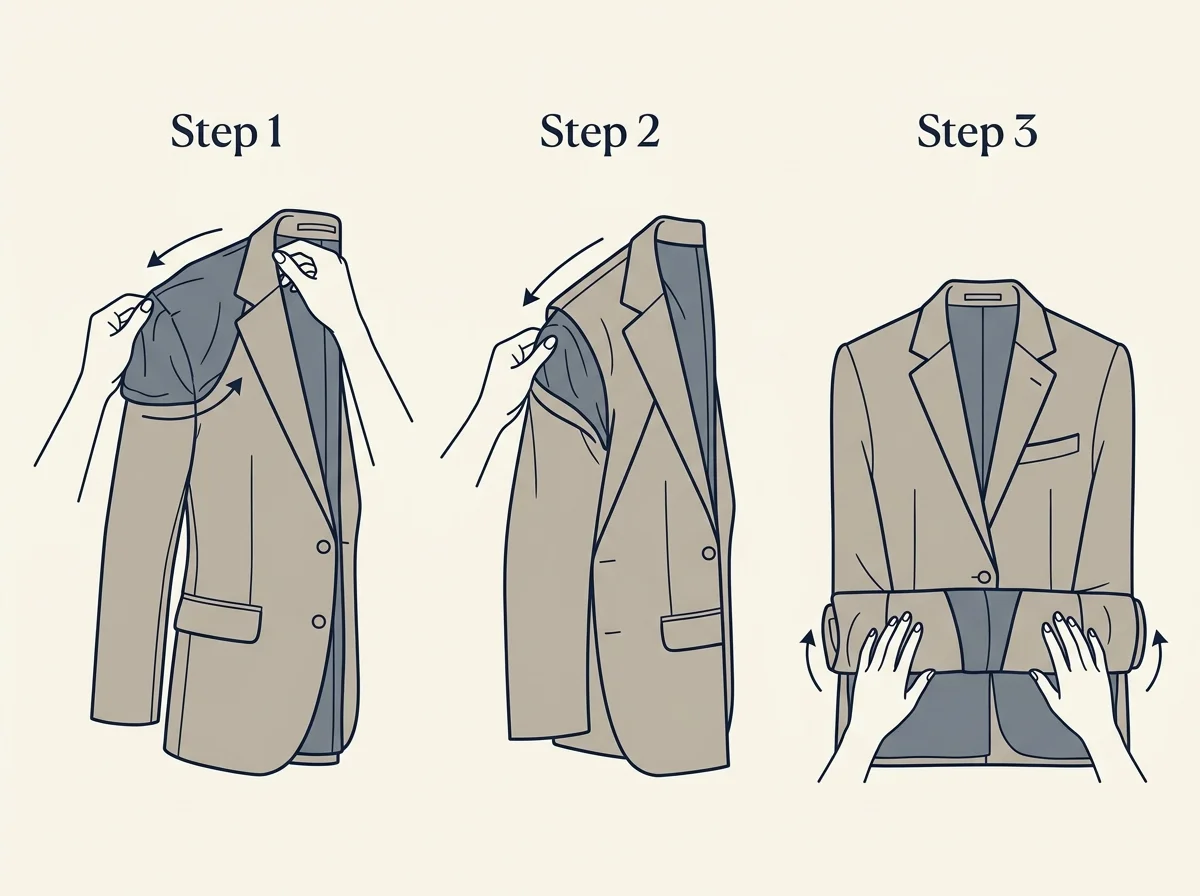
Soft, fluid garments, such as fine-gauge knit tops, modal underlayers, and satin camisoles, thrive when rolled into tight, compact cylinders. This technique helps you fill the negative space around the perimeter and corners of your suitcase frame.
Crisp, woven pieces that resist rolling, like a cotton poplin shirt, require a separate placement strategy. Lay these items flat across the very top of your packed roller bag. Placing them above the rolled cylinders minimizes the directional weight pressure resting on their collars, which helps prevent deep fabric lines from setting during transit.
The Logistics Buffer: Managing Liquid Rules and Secure Travel Assets
A perfectly organized wardrobe capsule can still be derailed by an uncoordinated approach to security checkpoints. Professional travel efficiency requires keeping your grooming kits and electronic devices highly accessible.
Aviation regulations strictly enforce the TSA 3-1-1 rule, which restricts all carry-on liquids, gels, and aerosols to 3.4-ounce (100-milliliter) containers stowed inside a single, transparent quart-sized bag. Decant your essential professional skincare into reusable silicone bottles before packing. An asymmetric detail worth noting: cheap silicone travel bottles can leak under cabin pressure drops. To avoid this, squeeze out the excess air before capping them tightly. Never rely on random hotel complimentary toiletries, which often contain harsh cleansers that can cause skin irritation right before an important presentation.
A frequent travel mistake is packing mission-critical tech or documentation deep inside your primary overhead roller bag. If you are flying on a smaller regional jet, flight crews will often mandate a last-minute gate-check due to crowded overhead compartments. If your suitcase is pulled into the cargo hold, your laptop, lithium batteries, and corporate presentation drives must come out instantly. Keeping a detachable tech sleeve inside your underseat personal item bag allows you to extract your business assets smoothly, safeguarding your itinerary and layout efficiency long before you arrive at the boarding line.
Sources
Official Sources
- Delta Air Lines | Carry-On Baggage Size, Rules & Restrictions | Access Date: July 19, 2026 | Source Tier: Tier 1
Industry Sources
- Who What Wear | What to Pack for a Business Trip: 7 Editor-Approved Outfits | Access Date: July 19, 2026 | Source Tier: Tier 5
- Who What Wear | The Ultimate Editor Carry-On Packing Guide | Access Date: July 19, 2026 | Source Tier: Tier 5
- Travelpro Luggage Corporation | Sizing Compliance and Network Aircraft Overhead Dimensions | Access Date: July 19, 2026 | Source Tier: Tier 6
- LOJEL Luggage Journal | Cabin Architecture and Underseat Clearances | Access Date: July 19, 2026 | Source Tier: Tier 6
- Allianz Partners | Business Travel Comprehensive Asset Packing Blueprint | Access Date: July 19, 2026 | Source Tier: Tier 5
- C&A European Registry | Structural Textile Packing & Outerwear Preservation Techniques | Access Date: July 19, 2026 | Source Tier: Tier 6