
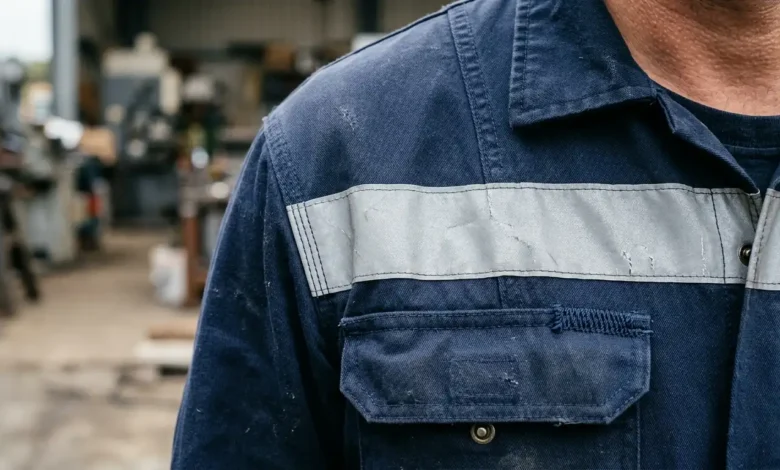
At six in the morning at a Gulf Coast refinery gate, the uniform check takes about four seconds: coveralls on, reflective tape intact, hard hat sticker current. What nobody can see in those four seconds is the sentence printed inside the collar, and that sentence is the one that does the actual protecting.
Oil refinery workwear uniform safety standards and materials sound like one procurement phrase, but they are really four separate decisions stacked on top of a fiber choice. Flash fire ratings, arc ratings, and visibility classes blur together into a mental bucket labeled the FR stuff, and that blur is exactly where buying mistakes happen.
This guide separates the standards first, then walks the material decision the way a textile buyer would: fiber first, weight second, finish third.
Quick answer: to get an oil refinery workwear uniform right, work in this order. 1) Confirm the label cites NFPA 2112 for flash fire. 2) Match the ASTM F1506 arc rating to your site’s hazard analysis, which for routine refinery tasks usually lands at Category 2, meaning 8 calories per square centimeter. 3) Add visibility as a dual-certified ANSI 107 layer, never a plain polyester vest over FR. 4) Choose inherent aramid or modacrylic fiber for industrial laundering and arc work, or treated FR cotton for cost and dry heat. 5) Retire garments on thin spots, tears, and cracked tape, not on age.
Which Safety Standards Govern Refinery Workwear?
Start with the enforcement umbrella, because it explains why the other standards exist. OSHA’s PPE rule, 29 CFR 1910.132, does not publish a refinery uniform specification. It requires the employer to assess the workplace for hazards and select PPE accordingly. In a 2011 standard interpretation on certified flame-resistant clothing, OSHA then points employers to NFPA 2113 for the selection, care, and use of those garments. So the practical chain is: OSHA mandates the assessment, and consensus standards define what passes it.
NFPA 2112: the flash fire gate
NFPA 2112, currently in its 2023 edition, is the garment certification for short-duration thermal exposure, which is the polite way of saying a flash fire. To pass, a garment’s fabric must survive the ASTM F1930 instrumented manikin test: a three-second engulfment with a predicted body burn of 50 percent or less. In plain language, a certified garment chars and self-extinguishes instead of melting onto skin, and the 50 percent ceiling is the difference between a survivable injury and a catastrophic one. If a coverall’s label does not cite NFPA 2112, it is not refinery workwear, whatever the brand calls it.
ASTM F1506 and NFPA 70E: the arc rating
Refineries are also full of energized equipment, which is where arc flash enters. ASTM F1506 is the fabric specification that requires an arc rating, reported as either ATPV (arc thermal performance value) or EBT (energy breakopen threshold), whichever is lower, in calories per square centimeter. NFPA 70E then sorts tasks into four PPE categories with minimum arc ratings of 4, 8, 25, and 40 calories per square centimeter. Most routine electrical and instrument work around a unit lands in Category 2, which is why an 8-calorie daily uniform became the industry default.
ANSI 107: the visibility layer
Where vehicle and equipment traffic shows up in the hazard assessment, high-visibility material enters too, governed by ANSI and ISEA 107-2020, with a revision that was still in public review as of this writing. The standard counts square inches: a Class 2 garment carries at least 775 square inches of fluorescent background material and 201 square inches of retroreflective tape, while Class 3 jumps to 1,240 and 310 and wraps the sleeves and legs for 360-degree visibility. Class 2 covers most daytime traffic areas; Class 3 is the night-turn and high-traffic answer.
At a glance: the four names on the label
- NFPA 2112 certifies the garment against flash fire, capped at 50 percent predicted body burn over three seconds.
- ASTM F1506 reports the fabric’s arc rating, which NFPA 70E task categories (4, 8, 25, 40 calories per square centimeter) then specify.
- ANSI 107 classes visibility by square inches of background and reflective material.
- OSHA 1910.132 is the enforcement umbrella: the site’s hazard assessment decides which of the other three apply.
Inherent or Treated FR: Which Fabric Decision Holds Up?
Every certified fabric on the market gets its flame resistance one of two ways. Inherent FR fibers are born non-flammable because the polymer itself will not burn, and that protection cannot be washed out. Treated FR starts as ordinary cotton, or a cotton-nylon blend, and receives an engineered FR chemistry that branded fabrics like Westex’s Indura and UltraSoft lines guarantee for the life of the garment.
The workhorse inherent blend is Nomex IIIA, which is 93 percent Nomex meta-aramid, 5 percent Kevlar para-aramid, and 2 percent antistatic fiber. Modacrylic blends are the other inherent family, and they matter because modacrylic takes fluorescent dye beautifully, which is why so much hi-vis FR shirting is built on it. On the treated side, FR cotton and 88 percent cotton with 12 percent high-tenacity nylon fabrics buy you cotton’s hand and a lower price per garment.
| Fiber family | What it is | Where it earns its keep | Watch-outs |
| Nomex IIIA aramid | 93 percent meta-aramid, 5 percent Kevlar, 2 percent antistatic fiber, inherently FR | The default for arc work and industrial laundry programs | Premium price, and a stiff hand for the first few washes |
| Modacrylic blends | Inherent FR synthetic spun with cotton and a trace of antistatic fiber | Hi-vis FR shirting, since modacrylic takes fluorescent dye well | Runs slightly heavier than aramid at the same arc rating |
| Treated FR cotton | Cotton engineered with a durable FR chemistry guaranteed for the garment’s life | Budget programs and dry-heat climates where cotton’s feel matters | Chlorine bleach has to stay out of the wash recipe |
| FR cotton-nylon | 88 percent cotton, 12 percent high-tenacity nylon with guaranteed FR | Tear-prone tasks, where the nylon lifts tear strength and softness | Price sits between plain cotton and full aramid |

The honest trade-off: inherent fiber wins wherever garments run through industrial laundering or arc exposure is routine, because there is no treatment to mismanage. Treated cotton wins on cost and on comfort in dry heat, and a well-made treated garment carries the same NFPA 2112 label. The mistake is treating the fiber as the certification. It is not. The label is the certification, and the fiber is just how the label gets earned.
How Heavy Should Refinery Workwear Be in Hot Weather?
Weight is the comfort dial. A 7-ounce twill is the daily-work default, 9 ounces and up buys abrasion resistance for knee-dragging tasks, and shirting runs 4.5 to 6 ounces. In a Houston August, that three-ounce spread between a heavy coverall and a light one is the difference between a tolerable shift and a dangerous one, because heat stress is the hazard that rides along with every other hazard on site.
The regulatory picture adds urgency without adding a rulebook. OSHA’s proposed federal heat illness prevention standard stalled, and as of 2026 the agency enforces heat through the General Duty Clause and its emphasis programs rather than a final standard.
The practical effect is that sites still write heat plans, and the uniform is part of the plan. Research backs up the adjunct tools: a field evaluation from the UTHealth Houston School of Public Health found cooling vests reduced measured heat strain in workers, while NIOSH cautions that ice-packet vests are heavy and can over-cool if the packing is too cold.
So the vest works as a third layer of defense behind shade, water, and work-rest cycles, not as a substitute for them. The consumer-wardrobe version of this logic lives in our technical guide to hot-weather fabrics, and the principle transfers: fiber and weight decide comfort before any brand does.
Construction details are the other half of hot-weather durability, and this is where workwear brands earn their prices: triple-stitched seams, bar-tacked stress points, a gusseted crotch, articulated knees, and ripstop reinforcement at the knees and cuffs. None of it shows up in a product photo. All of it shows up in month six.
Can Hi-Vis and Chemical Splash Protection Stack On Top?
Visibility and flame resistance are separate certifications, and they have to agree on the same garment. Polyester melts, so a plain polyester hi-vis vest worn over an FR coverall adds a melting layer on top of a non-melting one. Most sites solve this with dual-certified pieces, an FR vest that also carries the ANSI 107 materials, or coveralls with the reflective tape sewn directly onto certified fabric.
Chemical splash is the other common stacking error. NFPA 2112 garments are explicitly not protection against chemicals, oils, hot metals, liquids, or steam, and the standard says so. Splash tasks need separate chemical PPE selected from the hazard assessment. The same confusion reaches the laundry room: bleach-resistant workwear is a real category for chemical and custodial areas, but the resistance lives in the dye chemistry, not the wash recipe. Chlorine bleach in the wash degrades FR fabrics over time, which is why FR care guidance is unanimous in banning it.
How Do You Wash FR Workwear, and When Do You Retire It?
The wash rules are short and non-negotiable: no chlorine bleach, no fabric softener, no starch. Softeners and starches leave residues on the fiber that can compromise the very protection you paid for, and bleach steadily degrades the fabric. If a stain will not wash out without bleach, the garment has told you something. Our walkthrough on how to read clothing labels covers the consumer version of this skill, and an FR care tag is the highest-stakes version of it in existence.
Repairs follow NFPA 2113: patches and thread must themselves be certified FR, so a non-FR patch sewn onto a certified coverall is a hole in the certification, not just in the fabric. Retirement follows the same mechanical logic. There is no calendar age and no wash-count expiry for a sound garment. Retire it for thin spots, tears, frayed seams, flammable contamination that will not launder out, or reflective tape that has cracked and lost its retroreflection. A five-year-old coverall with sound fabric and a readable label is still certified. A five-month-old one with ground-through knees is not.
Does Vintage or Fashion Workwear Belong Anywhere Near a Refinery?
The workwear aesthetic is having a long moment, and the heritage pieces deserve it. A 14-ounce raw denim jacket and a Japanese workwear chore coat are genuinely durable garments, and we have written about how to buy the denim properly in our raw denim buying guide. But untreated cotton ignites and keeps burning, and no certification existed for a 1970s chore coat. The tell is never the logo, by the way. The same brands that built the heritage aesthetic now sell certified FR lines, so a Carhartt label and a Carhartt FR label are different garments entirely. Keep the vintage jacket for the tailgate. The unit gets the label that cites the standard.
Buying for the Situation You’re Actually In
If your site issues everything: read the collar label during your first week anyway. Knowing which standard each issued piece cites, and which NFPA 70E category your task list specifies, turns you from a uniform wearer into someone who can spot a wrong issue before it matters.
If you buy your own: buy to the site’s written hazard assessment, not to anxiety. A Category 4 arc suit for Category 2 work is not extra safety, it is extra heat burden, and heat burden is its own hazard. Size for the base layer you will actually wear under it.
If you work summer turns: lean toward lighter inherent blends in the 4.5 to 6 ounce shirting range, a wicking base layer that is itself FR, and a cooling vest as an adjunct to work-rest cycles. Dawn crews should treat the ANSI 107 class as part of the uniform, not an add-on.
If your size changed since the last issue: FR programs usually exchange issued garments, and if you are buying, order one set and test it in a real shift before committing to a full wardrobe. Fit problems in FR clothing show up at hour ten, not in the fitting room.
Frequently Asked Questions About Refinery Workwear Standards
What safety standards apply to oil refinery workwear?
Four, layered. OSHA 29 CFR 1910.132 requires the site hazard assessment that triggers everything else. NFPA 2112 certifies the garment against flash fire. ASTM F1506 reports the arc rating that NFPA 70E task categories then specify. ANSI 107 classes the visibility materials, and NFPA 2113 governs selection, care, and retirement.
Can a vintage workwear jacket meet modern safety standards?
No. Untreated cotton ignites and keeps burning, and no certification existed for a 1970s chore coat. Heritage denim and Japanese workwear styles are durable as fashion, which is exactly why they belong at the tailgate and not inside the gate.
What fabric is best for hot weather industrial work?
A lighter inherent blend, typically a 4.5 to 6 ounce modacrylic or aramid shirting, because it keeps the FR rating without the weight of a 9 ounce twill. Treated FR cotton breathes well in dry heat. The mistake is a polyester base layer under either, since polyester melts.
How often should FR workwear be replaced?
On condition, not on a calendar. Retire a garment for thin spots, tears, frayed seams, flammable contamination that will not wash out, or cracked reflective tape. A well-laundered FR coverall with sound fabric keeps its rating for years.
Is hi-vis workwear required in all industrial settings?
Only where the hazard assessment calls for it, usually vehicle and equipment traffic. Where it applies, ANSI 107 sets the class: Class 2 for most daytime traffic areas, Class 3 for high-traffic and night work.
The Label Is the Whole Point
Four seconds at the gate and one sentence inside the collar are the same check, performed at different depths. Read the label on your current uniform tonight and match it against your site’s written hazard assessment: NFPA 2112 for the flash fire, an arc rating that meets the category your tasks specify, ANSI 107 materials if traffic demands them. That single comparison is the entire oil refinery workwear decision in miniature. Standards first, fiber second, and everything else is taste.
Sources
- U.S. Department of Labor, OSHA: 29 CFR Part 1910 Subpart I, Personal Protective Equipment (eCFR current text), Access Date: August 8, 2026
- U.S. Department of Labor, OSHA: Standard Interpretation, Certified Flame-Resistant Clothing Used by Industrial Personnel (October 6, 2011), Access Date: August 8, 2026
- U.S. Department of Labor, OSHA: Heat Stress Guide, Access Date: August 8, 2026
- CDC, NIOSH: PPE Heat Burden, Heat Stress Recommendations, Access Date: August 8, 2026
- NFPA: NFPA 2112 Standard Development Page, Access Date: August 8, 2026
- NFPA: NFPA 2113 Standard Development Page, Access Date: August 8, 2026
- Westex, a Milliken brand: Making Sense of NFPA 2112, Access Date: August 8, 2026
- DuPont: Inherent versus Treated Flame Resistant Fabrics, Access Date: August 8, 2026
- ANSI Blog: ANSI/ISEA 107-2020, High-Visibility Safety Apparel, Access Date: August 8, 2026
- Arcwear: ATPV vs. EBT, Arc Ratings Explained, Access Date: August 8, 2026
- Enespro (thinkNSA): What Are the 4 Different Arc Flash PPE Categories in NFPA 70E?, Access Date: August 8, 2026
- Tyndale: Important Information Regarding Bleach and FR Clothing, Access Date: August 8, 2026
- GoSafe: A Guide to Inspecting and Knowing When to Retire FR Garments, Access Date: August 8, 2026
- Westex, a Milliken brand: UltraSoft Fabric, Access Date: August 8, 2026
- UTHealth Houston School of Public Health: Researchers Evaluate Most Effective Methods of Preventing Heat Stress and Illness in Workers, Access Date: August 8, 2026
- TenCate Protective Fabrics: What Is a Modacrylic Fiber?, Access Date: August 8, 2026
- MatWeb: DuPont Nomex 462 (Nomex IIIA) Aramid Staple Fiber Datasheet, Access Date: August 8, 2026